 F2P · Live
Lineage 2 Essence
Lineage 2 Essence is NCSoft's free-to-play take on the classic Korean MMORPG Lineage II, built around faster…
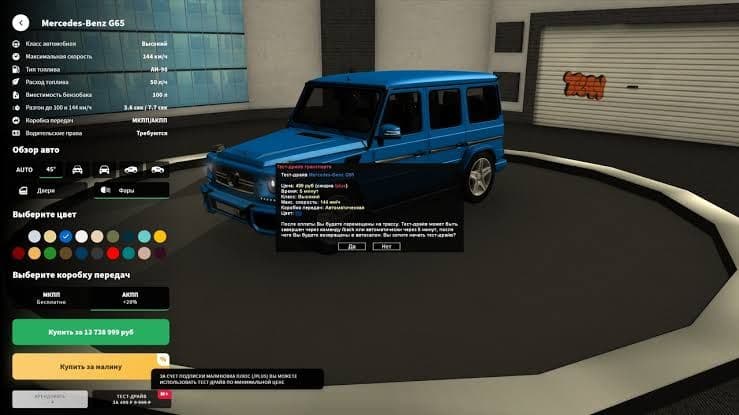
Malinovka is a free Russian roleplay server built on a modified GTA: San Andreas engine, where players work as truckers, police, or criminal factions instead of following any set storyline. Launched i...
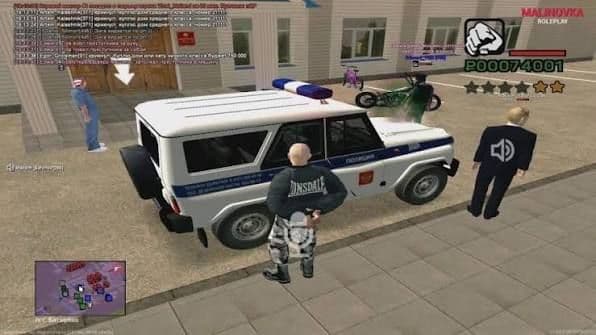
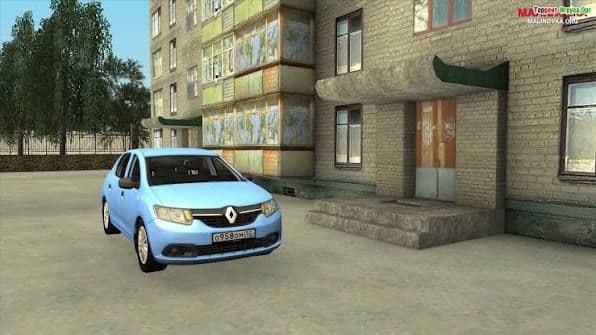
Malinovka is a Russian-developed multiplayer roleplay server built on a modified GTA: San Andreas engine, launched by Malinovka Team on February 22, 2019. It takes the "live a second life" formula popularized by GTA roleplay mods and drops it into a caricature of post-Soviet Russia — panel-block apartment blocks, battered domestic sedans, corner-store loiterers — instead of Los Santos. The project is free, still actively maintained seven years after launch by a small independent team, and a new map is already in development according to recent developer streams.
Malinovka reads very differently depending on which side of that seven-year gap a player is standing on. A newcomer sees a rough-edged, unfamiliar economy that's actively working against them for the first several hours. A veteran sees a system that's had years to sand those edges down into something worth defending — a rank, a business, a district. This review moves back and forth between those two views deliberately, because judging the game from only one of them misses roughly half of what it's actually offering.
Under the hood, Malinovka runs on a multiplayer modification of a nearly two-decade-old engine, and it shows immediately: low-poly character models, stiff animations, and draw distances that betray their PlayStation 2-era origins. A newcomer coming in expecting anything close to a modern open-world game will need a minute to adjust. A returning player barely notices anymore — for this crowd, the dated look is the point, not a compromise around it. Recognizable Soviet-block housing and a decade-old sedan parked outside it read as home rather than as a technical limitation.
That dated foundation pays off in one very practical way: minimum system requirements sit at around 3 GB of RAM and a GeForce GTX 460, hardware that would struggle to run most current live-service games at all. For a project with no publisher budget behind it, keeping the barrier to entry that low isn't an accident — it's arguably the reason the community has stayed as large as it has for as long as it has.
The map trades scale for density. It's noticeably smaller than the source game's Los Santos, split into a handful of legible zones — residential blocks, an industrial outskirt full of garages and warehouses, a downtown strip with the city administration and shops, and a rural fringe of private houses. Weather and a basic day-night cycle exist mostly as mood rather than mechanic; rain doesn't touch handling, but lit windows in a sleeping district at 3 a.m. do more for atmosphere than a graphics setting ever could.
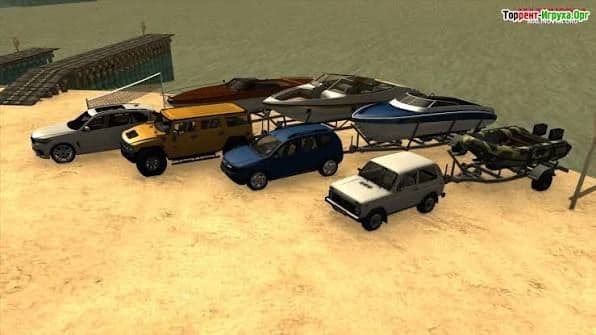
Vehicles carry a lot of the everyday texture here. The starting garage holds domestic economy cars and aging imports; better-status models open up as income grows, and the visual gap between a battered starter sedan and a downtown import is immediately readable to anyone passing by. Cargo work runs on trucks and rigs, public transport runs on buses and marshrutkas that a player can actually operate as a job rather than ride as scenery, and the military and higher-standing factions eventually get access to aircraft — planes and helicopters that require a separate clearance and noticeably raise the ceiling on both logistics and territorial conflict once someone earns the right to fly them.
Registration happens on the project's own site, and the client is downloaded from the same place — there's no storefront involved, sign-up requires confirming an account by email, and the whole distribution chain is Malinovka Team's own infrastructure rather than any third-party platform. A new character starts as literally homeless: a cheap default skin, close to zero money, and no reputation with anyone. A short chain of tutorial quests walks a first-timer through the basics — where to find off-the-books gig work, how the map is laid out, and where the first few rubles for food and ammunition are going to come from.
One detail is handled better than expected: level 1 and 2 characters default into a passive mode that makes them immune to bullets and physical contact, toggled through an in-game menu. The trade-off is real — no shooting, no driving, and the character is visually flagged for everyone nearby — but it's a sensible training-wheels period on a server where the other players are armed and not always friendly. By level three or four, the game nudges rather than forces a player out of it, which suggests the designers expect someone to actually be ready by then, not just old enough on paper.
Nobody drives here without passing a driving test first, and it isn't a rubber-stamp formality — fail it, and the character walks or begs for a ride. A separate weapons license works the same way, gating an entire category of activity behind an actual check rather than a purchase. Past that gate sits a real fork: trucking freight between cities, ferrying strangers as a taxi driver, working security or courier gigs, joining the police to chase down offenders, or going the other direction and signing on with one of the criminal factions. Military-affiliated groups sit furthest out on that spectrum, with eventual access to aircraft, but getting there runs through earned standing rather than a one-time application.
Combat, when it happens, doesn't pretend to be anything more measured than a third-person shooter lifted straight from the source material — no lock-on, no menu of actions to pick from, just direct aim and direct consequences for missing. Early money is genuinely tight: the gap between having enough for gas and not having it is felt on the tenth hour in a way that reads as deliberate friction rather than a balance oversight, pushing a new player toward steady work instead of aimless driving. Voice chat stops being optional right around here too — asking for a lift or help finishing a job is faster spoken than typed, and the server leans on it hard.
Players who go criminal get a different menu entirely — small-time theft and reselling stolen goods at first, working up to coordinated hits on guarded targets where the payoff depends less on shooting straight and more on the crew working as a unit: someone draws off the police, someone breaches the target, someone keeps the getaway car running. Police and security roles sit on the other side of that same loop — patrols, responding to calls, investigating what actually happened. None of this is a scripted mission chain with cutscenes bolted on; it's a live back-and-forth where the other side of the encounter is almost always a real person rather than a bot, and that single fact is what separates it from the equivalent single-player content on the same engine.
Ask a hundred-hour player what keeps them logged in and the answer usually isn't the story — there isn't one — it's the standing they've built. Factions stop being a formality once someone's put real time in: an internal rank structure runs from rookie up to leader, and the most ambitious, with the right reputation, can end up angling for something closer to president of the in-game world. Conflict between rival groups isn't negotiated in chat — it plays out as territorial war: raids, coordinated hits, and outright holding ground against rival crews. Getting to the top of that structure isn't handed out; it's earned through a mix of activity, loyalty, and whoever above you is willing to step aside, which makes faction leadership feel closer to an actual organization than to a guild rank bought with a currency sink.
The developers have clearly been tuning this over the years rather than leaving it to run wild. Contested point captures are capped at ten players per side, and on Tuesdays, any-weapon captures are turned off entirely — a small rule with an obvious purpose, keeping faction warfare from collapsing into a numbers-only brawl. Even open-field driving speed has been quietly reduced at some point, purely to discourage abusing terrain during chases. None of it reads as flashy design, but seven years of these small corrections is exactly what's kept the territorial layer from falling apart.
The server carries seasonal touches too — snow falls on the map in winter, Valentine's Day scatters cosmetic hearts around the world, and other holidays get their own limited events — while the developers stay visibly in touch with the playerbase through streams and roadmap updates rather than going quiet between patches. A new map is currently in the works, reportedly built but still being optimized, with no firm release window yet. Malinovka is also far from the only project of its kind; the Russian-language GTA-roleplay scene runs a whole ecosystem of competing servers with their own rules and monetization. What keeps this one relevant against that competition is mostly patience — a willingness to keep refining the same systems for years instead of chasing whatever the current trend happens to be, even at the cost of a visual overhaul that clearly isn't coming soon.
By the time a character has real money, it usually goes toward an apartment or a house in a specific district, a car that isn't one of the starting beaters, or a stake in an actual business — and none of it functions as pure cosmetics. Where someone lives and what they drive gets read by other players roughly the way real clothing gets read on a street, which gives ordinary purchases a social weight most sandbox games don't bother building.
Business ownership goes further than a menu number: a gas station, a shop, a car wash, a taxi depot — each one a specific object on the map with its own running costs, staffed by other players the owner hires and pays. It's an entire secondary layer sitting on top of the roleplay core, aimed squarely at anyone who finds simple wage-earning too small a goal and wants to manage other people's time inside the game world instead.
Character customization is available from the first minute but only really starts to matter once there's spare money for clothes, haircuts, and accessories that stop reading as "brand new account." Appearance functions as another layer of status here — a costume alone is usually enough to tell whether the person walking toward you is fresh off the tutorial or someone who's been running the same character for months. It's a small detail, but it's consistent with the rest of the design: almost nothing in Malinovka is purely decorative, and even the outfit someone picks quietly signals how long they've had to earn it.
Not in any way the current playerbase widely agrees on, though it wasn't always this clean. Malinovka runs as free-to-play, with an in-game currency called "maliny" spent on cosmetic vehicles and one-off bonuses, plus a Malinovka+ subscription that boosts how much bonus currency a donation returns. In the project's early years, player reviews frequently complained about donation-bought cars carrying a real advantage on the road and in confrontations; the balance has clearly shifted since, and recent feedback describes spending as optional rather than necessary — everything can be earned without paying, just more slowly and without the cosmetic extras. Nothing purchasable unlocks content that's otherwise unreachable, which is the detail that actually separates convenience spending from a pay-to-win economy, whatever the older reputation might suggest. It's also worth being precise about what that reputation was built on: the complaints clustered around specific vehicle purchases years ago, not around gear, weapons, or property, and those exact vehicles are no longer where the community's donation criticism lands.
Yes. Registration, the client, and the large majority of the game's content are free; the only paid layer is cosmetic currency and a subscription that speeds up progress rather than gating it.
Practically, yes — there's no English interface, no English-speaking community of any real size, and most of the roleplay depends on reading and typing Russian fluently.
No. It's PC-only, distributed exclusively through Malinovka Team's own launcher, with no console version, no mobile app, and no official Steam Deck status.
For a Russian-speaking player drawn to GTA-style roleplay, yes — for anyone without the language, the barrier is high enough that the rest of the review is somewhat academic.
Very low by current standards — around 3 GB of RAM and a GeForce GTX 460 as a minimum, low enough to run comfortably on hardware that's a decade or more old.
If the appeal of GTA-style roleplay already makes sense — clocking in as a trucker, buying an apartment, spending months building standing inside a faction with real people on the other end of the voice chat — then the question isn't really about Malinovka's quality, it's about whether learning enough Russian to function is worth it for a specific kind of sandbox experience. Anyone hoping for modern visuals, a real combat system, or a written campaign with an ending should look elsewhere; a twenty-year-old engine underneath a free-roaming social sandbox was never going to deliver any of those, and it isn't trying to. What it does deliver, seven years in, is a functioning small economy with real people behind every job title on it — a rarer thing than the outdated graphics might suggest.