 F2P · Live
Lineage 2 Essence
Lineage 2 Essence is NCSoft's free-to-play take on the classic Korean MMORPG Lineage II, built around faster…
Myth of Empires is a multiplayer war sandbox set in a fictionalised ancient East Asia, where survival crafting, NPC troops and horse warfare all feed into open-world sieges between guilds. Build a for...
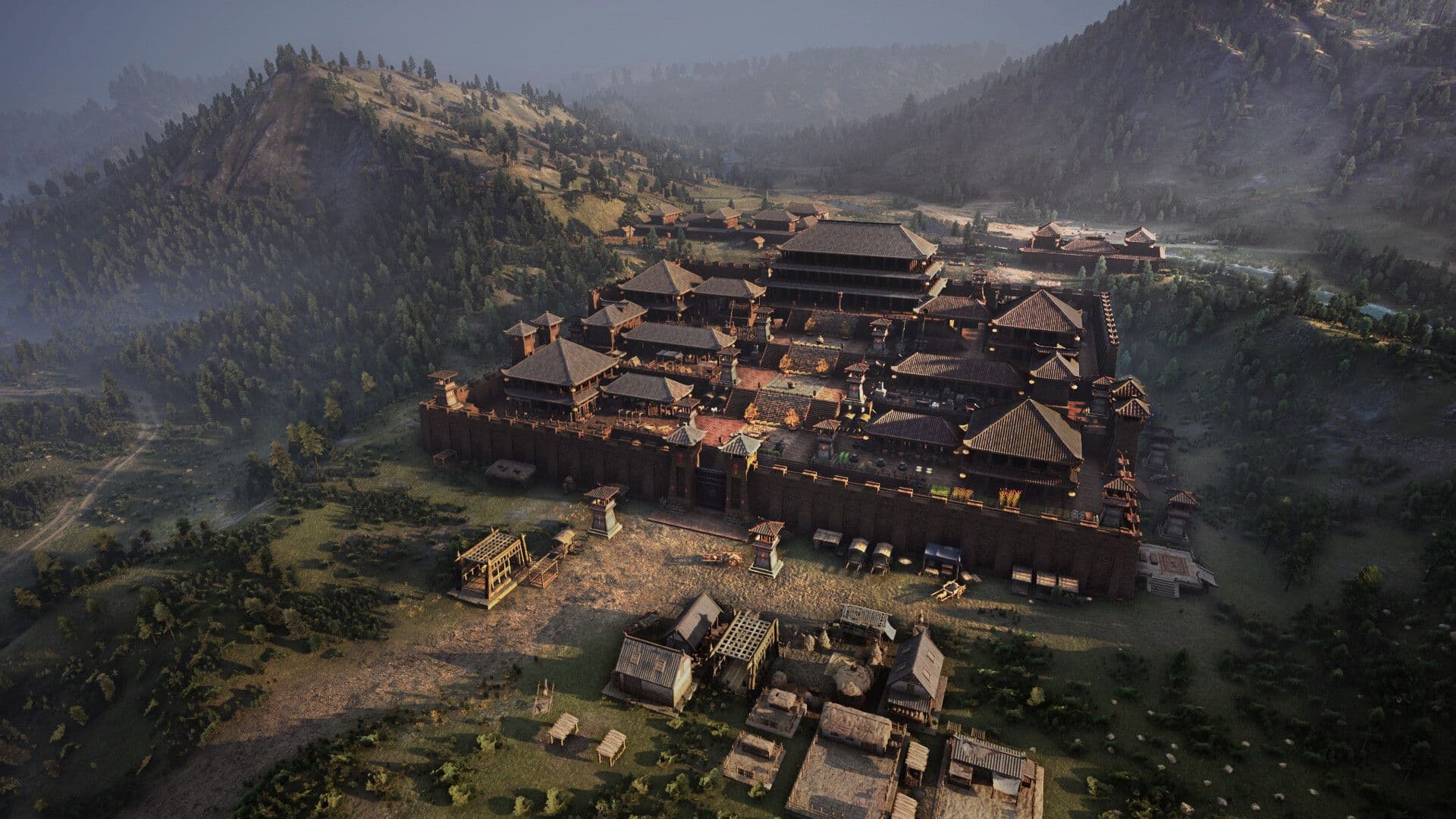
Myth of Empires is a multiplayer war sandbox developed by Chinese studio Angela Game and published by Imperium Interactive Entertainment, released in full on Steam in February 2024 after more than two years in Early Access and a copyright dispute that pulled it off the store entirely. It takes the survival and base-building loop familiar from Ark and Conan Exiles and aims all of it at organised warfare between guilds, with administrative regions, tax rates and a magistrate's seal to fight over. Two years after 1.0 it still receives paid civilization packs and still runs official servers, though since April 2026 it shares its world — and part of its audience — with a free seasonal spin-off called Myth of Empires: Throne.
Quick take: Myth of Empires earns its $29.99 if you arrive with a group and want a survival sandbox whose endgame is a scheduled war for a province rather than another raid boss. Solo players and anyone impatient with slow skill bars should look elsewhere, because almost every system in the game assumes a guild behind you. Most English-speaking players end up on community-hosted servers rather than official ones, and that choice matters more than any other decision you make here.
The setting is a fictionalised ancient East Asia designed to be fought over rather than toured. Zhongzhou, the base map, runs from snowfields and mountain passes down through plains, swamps and rainforest, with resource tiers rising the further you push from the safe starting regions. Two later maps arrived with DLC: Dongzhou adds volcanoes, coastlines, bamboo groves and islands, and Xizhou trades all of that for desert and oasis terrain dotted with cave dungeons and their bosses.
There is no central story, and the game does not pretend there is one. What stands in for narrative is the civilization framework — Jiuzhou first, then Hellas and Shah added through the Hellenic and Xizhou packs — each with its own architecture, armour silhouettes and weapon sets. Pick a path and your buildings and soldiers start to look different from the guild across the river, which matters more than it sounds when you are staring at an enemy fort trying to guess what is inside it.
Visually it sits where a 2021 Unreal Engine project sits in 2026: readable, occasionally handsome at dawn over a river valley, unremarkable up close. Terrain does the heavy lifting; character faces do not.
The opening hours are conventional survival routine, and the game is honest about that. You spawn with nothing, gather branches and flint, knap a stone axe, chop wood, and put up a shack before nightfall so the wolves have something to bump into. Food, water and temperature all tick down. Within a few hours you are mining copper, then iron, feeding ore into smelting furnaces and turning ingots into better tools that make the next tier of gathering bearable.
What separates the progression from its obvious reference points is that skills improve by doing, not by spending points. Swing a pickaxe and your mining proficiency climbs; loose arrows from horseback and your archery climbs. Character levels grant recipe points that decide which blueprints you learn, and expertise points let you accelerate the proficiencies you actually use, so a guild's designated miner and its designated archer diverge sharply by level 30 even if they started identically. It is the Mount & Blade model, stretched across an economy.
Sitting on top of that is a sixteen-tier nobility ladder bought with copper coins and honour points. The bonuses are deliberately small — the step from Commoner to Baron adds a couple of percent to maximum health — and they accumulate into something that quietly matters by the time you are contesting territory. The pace is slow. Players regularly report the level 60 ceiling taking well over a hundred hours on official rates, which is exactly why community servers advertise five-times and thirty-times multipliers on their front pages.
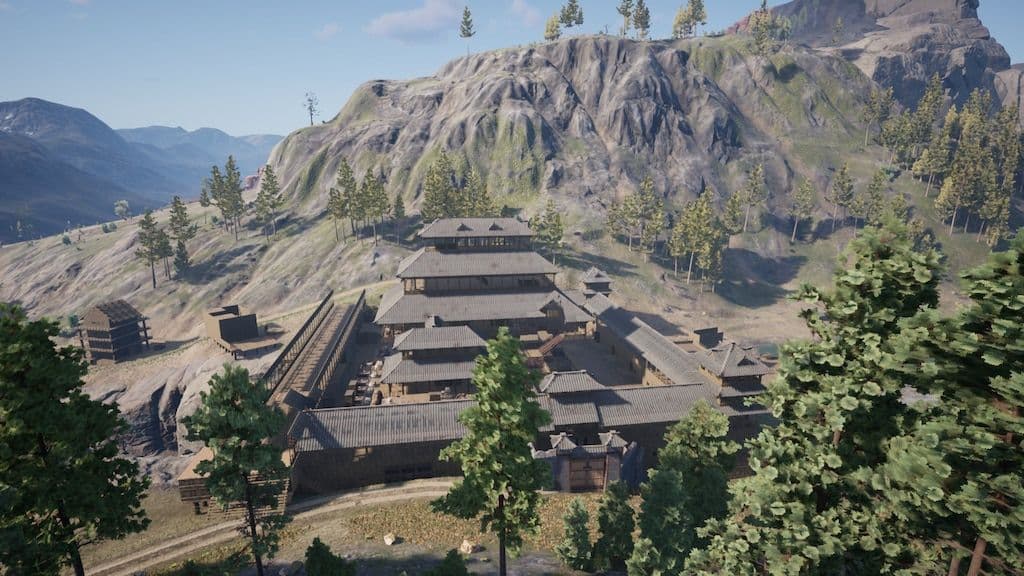
The build-up phase is the part of Myth of Empires that has no close competitor. Over 1,300 recipes span seven categories, and a mature guild base is a production chain rather than a set of decorations: ore into ingots, ingots into weapon components, hides into armour, grain into the food that keeps everything else running. Buildings snap together at a level of granularity that lets a determined architect produce a genuine fortress with layered walls, gate towers and internal keeps — and lets a sloppy one produce a shed with delusions.
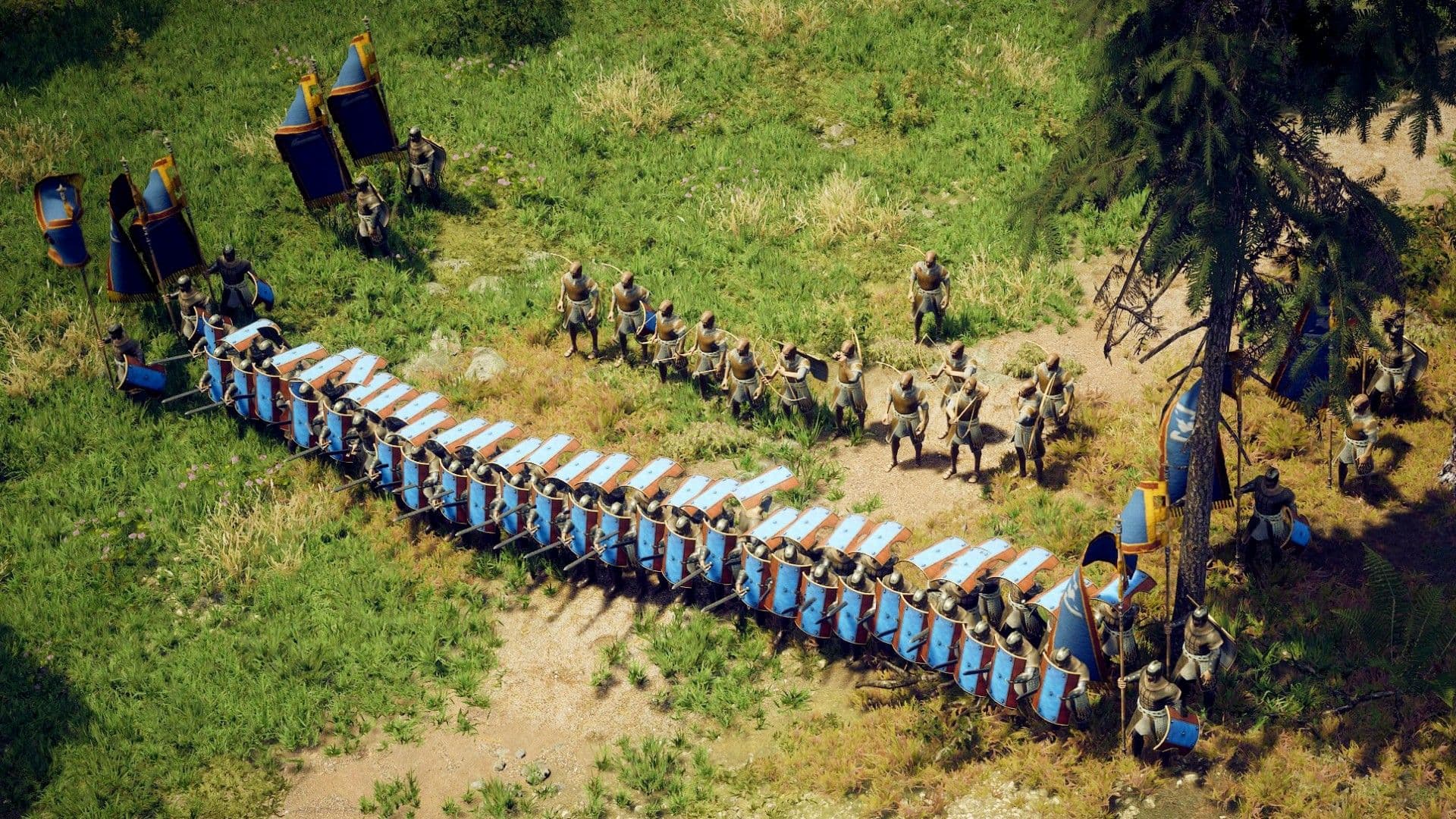
Recruiting NPCs is the mechanic that pulls the whole thing forward. You subdue or hire retainers and assign them to jobs: workers staff dedicated gathering buildings and consume food to keep producing, while combat retainers garrison your walls. Community guides put the practical ceiling at roughly nine or ten retainers with skills invested, of which up to three NPC soldiers follow you into battle. Horses run on their own systems — tamed, trained toward higher stats, and bred for better foals, which is a deeper animal husbandry layer than most survival games attempt.
Trade sits underneath all of it. Copper coins, taxes and vendor networks give the economy a currency that guild politics can actually squeeze, and caravan-style vehicles from the later packs make hauling goods a thing enemies can interrupt. If your guild loses the road, it loses the workshop three valleys over.
Partly, and the caveats are worth stating up front. Myth of Empires uses directional combat — attacks and blocks are aimed, feints exist, and timing decides duels — but veterans and newcomers agree the animations are slower and heavier than Mount & Blade or Mordhau, and hit registration on small moving targets has drawn complaints since Early Access. What the game adds in exchange is that proficiency changes how your character handles a weapon, so two players with identical gear do not fight identically.
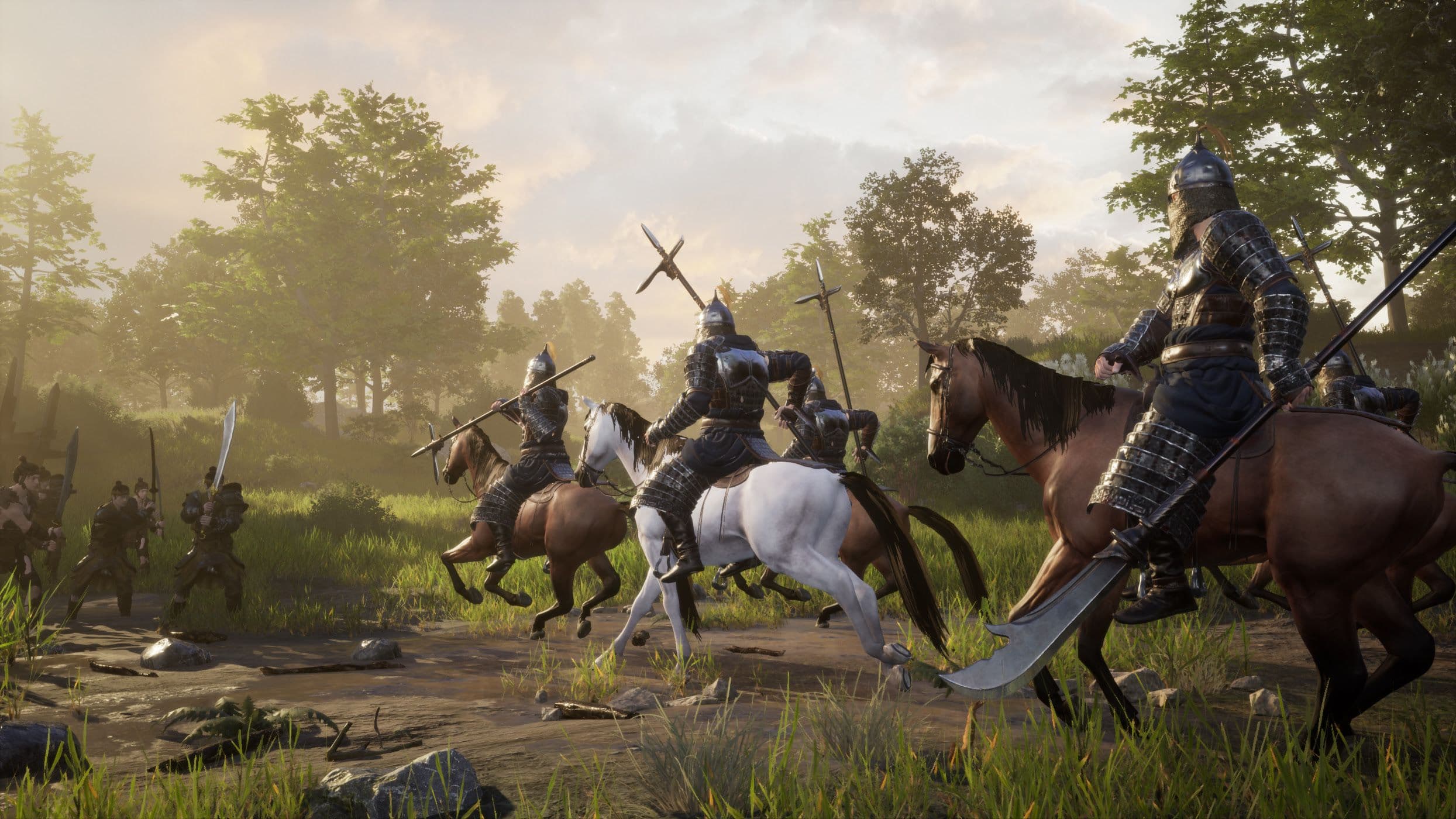
Mounted combat is where it clicks for most people. Horse archery in particular rewards practice in a way little else in the genre does, and a cavalry wing that knows what it is doing can dismantle infantry that broke formation. Dismount in the middle of a fight and NPCs will kill your horse, which turns a bad decision into a long walk home.
Sieges change the calculation again. Rams, trebuchets and ladders exist as buildable equipment, and structure durability against siege damage has been tuned repeatedly across patches — often specifically for season servers, where the developers slow early siege damage down and raise it as the season matures. Large battles are also where the engine strains: frame drops during mass fights are the single most common technical complaint in Steam reviews, and they have never fully gone away.
Everything above exists to feed one recurring event. Administrative regions on each server are contested through the County Battle, a scheduled siege in which guilds fight for an imperial seal and the Magistrate title attached to it, and the winning magistrate sets tax rates for the entire region. That is the endgame: not a boss table, but an office with revenue attached, defended by whatever fortifications and cavalry your guild has spent weeks assembling.
Fortress battles handle the layer below, letting guilds take and hold specific strongholds and the resource nodes around them. The season servers added a further tier — region-free rulesets with boosted progression, gear that no longer drops on death, and cross-server expeditions that let a dominant guild take the fight to another server's world entirely. The cadence gives the game something most survival sandboxes never manage: a reason for the grind to end in something other than the server going quiet.
The catch is scale of commitment. A county contest is not a pick-up activity; it needs a roster, a supply chain, someone who remembers to stock arrows and a schedule that survives contact with time zones. Guilds that can field twenty coordinated players run the map. Guilds that can field six will spend the evening watching their gate come down.
Server choice shapes the experience more than anything else, and official servers are not the default answer. Steam concurrency sits at roughly 900 to 1,100 players at any given moment in mid-2026, a figure that has been stable for months but should be read carefully: it counts Steam sessions only, it lumps official and community servers together, and it excludes players on the game's own launcher. All-time peak figures also vary by tracker, from around 34,000 to nearly 48,000, so treat any single number as an estimate rather than a census.
Officials are not region-locked, which means English-speaking players routinely share worlds with far larger and better-organised Chinese guilds — a recurring theme in Western reviews since the relaunch. Servers with low activity can also be consolidated, so joining a quiet one to avoid competition tends to backfire. The community-hosted scene solves several problems at once: adjusted rates, admin moderation, no cash shop, and a population that speaks your language and logs in at your hours.
Guild dependence is total. Solo play is technically supported, including private and single-player modes, and it is a reasonable way to learn the crafting systems in peace. It is not a way to see the endgame.
The game's biggest problem was never its design. In December 2021, three weeks after a strong Early Access debut, Snail Games and Studio Wildcard filed copyright and trade-secret claims alleging that Angela Game had used code and assets from Ark: Survival Evolved, and Valve pulled the game from Steam on a DMCA notice. What followed was two years in exile: a proprietary launcher, a shrinking Western playerbase, and a Chinese-speaking core that stayed while almost everyone else drifted away.
The parties settled in October 2023 on terms that included ongoing royalties from Angela Game to Snail, a withdrawn takedown notice, and a partnership to bring the game back to a wider market. The 1.0 release arrived on Steam in February 2024. Console versions were announced as part of the same deal and have not materialised.
Why this belongs in a purchase decision: the delisting is the reason a game with this much systemic depth has a fraction of the audience its peers do, and it is also the reason its official servers skew heavily toward players you may not share a language or a schedule with. The lawsuit is settled. Its consequences are still on the server list.
The base game is $29.99, with roughly $51 more in DLC, and official servers run an in-game shop on top of that. The paid packs split between content and cosmetics: Dongzhou at $9.99 and Hellenic at $12.99 add maps and civilizations, Xizhou at $14.99 adds the desert map plus new systems, and instrument and carriage packs sit lower at $4.99 and $7.99. The full bundle lands around $80 — a lot for a game this size, and Xizhou's own Steam rating has hovered near Mixed, with buyers arguing about how much of it is new gameplay versus a paid map.
The shop is the sharper question. Alongside skins, official servers let players purchase items, animals and building materials, and a 2024 change allowed purchased currency to convert accumulated reserve proficiency into real skill progress at higher levels. Defenders call that paying to skip grind rather than paying to win; critics point out that in a game where territory is claimed by whoever gets there first with the right infrastructure, buying weeks of progress is a competitive act. Both readings are defensible, and both explain why so much of the veteran playerbase treats community servers as the real game.
Myth of Empires is the most interesting survival sandbox almost nobody talks about, and the reasons for that silence are entirely its own doing. The design is unusually ambitious — a working economy, an NPC labour force, cavalry warfare and a political endgame in which the prize is a tax rate — and the presentation around it has been mishandled at nearly every step, from the lawsuit that erased its launch momentum to a DLC strategy that asks $80 of a player who has not yet decided whether they like the combat.
What remains is a game that repays organisation and punishes casual interest, which is an unfashionable thing to be in 2026. If you have five friends, a weekend habit and tolerance for jank, a community server here will give you a campaign you remember for years. If you are shopping alone for something to fill twenty hours, this is not it, and the free seasonal version is a cheaper way to find that out. The players who bounced off it over the years were not wrong about the game; they simply were not the guild it was built for.
No. The original game is buy-to-play at $29.99 on Steam with optional paid DLC. The separate seasonal title Myth of Empires: Throne, launched in April 2026, is free.
On official servers there is a defensible argument that it is: purchased currency can convert reserve proficiency into progress, and items, animals and materials are buyable. Community-hosted servers have no such shop, which is why most long-term players use them.
Yes, through single-player, private hosting or a PvE server, and the crafting and building systems hold up alone. Territory control and county battles do not — those assume a functioning guild.
It keeps the survival and base-building foundation but replaces creature taming and instanced bosses with NPC troops, directional melee, horse warfare and a server-wide political layer of regions, magistrates and taxes.
Yes, with a stable Steam concurrency of roughly a thousand players, ongoing maintenance, and paid civilization packs still being released. It is a small, committed population rather than a growing one.