 F2P · Live
Lineage 2 Essence
Lineage 2 Essence is NCSoft's free-to-play take on the classic Korean MMORPG Lineage II, built around faster…
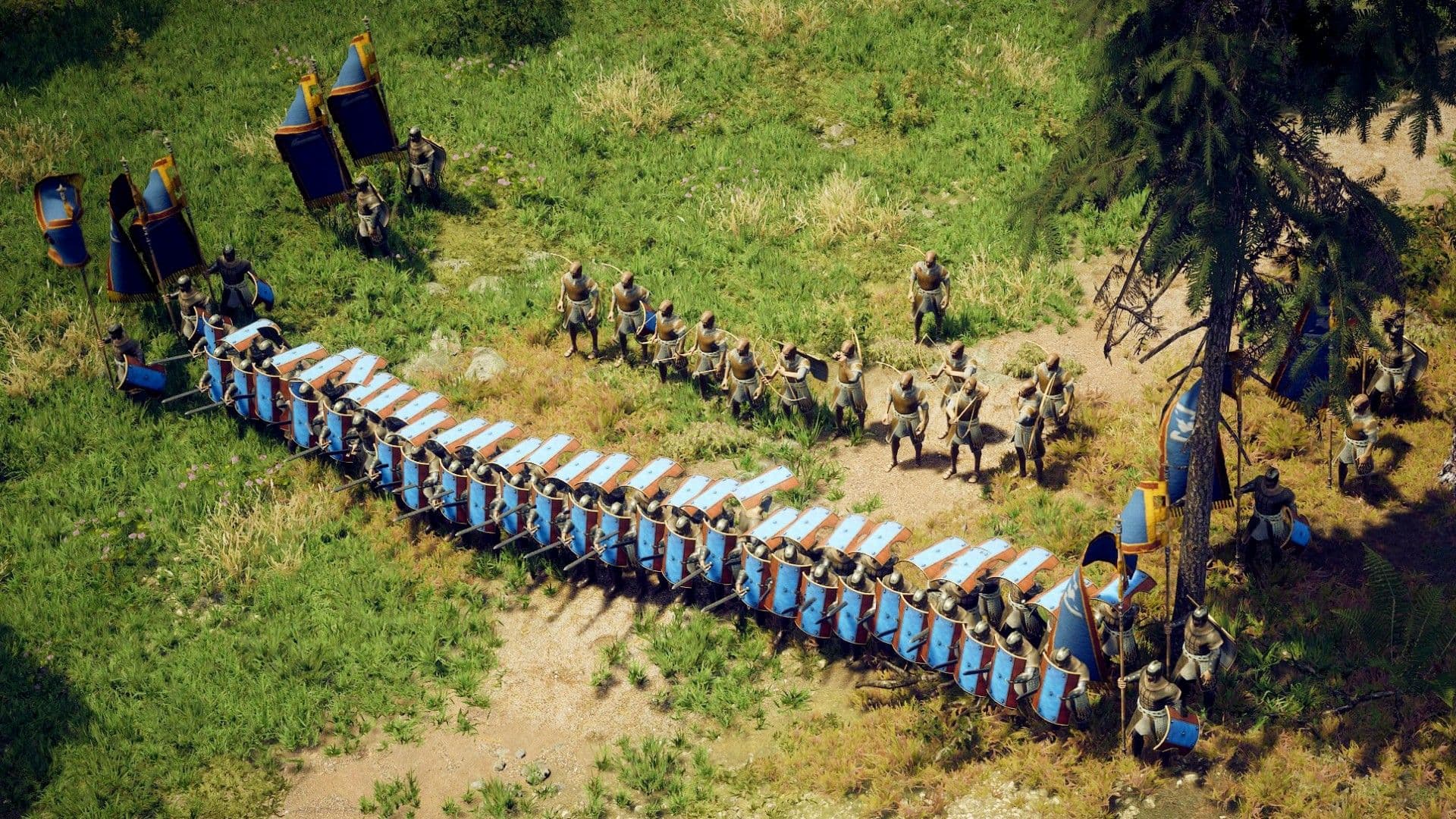
Anvil Empires drops thousands of players into Calligo, a persistent medieval world where three empires wage wars that unfold over weeks — fought with shield walls and siege engines, and won with farms...
Anvil Empires is a persistent-world medieval war MMO from Siege Camp, the Toronto studio behind Foxhole — the WWI-flavored logistics war game where thousands of players run supply lines, dig trenches, and fight month-long conflicts that historians on Reddit later write up like real campaigns. Announced in March 2023 and in open pre-alpha testing on Steam ever since, Anvil Empires takes that same "one soldier in a vast machine" premise and moves it a thousand years backward: swords instead of rifles, homesteads instead of factories, and a custom server engine built to put up to 1,000 players into a single melee battle. The game has no release date. Siege Camp's stated goal is a Steam Early Access launch in 2026 once the remaining foundational systems land, which makes this Anvil Empires preview an assessment of a construction site — a promising one, but a construction site all the same.
Every design decision in Anvil Empires flows from a single technical bet. Siege Camp spent years building the R² Engine, a custom multiplayer engine designed to support up to a thousand players fighting in one dense battle, with tens of thousands of simulated entities — crops, animals, structures, supply carts — ticking away across the wider world at the same time. The studio ran a large-scale tech demo of it as far back as 2019, and stress-tested it publicly during a Steam Next Fest "Massive Battle Demo" in June 2025, where anyone could drop into a scripted siege alongside hundreds of strangers. Foxhole proved Siege Camp can run player-driven wars at scale; the R² Engine exists to multiply that scale by an order of magnitude.
The setting is Calligo, a fictional early-medieval land currently split between three empires — the Ancients, the Remnants, and the Pagans, the last of which only entered testing in mid-2026. For now the factions differ mostly in aesthetics and spawn locations, with distinct gameplay identities promised during Early Access development. The world itself is genuinely large: after the latest rebuild, the map covers roughly 480 square kilometers, its main continent broken into three sections joined by additional landmasses and over a dozen scattered islands. There are no safe zones and no artificial barriers to PvP anywhere on it. A war here is meant to play out over weeks, and the honest way to explain what that means is to walk through one.
A fresh character in a pre-alpha test picks an empire, picks a spawn point on the map, and arrives in the world owning nothing. The opening loop is closer to a survival game than an MMORPG: gather wood and stone, keep yourself fed, and decide whether to attach yourself to an existing town or strike out and claim a homestead — a personal plot where you can build a house, plant fields, and raise animals. Housing got real depth over the course of testing: interiors are walkable, houses are modular with custom layouts, and later builds added a detail that says a lot about the simulation's ambitions — furnaces and forges now need chimneys, because without ventilation the smoke fills the room and starts damaging anyone inside.
Towns are where individual effort turns into faction infrastructure. A settlement grows from a hamlet into a walled town shared by dozens or hundreds of players, anchored by a Town Keep — reworked in the July 2026 devblog to include built-in walls, gates, and a larger interior. Around that core, players construct the farming and hunting industries that will eventually feed an army, plus market shops where goods change hands. Progress is collective by design. Nobody levels up in a traditional sense; a character's power comes almost entirely from equipment, food, and the settlement standing behind them, which is exactly the "cog in the wheel" perspective Foxhole veterans will recognize. The trade-off is equally familiar: if you want a power fantasy where one hero matters, this design will actively frustrate you, and Siege Camp has never pretended otherwise.
Peaceful farming is step one. The real game starts when your town has to supply a front line two regions away. Logistics in Anvil Empires means physically moving things — grain, weapons, armor, siege materials — using pack animals, donkey trains, and carts along roads that enemies can watch and raid. Devblogs through 2026 layered a proper trade economy on top of this: new resources and equipment tiers, a secure item-exchange interface, rental systems, and bounties that put a price on notorious raiders' heads. Below ground sits the Underworld, a network of caves entered through surface openings, where mining operations pull out the ore and silver that the surface economy runs on.
Anyone who has played Foxhole knows both the magic and the misery this structure produces. When it works, a well-run supply line is the most satisfying thing in the game — a quiet, unglamorous effort that visibly wins battles for people who will never know your name. When it fails, it fails as tedium: hauling goods is slow by design, raiders target exactly the players least equipped to fight back, and the whole economy depends on enough volunteers choosing the wheelbarrow over the sword. Pre-alpha tests can't answer whether Anvil Empires has enough of those volunteers, because a five-day test attracts the dedicated. A persistent world running around the clock, across time zones, is a different and much harder problem.
Combat in Anvil Empires is top-down, physical, and deliberately unheroic — you are one fighter in a shield wall, not a champion carving through mobs. The system was overhauled in the July 2026 devblog into something more deliberate: three attack types per weapon with different speeds and commitments, plus an active shield mechanic that asks defenders to raise and angle their block rather than passively soak hits. The arsenal has been expanding test by test — spears, axes, longswords, crossbows — and each weapon carries its own rhythm and reach, which matters enormously when the fight is fifty people wide and formation discipline decides who holds the line.
Mass is the whole point. Skirmishes over a farm might involve a dozen players, but the engine is built for the moments when two armies actually collide — hundreds of fighters pressed into the same field, archers and crossbowmen behind, cavalry probing the flanks, all of it running in real time on one server. The Next Fest demo showed the technology holding under that load, and it also showed the current ceiling: hit registration and combat feel have been reworked repeatedly across the pre-alpha precisely because early builds drew criticism for stiffness. Fighting in a crowd this dense will never feel like a polished action game, and Siege Camp seems to be aiming for readable and fair rather than flashy. Whether the latest combat model gets there is one of the bigger open questions heading into Early Access.
Wars in Calligo end at walls. Taking a fortified town means establishing a siege camp outside it, blockading the defenders, building war machines, and breaching fortifications that other players spent days constructing — while those players fight back from the ramparts. This is the content the entire economy exists to enable, and it's where the thousand-player promise stops being a tech demo and becomes the game. Recent development has focused on formalizing what victory even means: new win conditions arrived alongside the Pagans and the trade economy, moving the game away from open-ended tests toward wars with a defined arc and an actual ending, after which the world presumably resets for the next age.
The three-faction structure is doing quiet, important work here. Two-sided wars snowball — the losing side bleeds players, the winning side steamrolls, and the war dies before its scheduled end, a pattern Foxhole has fought for years. A third empire creates shifting pressure on every border and gives a losing faction somewhere to matter. But the Pagans have existed in testing for only a few months, with placeholder-equivalent equipment, so nobody outside Siege Camp knows whether the triangle holds up over a full multi-week war at real population. That test hasn't happened yet.
Anvil Empires has now been in public pre-alpha longer than many MMOs spend in their entire announced-to-launched cycle. Testing began in April 2023, and the devblog trail since — 28 entries and counting — reads like a game being assembled and reassembled in public: a world expansion in 2024, the Underworld and combat stability systems that same year, the Avatar character and equipment overhaul in early 2026, then bounties, creatures, and the Pagan faction in May. The most telling entry is the most recent one. In July 2026, Siege Camp announced it had thrown out the world map entirely and rebuilt Calligo from scratch, citing years of accumulated problems with usable space and terrain elevation. Rebuilding your entire world three years into testing is either alarming or reassuring depending on your temperament; the studio's own framing is that Foxhole took over six years to grow from a 64-player prototype into persistent thousand-player wars, and that this project will follow the same patient, iterative path — with Early Access as a beginning rather than an end.
The community around the pre-alpha has its own friction worth flagging. Access comes in limited waves, and some players report waiting a year or more for a key, which breeds resentment on the Steam forums. Others voice a sharper worry: that organized Foxhole clans already dominate the small test population, and that a game built on mass cooperation inherits mass-cooperation politics — gatekeeping, zerg culture, and drama included. That criticism is about the player culture more than the design, but for a game where your experience depends entirely on the people around you, it isn't a trivial one.
Anvil Empires currently has no monetization at all — the pre-alpha is free, and Siege Camp has stated outright that the testing phase exists to refine the game, not to charge for access. No business model has been announced for the eventual release. The obvious precedent is Foxhole, which Siege Camp sells as a straightforward one-time purchase with cosmetic-free, shop-free wartime gameplay, and nothing in nine years of that studio's history suggests an appetite for selling power. Until a price and model are confirmed, though, that's an inference from track record rather than a fact, and this section will get a real answer only when the Early Access page does.
Siege Camp is one of very few studios on earth with a shipped, running proof that players will voluntarily grow wheat so that strangers can fight a war — and Anvil Empires is a direct attempt to do that again, bigger, in a setting where the logistics are donkeys and the artillery is a trebuchet. The ambition is credible precisely because it isn't new to this team. What's unproven is everything that scale changes: whether melee stays readable with a thousand bodies on screen, whether three factions balance a multi-week war, whether enough players choose the supply cart when nobody is forcing them to. If persistent, player-run conflict is your genre, put this on the watchlist and request pre-alpha access now, because the free tests are the whole show until Early Access arrives. Just come with a blacksmith's patience. Anvil Empires is still on the anvil itself — the shape is visible, the metal is hot, and Siege Camp keeps hammering out sections it already forged once. Games made this way tend to take years longer than anyone hopes, and last for years longer than anyone expects.