 Free To Play
Ragnarok Online
MMORPGReleased
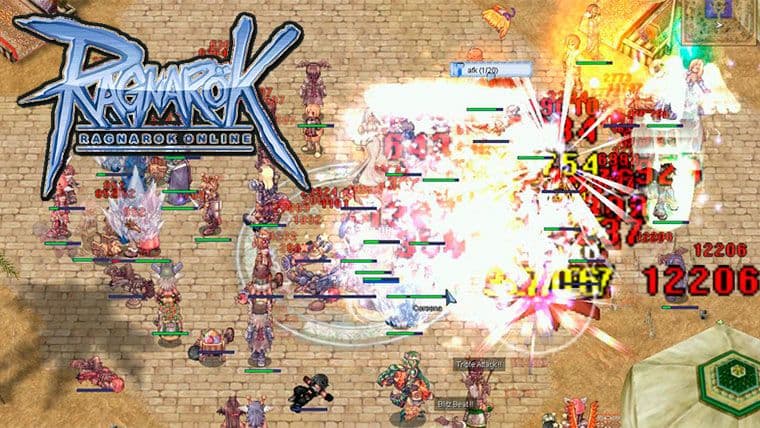
Ragnarok Online has been running since 2002, and the card system it introduced — socketing monster drops into weapons and armor — is still one of the ...
Minimum and recommended PC specs to run the game
← Back to game reviewIf your PC can run this game, you'll also be able to play these:
Free To PlayRagnarok Online has been running since 2002, and the card system it introduced — socketing monster drops into weapons and armor — is still one of the ...
 Free To Play
Tibia is the 1997 fantasy MMORPG that never stopped shipping updates — nearly 29 years in and still adding new classes, new bosses, and new content. F...
World of Sea Battle is built upon an unconventional architectural foundation compared to modern big-budget MMOs: the client runs on the lightweight Microsoft XNA framework alongside specialized SharpDX libraries, routing graphics calls directly to DirectX 9.0c and DirectX 11 APIs. Forgoing cumbersome commercial game engines eliminated bloated memory overheads and multi-gigabyte shader compilation pipelines, establishing remarkably low hardware entry barriers even on legacy PC configurations.
The Central Processing Unit (CPU) bears primary responsibility for physical environment calculations and multi-entity network synchronization. The processor continuously evaluates ocean wave fluid dynamics, aerodynamic wind resistance along the wind rose, ballistic trajectories of hundreds of simultaneous round shots, and localized modular damage states across each ship hull. Single-thread performance and Instructions Per Cycle (IPC) remain paramount. While a baseline quad-core processor such as an Intel Core i5-4570 or AMD Phenom II X4 B60 handles open-sea transit adequately, an Intel Core i7-3770 or AMD FX-9370 is recommended to maintain stable frame timing during massive port sieges involving dozens of player-crewed line ships.
Graphics hardware and Dedicated Video Memory (VRAM) are utilized primarily to render dynamic ocean surfaces, realistic wave displacement, volumetric storms, and thick powder smoke plumes generated by synchronized broadsides. Because the rendering pipeline avoids costly ray tracing and excessive geometric meshes, the client operates reliably on vintage GPUs like the GeForce GTX 460 or Radeon HD 6850 with 1 GB of VRAM. Sustaining an uncompromised 60 frames per second at high ocean shader presets and extended horizon visibility calls for a GeForce GTX 660 or Radeon HD 7850 equipped with 2 GB of video memory.
System Memory (RAM) utilization is exceptionally conservative by modern standards. A modest baseline of 2 GB of RAM suffices for executing the client during coastal cruising on early-tier vessels. An allocation of 4 GB of system memory is recommended to eliminate micro-stutter when traversing distant archipelago sectors, providing ample headroom to buffer mesh geometry for over fifty historical vessels, fortress texture atlases, and environmental audio without triggering pagefile swapping.
Storage demands are trivial by contemporary benchmarks, requiring merely 4 GB of free drive space. Owing to highly compact asset sizes and progressive sector streaming, World of Sea Battle runs smoothly on traditional mechanical hard drives (HDD). The adoption of a solid-state drive (SSD) speeds up initial client initialization upon launch, yet remains entirely optional for day-to-day maritime exploration and combat.