Complete Crafting & Gear Progression Guide in Throne and Liberty: Blueprints, Fusion, and Market Economics
Quick Take: In Throne and Liberty, there is no traditional craft leveling for weapons and armor — you will never have to forge hundreds of grey daggers just to unlock a skill tier. Every city artisan is universal: an ordinary blacksmith in starting Castleton can craft both a level 10 training blade and legendary Resistance gear sets or Archboss Tevent weapons. The sole craft featuring personal progression (Levels 1–25) is Cooking, covered in a dedicated companion guide. This master hub covers urban workshops, raw material pipelines, the Lithograph Book, crafting lithographs, and converting crafts into Lucent via the Auction House.
Crafting Architecture: City Workshops Instead of Skill Levels
Forget the classic Korean and Western MMO formula where gear crafting is gated behind hundreds of hours of grinding tradeskill levels. In Throne and Liberty, characters possess no hidden Blacksmithing or Tailoring skill bars. Production is organized entirely through urban artisan workshops: you act as the contractor and quartermaster, while municipal NPC crafters assemble finished items for a flat fee and a regional territory tax.
Your objective as a craftsman is straightforward: secure the lithograph blueprint, gather raw materials across the open world, complete contracts, and refine reagents into the required tier. Once your inventory is stocked, you simply visit the appropriate artisan in town and collect your finished gear.
Autonomous Craft: Cooking as a Standalone Profession
The only craft in the game featuring personal level progression is Cooking. It features a dedicated tradeskill bar spanning Levels 1 to 25, public cooking ovens in cities, hidden world recipes, and powerful combat banquets boosting Critical Hit, Mana Regeneration, and Boss Damage.
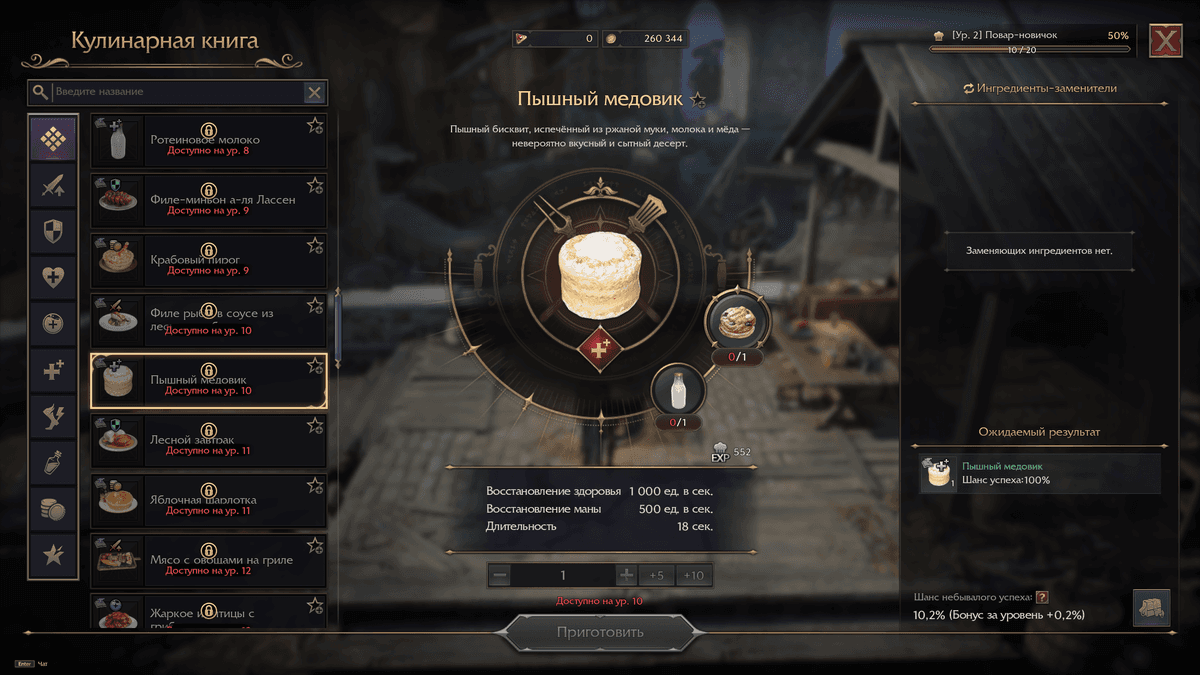
Cooking functions independently from city weapon forges and follows its own gathering and leveling rules. Because of this, we cover it thoroughly in a dedicated companion guide:
Dedicated Guide: Complete Throne and Liberty Cooking Guide (Lv. 1–25)
If you need sustained combat buffs for guild raids and castle sieges, or wish to monetize gourmet dishes on the exchange, check out our deep-dive guide:
- Optimal 1–25 leveling route without wasting scarce Salt and Cooking Oil;
- Complete catalogue of combat dishes for Critical Hit, Hit Chance, Mana Regen, and Defense;
- Ingredient substitution charts for wild herbs, meats, and grains;
- Lucent generation strategies through banquet platters and remedy sales.
Read the full guide: Throne and Liberty Cooking Guide: 1–25 Leveling, Talandre Recipes, and Lucent Profit.
The Complete Five-Step Crafting Cycle
Crafting any piece of gear, skill growth book, or fishing rod follows five consecutive production phases:
| Phase | Player Action | Primary Sources & Consumables | Phase Output |
|---|---|---|---|
| 1. Gathering Raw Materials | Mine ore nodes, log timber, hunt open-world mobs, complete daily contracts, and deploy pets | Mining veins, trees, open-world mobs, Resistance Contracts, Amitoi Expeditions | Raw ore, timber, pelts, threads, parchment, and Contract Coins |
| 2. Material Refinement | Fuse lower-grade resources at a 5:1 ratio and dissolve surplus gear | City artisan menus, the Dissolve feature in the inventory | Quality Manasteel, Alchemical Powder, ingots, and weapon blanks |
| 3. Securing Lithographs | Complete Lithograph Book pages, progress the Codex, and farm dungeon bosses | Lithograph Book, dungeon bosses, Contract Coin Merchant | Blank universal lithographs (Green) or named blueprints for Rare and Epic items |
| 4. Artisan Assembly | Select recipes at NPC workshops, paying crafting commissions and castle tax | Weapon Crafter, Armor Crafter, Accessories Crafter, Skills Crafter | Finished weapons, armor, accessories, or skill growth books |
| 5. Market Distribution | Equip the crafted item or sell tradeable procs on the Auction House | Chance for Great Success, sealing gear with Precious Enchanted Ink | Direct combat gear upgrades or pure profit in Lucent |
City Artisan Directory: Who Crafts What
In every major hub, the artisan quarter is strictly partitioned by trade. Whether you are in Castleton or Stonegard, look for the following specialists:
- Weapon Crafter (Weapons Menu): Forges all 8 weapon classes (Sword & Shield, Greatsword, Daggers, Longbow, Crossbows, Staff, Wand & Tome, Spear). Also manufactures Weapon Blanks and crafts World Boss (Morokai, Chernobog) and Archboss (Tevent) armaments.
- Armor Crafter (Armor Menu): Crafts helmets, chest pieces, greaves, gloves, boots, and cloaks across all three armor weight classes (Plate, Leather, Cloth), including Epic Resistance set gear.
- Accessories Crafter (Accessories Menu): Crafts necklaces, bracelets, rings, and belts; refines Gold Ore into Gold Ingots and assembles accessory mountings.
- Skills Crafter / Senior Skill Researcher (Skill Books Menu): The cornerstone of character skill progression. Crafts Quality, Rare, and Precious Skill Growth Books (including omnipotent Almighty tomes) and refines their core reagents.
- Sundries Crafter (Items Menu): The utilitarian workshop. Assembles fishing rods (Bamboo up to Tevent), endgame Purity Stones, Stellarite, and Mercenary Certificates for open-world dungeon contracts.
- Contract Coin Merchant: Exchanges earned Contract Coins for blank lithographs, guaranteed Rare Parchment shipments, and valuable Precious Enchanted Ink.
Territory Castle Tax: Avoiding Costly Crafting Surcharges
Pay close attention to the tax indicator directly below the material list in the crafting window: "Tax: +10%" (or "+30%"). This is a territorial surcharge levied directly by the guild currently holding Stonegard Castle on your server.
Total crafting cost consists of two distinct components:
- Base Artisan Fee: A fixed Sollant commission for the crafter's labor;
- Castle Surcharge: A percentage-based tax deposited straight into the ruling guild's treasury.
Pre-Crafting Anvil Checklist
To avoid running back and forth between the forge, bank, and Auction House, run through this four-point check before starting any crafting session:
- Lithograph on Hand: Green gear requires a universal category lithograph (weapons, armor, accessories), while blue and purple items strictly demand their specific named lithograph.
- Stellarite and Alchemical Powder Reserves: These two primary catalysts are consumed rapidly. Dissolve unwanted loot to maintain your Alchemical Powder stock, and hunt dungeon mobs for Stellarite.
- In-Recipe Material Tracking: If any reagent is missing, click its icon directly within the artisan's recipe window — the UI will highlight drops, gathering nodes, and vendors on your world map.
- Sollant Reserve for Taxes: Ensure your gold balance covers not just the final assembly cost, but also every intermediate 5:1 refining step for timber, pelts, and metal ingots.
Quick Take: City artisans in Throne and Liberty operate as fully unlocked production hubs with zero character tradeskill prerequisites. From your very first arrival in Castleton, the standard Weapon Crafter can forge armaments across all 8 weapon classes — from beginner green blades to Archboss Tevent relics. The Armor Crafter assembles Resistance set armor, the Accessories Crafter casts jewelry, the Senior Skill Researcher transcribes skill books up to Almighty tomes, and the Sundries Crafter provides fishing rods and Mercenary Certificates for endgame abyss dungeons. The only difference between cities is the active Castle Tax rate.
City Artisans: Complete Recipe Catalogs from Level 1
Do not waste travel time searching for "master artisans" in endgame hubs like Vienta Village or Stonegard Castle. The game features no hidden or gated craftsmen: the crafting catalog at the Weapon Crafter in starting Castleton is completely identical to that of the royal armorer in the capital fortress.
Your ability to forge any item depends entirely on what you carry in your bags: having the requisite lithograph blueprint, refining materials to the necessary quality tier, and holding enough Sollant to cover assembly commissions and the regional castle tax.
Weapon Crafter: From Training Blades to Tevent Relics
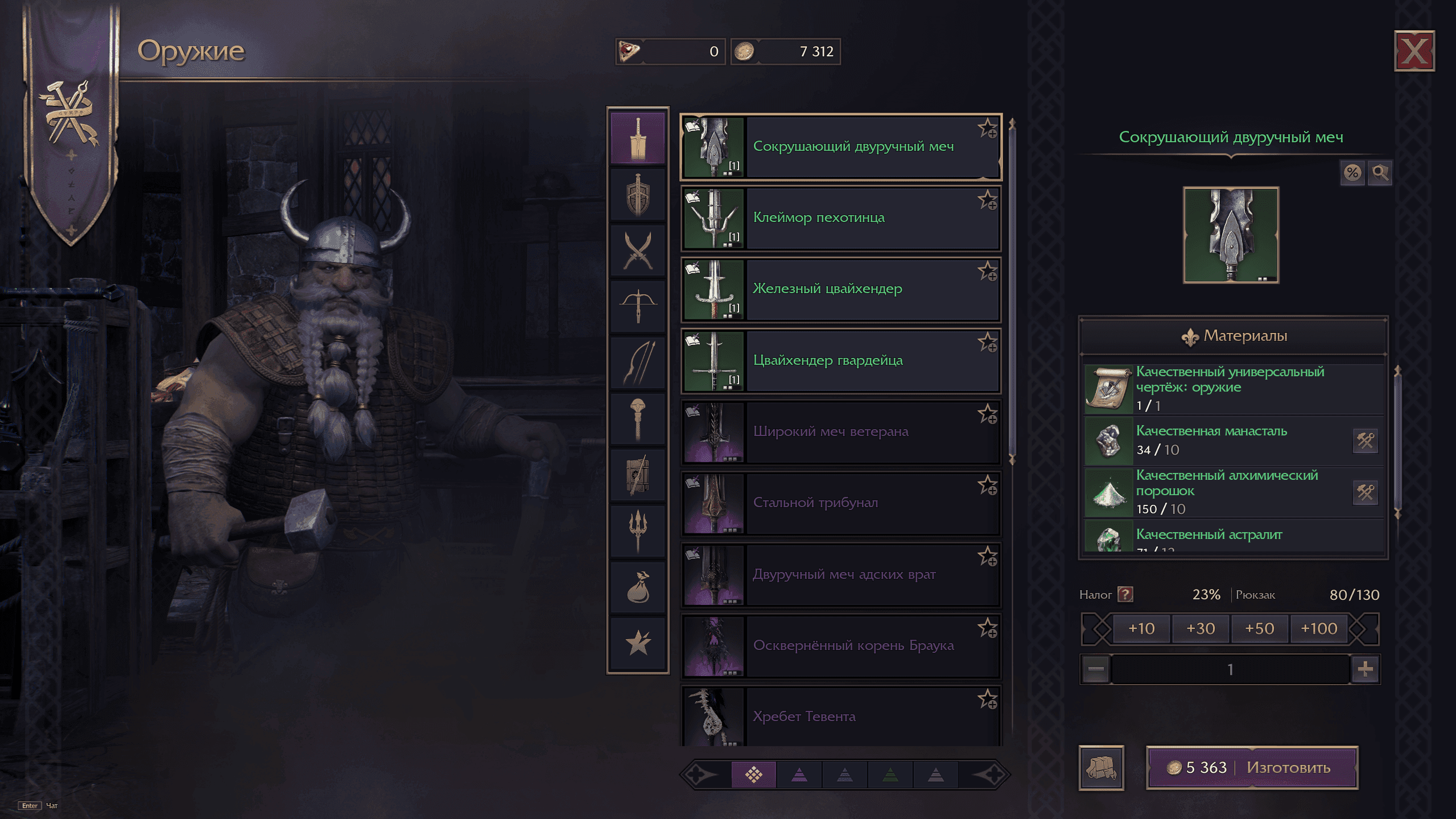
In Castleton, the forge is overseen by Weapon Crafter Lager (accessible via the Weapons menu). This workshop manufactures weaponry for all eight weapon classes: Sword & Shield, Greatsword, Daggers, Longbow, Crossbows, Staff, Wand & Tome, and Spear.
| Weapon Tier | Menu Examples | Assembly Requirements | Recipe Specifics |
|---|---|---|---|
| Quality (Green) | Crushing Greatsword, Infantry Claymore, Iron Zweihander | Quality Lithograph: Weapons, Quality Manasteel, Quality Alchemical Powder, Quality Stellarite | Uses a cheap universal category lithograph; covers all leveling weapon needs up to level 30 |
| Rare (Blue) | Veteran's Broadsword, Steel Tribunal, Hell Gate Greatsword | Specific named item lithograph, Rare Manasteel, Rare Alchemical Powder, Rare Stellarite | Requires a specific named lithograph; raw materials are refined at this same blacksmith from green ingots |
| Precious (Purple / Epic) | Severe Punishment Greatsword, Resistance Hero Greatsword | Specific named epic lithograph, Precious Manasteel, Precious Alchemical Powder, Precious Stellarite | Endgame armaments; consumes large quantities of Alchemical Powder and Precious-tier metals |
| World Boss & Archboss Weapons | Corrupted Root of Braud, Tevent's Spine | Boss Soul Fragments, high-tier Weapon Blanks | BiS armaments featuring unique passive traits; assembled directly in Castleton with no special progression hurdles |
Intermediate components — Weapon Blanks (Quality Weapon Blank, Rare Weapon Blank) — are also forged here. Crafting them requires the dedicated red gemstone, Pure Rubrix (Quality Pure Rubrix), alongside Stellarite and Alchemical Powder.
Armor Crafter: Plate, Leather, Cloth, and Resistance Sets
Defensive specialists — Armor Crafter Rachel and Armor Crafter Marian — manage the Armor menu. They equip all six defensive slots: Helmet, Cloak, Chest, Gloves, Pants/Greaves, and Boots.
Recipes are strictly divided across three armor weight categories:
- Plate (Heavy Armor): Requires Manasteel ingots and the protective green gemstone — Pure Stalon (Quality, Rare, and Precious Pure Stalon). Foundational pieces include Swordsman Helm, Paladin Helm, and Seneschal Helm.
- Runic Leather (Medium Armor): Fashioned from cured pelts (Runic Leather, Quality Runic Leather), Alchemical Powder, and Stellarite. Foundational pieces include Deerskin Hat, Marksman Hat, and Assassin Hood.
- Ether Thread (Light Armor / Cloth): Woven from gathered fibers (Ether Thread, Quality Ether Thread) tailored for spellcasters and healers. Foundational pieces include Court Mage Hat and Oracle Hood.
Accessories Crafter: Arcane Jewelry and Gold Bars
Jewelry is crafted by the Accessories Crafter (via the Accessories menu). Rings, necklaces, bracelets, and belts directly scale secondary combat statistics: Critical Hit, Mana Regeneration, Armor Penetration, and Crowd Control Resistance.
Key elements of jewelry crafting:
- Slots: Crafts necklaces (Rockfall Necklace, Storm Necklace, Flame Necklace), bracelets, rings, and belts.
- Dedicated Gemstone: The blue crystal Pure Emeret (Quality, Rare, and Precious Pure Emeret), which is consumed in casting Quality Accessory Mountings.
- Precious Metal: Smelting Gold Ore (Quality Gold Ore, Rare Gold Ingot) gathered from nodes or rewarded by contracts.
- Universal Lithographs: Green accessories require a Quality Lithograph: Accessories.
Senior Skill Researcher: The Ability Growth Station
Senior Skill Researcher Adrian in Castleton (managing the Skill Books menu) is the single most important NPC for boosting your damage output and survivability. While he does not forge armor, he produces the growth books required to level active and passive skills.
Adrian handles two vital functions:
- Refining Base Reagents:
- Parchment: Quality Parchment → Rare Parchment → Precious Parchment.
- Arcane Gem: Quality Pure Marind → Rare Pure Marind → Precious Pure Marind.
- Transcribing Skill Growth Books:
- Quality Skill Growth Book (Green): Costs Quality Parchment x5, Quality Pure Marind x1, plus Sollant and tax.
- Rare Skill Growth Book (Blue): Requires blue equivalents: Rare Parchment x5 and Rare Pure Marind x2.
- Precious Skill Growth Book (Purple): Transcribed from purple components for high-end mastery.
- Precious Skill Growth Book: Almighty: Universal endgame tomes utilized for maxing out signature skills.
Sundries Crafter: Tackle, Purity Stones, and Mercenary Passes
Sundries Crafter Rosetta (handling the Items menu) manages non-combat lifeskills gear and keys required for high-yield dungeons:
- Fishing Rod Progression: The full rod upgrade path: Bamboo Fishing Rod → Steel Fishing Rod → Bone Fishing Rod → Obsidian Fishing Rod → Dreamweaver Fishing Rod → Tevent Fishing Rod. High-end rods consume shaped timber, Manasteel, and natural jade.
- Purity Stones (Energy, Life, Resolve, Triumph): Endgame catalysts used for rerolling equipment traits. Assembled from base Purity Stones and Abyss Clods (40–50 per stone).
- Mercenary Certificates I and II: Contract activation passes for high-risk open-world dungeons (Temple of Truth, Berkant Mansion, Crimson Mansion II, Syleus's Abyss, Shadow Crypt). Crafted using Resistance Contract Scrolls.
- Queen Bellandir Antidotes: Potent specialized remedies (Queen Bellandir's Fall Antidote), without which the sand Archboss's neurotoxin wipes full groups within seconds.
Crafting Cost: Base Fees and Territorial Castle Tax
Every time you initiate a craft, the total Sollant deduction is calculated using a strict formula based on the artisan fee and regional castle tax:
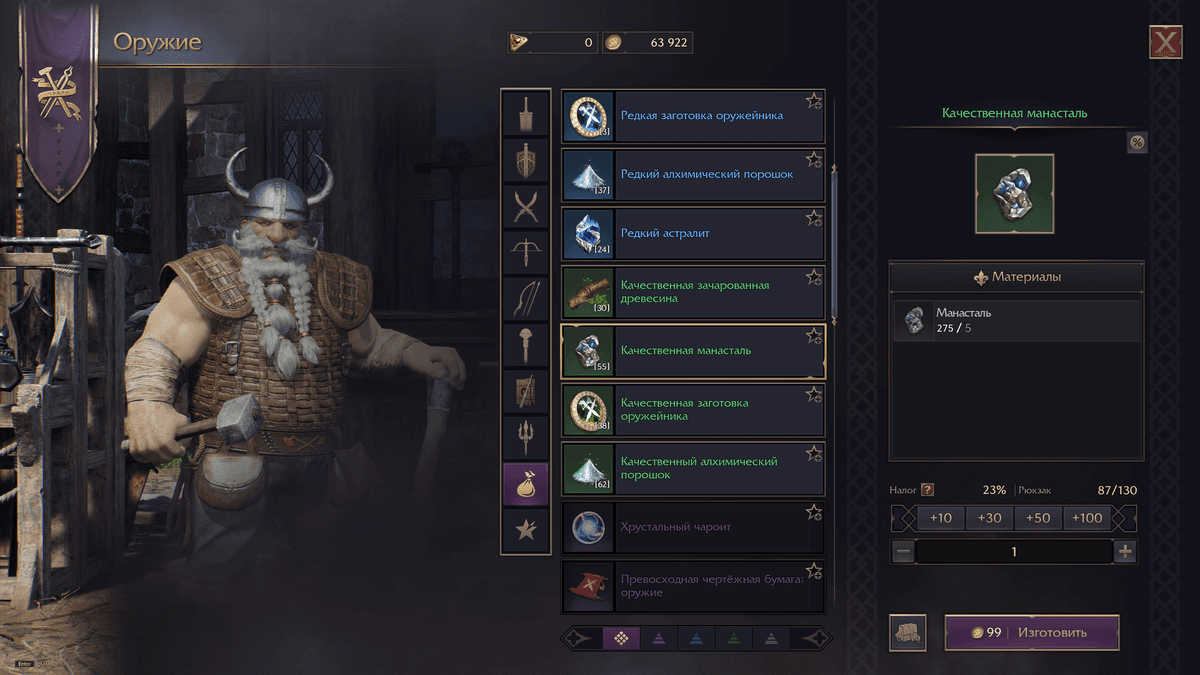
Crafting Cost Formula:
Total Cost = Base Artisan Commission + (Base Artisan Commission × Castle Tax Rate)
If the base assembly fee is 2,396 Sollant, and the ruling guild has set the castle tax to +10% (or +30% during siege war), the total surcharge is clearly displayed right above the "Craft" button.
Because every city artisan shares the exact same recipe database, the sole factor in deciding where to craft in bulk is finding the settlement with the lowest active territory tax on the world map.
Quick Take: The Lithograph Book is Throne and Liberty's built-in collection system spanning 354 equipment entries. A vital beginner mechanic: items not yet registered in your collection display a white open book icon in the top-left corner of their item frame. Upon arriving in Castleton, you can purchase all uncollected starting gear from the municipal Equipment Merchant for cheap Sollant, register them into the book, and instantly collect valuable milestone rewards: character EXP, Quality Universal Lithographs, and Quality Pure Marind. This section also breaks down how to seal dungeon drops into tradeable lithographs using Precious Enchanted Ink to generate Lucent on the Auction House.
The Lithograph Book: Collection Architecture and Mechanics
In the official client, the collection codex is named the Lithograph Book (accessed via hotkey F2 or the book tab in your inventory). Turning in items rewards your account with account-wide milestone EXP, universal lithographs, and weapon/armor growth stones.
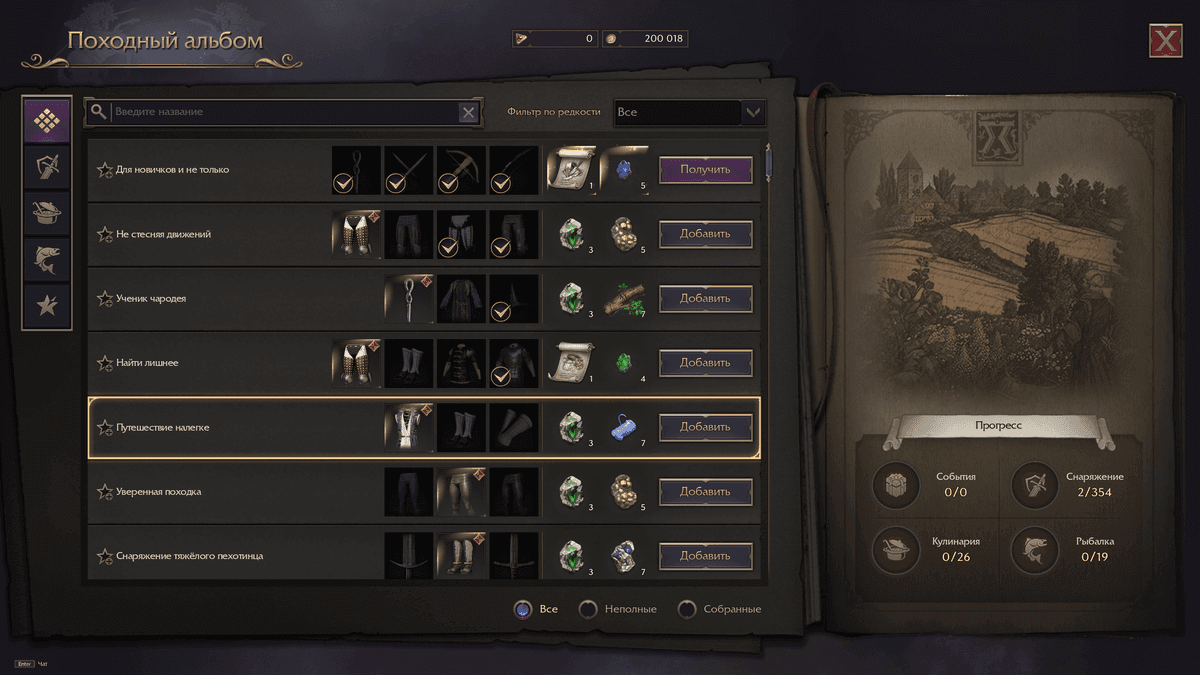
The collection catalog is organized across four distinct categories:
- Equipment (354 Entries): The primary branch. Features collection sets such as: "For Novices and Beyond", "Reliable Protection", "Hard Training", "Knife Fighting for Beginners", "Apprentice Assassin", "At the Forefront", "Crown Defender's Arsenal", "Unrestricted Movement", "Apprentice Wizard", "Heavy Infantry Gear", and dozens more.
- Cooking (26 Entries): Culinary dishes and banquet platters (detailed extensively in our dedicated Cooking Guide).
- Fishing (19 Entries): Catalog of freshwater and saltwater catches from all continental biomes.
- Events: Seasonal time-limited pages tied to active holiday game events.
The Book Marker: Open Book Icon on Item Frames
The client features an intuitive visual indicator for uncollected equipment:
How to Read the Collection Marker:
If an item has not yet been registered in your Lithograph Book, a small white open book icon appears in the top-left corner of its icon frame.
The moment that item is registered into the book, the icon vanishes from all future copies of that item. This marker updates dynamically across your inventory, storage vault, quest reward popups, and NPC merchant shop windows.
Beginner Trick: Fast-Tracking Collections via the Equipment Merchant
The quickest method to stock up on early universal lithographs and Marind immediately upon arriving in Castleton:
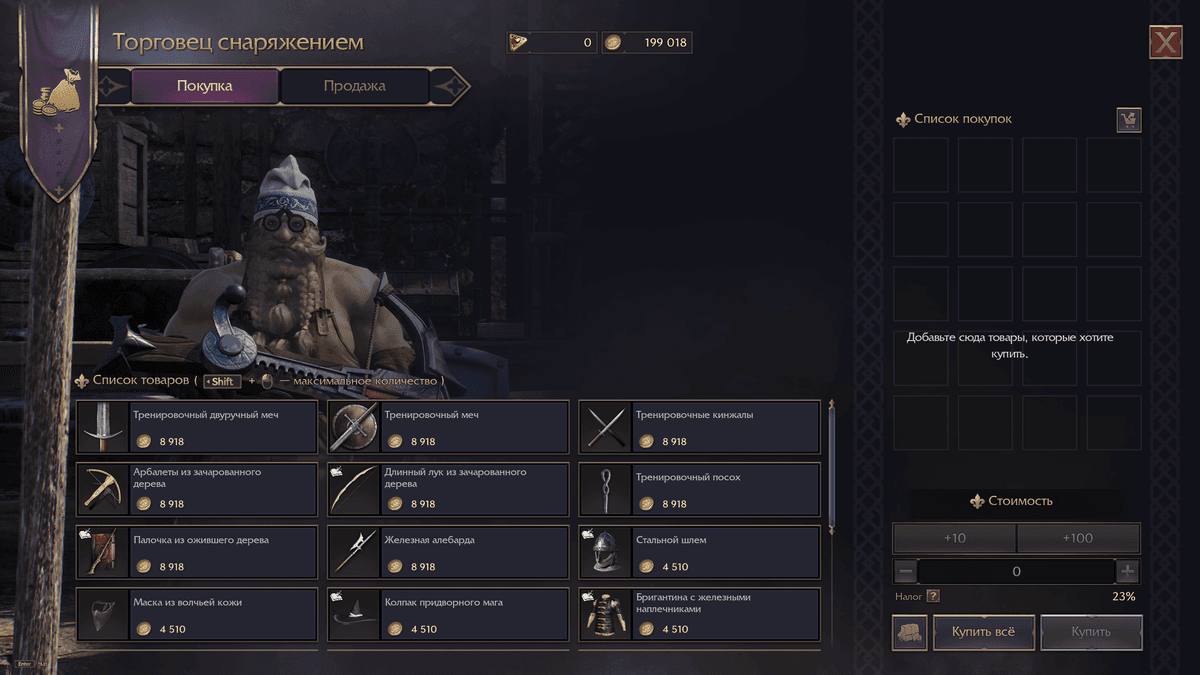
- Locate the NPC Equipment Merchant in central Castleton.
- Open the store and browse the stock: basic training weapons, recruit tunics, apprentice hoods, and iron gauntlets.
- Purchase one copy of every item displaying the white open book icon. Common grey and green gear costs pocket change (between 200 and 10,000 Sollant each).
- Open your Lithograph Book: dozens of "Register" buttons will glow active.
- Turn in the purchased gear to complete pages like "For Novices and Beyond", "Hard Training", "Reliable Protection", and "Knife Fighting for Beginners" in under two minutes.
| Purchased Merchant Gear | Lithograph Book Page | Completion Milestone Rewards |
|---|---|---|
| Training Greatsword, Training Sword, Training Daggers | "For Novices and Beyond" | Quality Lithograph: Weapons, Character EXP, Sollant |
| Court Mage Hat, Raven Catcher Robe | "Apprentice Wizard" | Quality Pure Marind (x10), Sollant |
| Iron Pauldron Brigandine, Steel Plate Gauntlets | "Reliable Protection" | Quality Lithograph: Armor, Growth Stones |
| Enchanted Wood Longbow, Living Wood Wand | "At the Forefront" | Polishing Stones, Universal Accessory Lithographs |
Spending merely 15,000–20,000 Sollant right after the prologue completely resolves your early shortage of universal lithographs and Marind without having to run through early-game mob fields.
Lithograph Classification: Universal vs. Named Blueprints
A Lithograph represents your crafting blueprint at city artisans. In Throne and Liberty, lithographs fall into two distinct mechanical categories:
Universal Lithographs (Quality / Green Tier):
- Quality Lithograph: Weapons — unlocks assembly of any green-tier weapon (from daggers to staves);
- Quality Lithograph: Armor — covers any slot in the green armor category;
- Quality Lithograph: Accessories — applies to all green rings, belts, and necklaces.
Acquired as rewards from the Lithograph Book, Resistance Contracts, or purchased from the Contract Coin Merchant.
- Named Lithographs (Rare Blue and Precious Purple Tiers):
- Every blue and purple item requires its exact named blueprint (e.g., Lithograph: Veteran's Broadsword, Lithograph: Severe Punishment Greatsword, or Lithograph: Resistance Lore Plate Greaves).
- Obtained from co-op dungeon bosses, open-world elite mobs, or purchased directly from the Auction House for Lucent.
Sealing Dungeon Drops into Tradeable Lithographs
When high-value Rare or Epic gear drops in a dungeon for a class you do not play, you can convert it into a tradeable blueprint and sell it on the Auction House for Lucent.
Requirements for sealing equipment into lithographs:
- The Item Must Be Pristine: Enhancement level strictly +0, zero unlocked or slotted traits, and unbound (tradeable status). Upgraded gear cannot be sealed.
- Lithograph Blank Base: Manufactured at the city blacksmith (Precious Lithograph Blank: Weapons or Precious Lithograph Blank: Armor).
- Precious Enchanted Ink: Purchased from the Contract Coin Merchant for Contract Coins. Unlocks at level 50 with a weekly purchase limit of 50 bottles.
- Packaging Process: Select the "Seal" option within the item's context menu in your inventory. The original item is consumed, yielding a tradeable lithograph marked with the scales icon, ready for immediate listing on the exchange.
Quick Take: Crafting production in Throne and Liberty is anchored by a strict 5:1 material fusion rule: five units of a lower-tier resource merge into one unit of the subsequent grade. Every artisan profession is tied to a specific gemstone: Pure Rubrix (Weapons), Pure Stalon (Armor), Pure Emeret (Accessories), and Pure Marind (Skill Books). There is no need to consult third-party drop tables: clicking any missing ingredient directly inside the artisan recipe interface opens a tracking menu that marks monsters, gathering nodes, and merchants directly on your in-game world map.
Four Base Materials and the 5:1 Fusion Ratio
Every piece of equipment in the game is assembled from four foundational raw material types. Each resource evolves across four standardized quality tiers: Base (Grey) → Quality (Green) → Rare (Blue) → Precious (Purple / Epic).
| Resource Type | Evolution Pipeline | Primary Usage | Open-World Sources |
|---|---|---|---|
| Metal | Manasteel → Quality → Rare → Precious Manasteel | Blades, shields, plate armor, fishing rod tips | Ore veins, Crystal Ashlar nodes, underground caverns |
| Timber | Enchanted Wood → Quality → Rare → Precious Enchanted Wood | Bows, staves, wands, crossbows, fishing rod shafts | Logging dry and enchanted trees across forests |
| Leather | Runic Leather → Quality → Rare → Precious Runic Leather | Medium armor, gloves, belts, quivers | Beast drops (wolves, wild boars, reptiles) |
| Cloth | Ether Thread → Quality → Rare → Precious Ether Thread | Light armor, robes, wizard hoods | Wild herb gathering, spider silk cocoons |
Advancing a resource to the next tier requires exactly 5 units of the preceding grade plus an artisan commission adjusted by territorial castle tax:
- 5 Base Grey units = 1 Quality Resource (Green);
- 5 Quality units = 1 Rare Resource (Blue) — equivalent to 25 base units;
- 5 Rare units = 1 Precious Resource (Purple) — equivalent to 125 base units.
Dedicated Gemstones and Catalysts
Smelted metal and cured leather alone are insufficient to forge weapon and armor blanks — each crafting profession requires a dedicated elemental gemstone:
- Pure Rubrix (Weapons): Gathered from mineral deposits or bought from the Contract Coin Merchant. Progression: Quality → Rare → Precious Pure Rubrix. Consumed in all Weapon Blanks.
- Pure Stalon (Armor): The protective gemstone for armor crafters. Progression: Quality → Rare → Precious Pure Stalon. Required for Plate and protective gear.
- Pure Emeret (Accessories): The jeweler's stone. Progression: Quality → Rare → Precious Pure Emeret. Forms the foundation of mountings, rings, and pendants.
- Gold Ore / Gold Ingot: Smelting metal for luxury jewelry (Gold Ore → Quality → Rare Gold Ingot).
- Pure Marind: The arcane crystal for skill books (Quality → Rare → Precious Pure Marind). The most strictly constrained gemstone in the game.
Additionally, every gear recipe incorporates two universal catalyst reagents:
- Alchemical Powder (Quality, Rare, Precious): Acquired by dissolving unwanted equipment via the Dissolve button in your inventory. Never sell trash gear to NPC vendors for copper coins — always dissolve it for Alchemical Powder.
- Stellarite (Quality, Rare, Precious): Condensed arcane energy harvested from open-world mobs and co-op dungeons. Consumed by the dozen during every crafting process.
Interactive Material Tracker: Direct Navigation from Recipes
The crafting interface includes a built-in search tool. Whenever a red deficiency counter appears beside a material (e.g., Quality Stellarite: 12/20), click directly on the ingredient's icon in the recipe window:
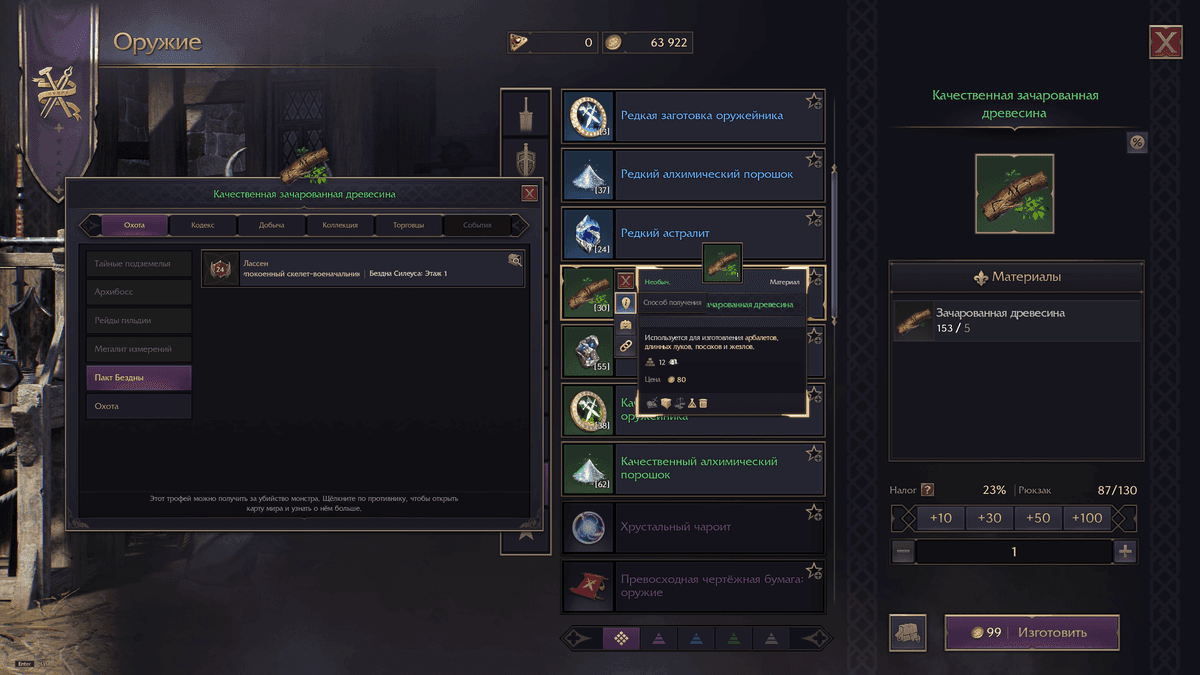
- "Hunting" Tab: Lists all creatures dropping the resource, displaying mob category (Beast, Humanoid), difficulty tier (Normal, Elite), and region (Howling Plains, Urstella Fields, Carmine Forest). Clicking a monster opens your world map with an active waypoint on its habitat.
- "Gathering" Tab: Displays mining veins (Crystal Ashlar) and logging groves sorted by recommended level (Monolith Wastelands Lv. 24–27, Stonegard Lv. 28–31, Daybreak Shore Lv. 38–40, Scorched Lands Lv. 41–42, Cursed Wasteland Lv. 43–45, Grayhollow Forest Lv. 50).
- "Merchants" Tab: Highlights NPC vendors carrying the item (Contract Coin Merchant in Castleton, Stonegard, Vienta Village, Herba Village).
- "Codex" and "Events" Tabs: Pinpoints regional questlines and dynamic public events offering the material as milestone rewards.
Resistance Contracts: Targeted Material Selection
Resistance Contracts (daily missions) represent the single most dependable source of crafting resources in the game. Completing commissions like "Following the Grain Trail" or "Saving the Soil" grants EXP, Contract Coins, and material reward chests.
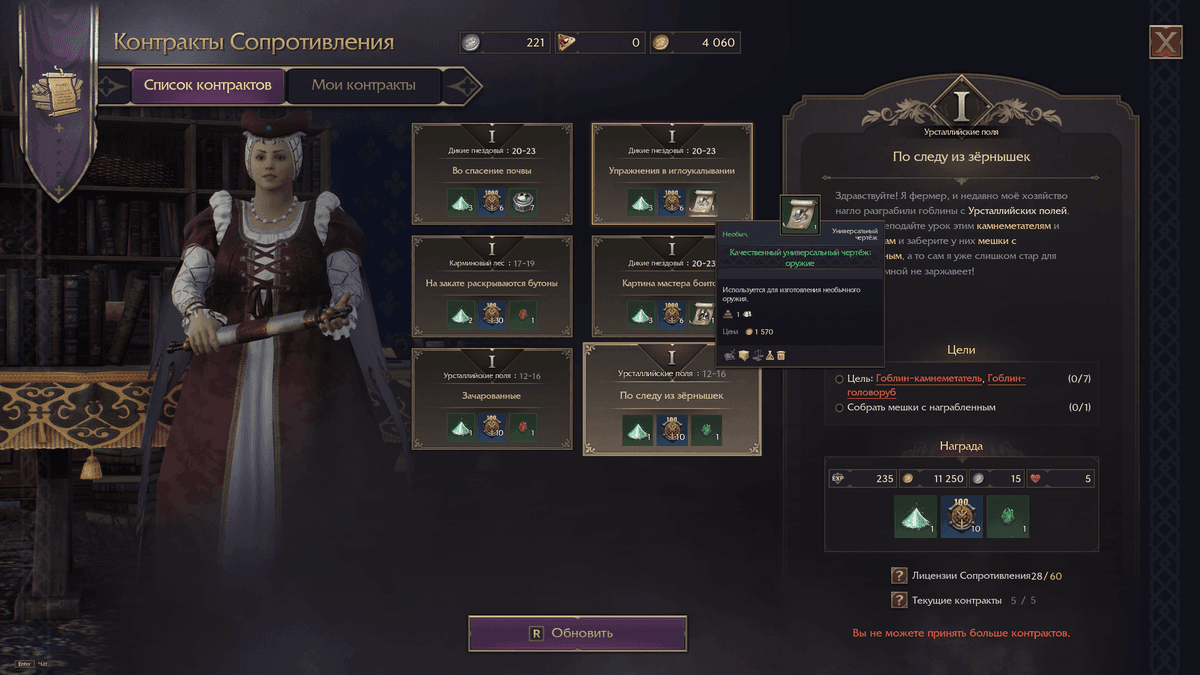
Quality Crafting Material Selection Chest: The true value of daily contracts lies in these selectable material chests:
- Quality Enchanted Wood (x1)
- Quality Manasteel (x1)
- Quality Runic Leather (x1)
- Quality Ether Thread (x1)
- Quality Gold Ore (x1)
Do not open these chests at random. Store them in your personal vault and unpack them strictly when you find yourself short a few ingots or timber pieces for an active crafting recipe.
Passive Gathering: Amitoi Expeditions
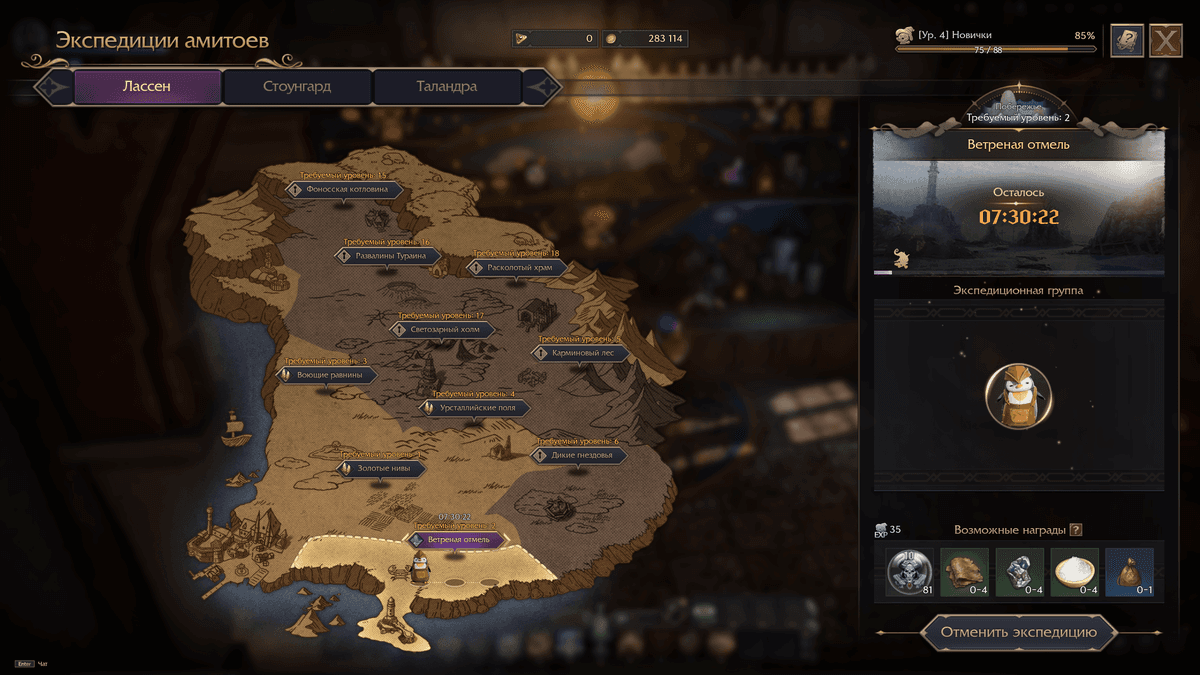
Never let your companion pets sit idle: dispatch them on Amitoi Expeditions via your Amitoi House. By deploying pets to surveyed map zones for 1, 2, 4, or 8 hours, you generate a steady stream of ore, timber, pelts, and gems while running dungeons or logged out.
Quick Take: Character damage output and survivability in Throne and Liberty scale directly with skill tiers, leveled exclusively through Skill Growth Books. Book production is overseen by municipal Senior Skill Researchers (Adrian in Castleton). The crafting formula is straightforward: Pure Marind + Parchment. The true progression bottleneck is Pure Marind: it does not drop from standard open-world mobs, and its mineral veins are scarce and heavily contested. Parchment, conversely, drops abundantly from everyday monsters and can be passively supplemented through the Contract Coin Merchant.
Skill Growth Tiers: From Green Tomes to Almighty Mastery
Every active and passive weapon skill evolves across standard quality tiers: Base (Grey) → Quality (Green) → Rare (Blue) → Precious (Purple / Epic). Upgrading a skill to a higher tier does not simply boost raw damage or healing coefficients — it unlocks branching skill specializations (tripods) and reduces cooldown timers.
The Skill Books crafting menu features four distinct categories of tomes:
| Skill Book | Quality Tier | Materials per Book | Combat Role |
|---|---|---|---|
| Quality Skill Growth Book | Green (Quality) | Quality Parchment (x5) + Quality Pure Marind (x1) + Sollant | Foundational skill leveling throughout the leveling storyline and early game |
| Rare Skill Growth Book | Blue (Rare) | Rare Parchment (x5) + Rare Pure Marind (x1) + Sollant | Midgame progression; provides substantial increases to damage and healing multipliers |
| Precious Skill Growth Book | Purple (Precious / Epic) | Precious Parchment (x5) + Precious Pure Marind (x1) + Sollant | Endgame mastery required for Tier 2 co-op dungeons, guild raids, and castle sieges |
| Precious Skill Growth Book: Almighty | Purple (Universal) | Precious Parchment, Precious Marind, specialized catalysts | Universal master tomes used to upgrade signature abilities without weapon-type restrictions |
The Reagent Pair: Pure Marind and Parchment
Skill Growth Books require neither metal ingots nor cured leather — ability progression revolves entirely around two reagents refined directly at the crafter via the standard 5:1 ratio:
| Reagent | Artisan Fusion Stages (5:1 Ratio) | Consumption Rules |
|---|---|---|
| Pure Marind | Quality → Rare → Precious Pure Marind | Consumed at a flat rate of 1 gemstone per book. Refined Marind can also be merged: Rare → Precious Marind. |
| Parchment | Quality → Rare → Precious Parchment | Strictly consumed at a rate of 5 sheets per book of the corresponding quality grade. |
Acquiring Parchment: Open-World Grinding and Daily Channels
Contrary to common misconceptions, Parchment is not locked behind artificial daily timegates — it is a standard monster hunting drop that accumulates naturally across open-world zones and instanced dungeons in massive quantities:
- Open-World Hunting (Primary Source): Parchment drops from an extensive pool of mobs across Solisium. Quality Parchment drops even from low-level beasts (such as Fanged Wolves Lv. 10 on the Howling Plains), while level 50 humanoid encampments like the orcs in the Fire Cave (Orc Warrior, Orc Archer, Orc Shaman Lv. 50) drop stacks of parchment during standard mob grinding sessions.
- Secret Dungeons and Abyss Floors: Open-world Abyss dungeons and instanced boss fights yield high volumes of parchment from elite pack clears.
- Contract Coin Merchant (Guaranteed Daily Passive): If you lack time for manual mob grinding, the Contract Coin Merchant in Castleton or Stonegard sells Rare Parchment starting at level 25 for Contract Coins (daily limit: 25 sheets per day). This provides an effortless catch-up channel for daily-contract runners.
- Resistance Contracts and Dynamic Events: Completing daily commissions on hunting grounds and taking part in regional public events regularly rewards material satchels containing parchment bundles.
Pure Marind: The Real Skill Progression Bottleneck
Unlike parchment, Pure Marind never drops as standard mob loot in the field. This makes Marind the single most constrained resource in skill progression. Mineral veins in the world are scarce, feature prolonged respawn timers, and face intense competition from neighboring gatherers.
Relying solely on pickaxe gathering will quickly stall your progress — you must cultivate multiple steady streams of Marind:
- Open-World Node Gathering: Mineral deposits of Marind are distributed across level-scaled zones:
- Windless Shore (Lv. 4–7, Laslan) — Quality Marind veins for starter green skill books;
- Monolith Wastelands (Lv. 24–27, Stonegard) — Open arid plains with sparse crystalline deposits;
- Stonegard Ruins (Lv. 28–31, Stonegard) — Rocky outcrops and elevated ridges;
- Daybreak Shore (Lv. 38–40, Stonegard) — Coastal cliffside deposits;
- Scorched Lands (Lv. 41–42) and Cursed Wasteland (Lv. 43–45) — High-level zones hosting Rare and Precious Marind nodes.
- Amitoi Expeditions (Essential Passive Inflow): While running dungeons or offline, deploy companion pets on expeditions from your Amitoi House. Sending pets to mineral-rich regions yields steady daily bundles of Pure Marind.
- Mystic Portals and Mystic Globes: While exploring the open world, open floating Mystic Globes using Mystic Keys — they consistently drop refined crystals and Pure Marind.
- Adventure and Exploration Codex: Completing regional exploration objectives and purple main storyline chapters rewards substantial fixed bundles of Rare Marind.
- Lithograph Book and Dynamic Events: Milestone rewards from turning in completed collection pages and participating in regional public contests.
Common Skill Crafting Pitfalls
- Never Dissolve Purple Marind into Green: The game permits breaking down high-tier gems into lower grades. Never utilize this feature: Precious Marind is exceptionally scarce at max level, and fusing it back up will cost hundreds of thousands of wasted Sollant.
- Do Not Level All 12 Action Bar Skills Simultaneously: Select the 3 to 4 cornerstone skills of your primary combat rotation (your primary burst attack, main crowd control, or core heal) and push them to Blue and Purple first. Spreading books evenly across your entire hotbar leaves your character with mediocre DPS in high-tier dungeons.
- Do Not Neglect Weapon Passives: Passive abilities provide permanent passive stat scaling without consuming Mana. Distribute your skill books evenly between active rotational skills and vital weapon passives.
Quick Take: The municipal Sundries Crafter workshop (Rosetta in Castleton, accessible via the Items menu) equips adventurers with vital utility tools and endgame dungeon permits. Here, players forge the complete progression of fishing rods from the humble Bamboo model up to the legendary Tevent Fishing Rod, assemble endgame trait-rerolling Purity Stones utilizing Abyss Clods, and print Rank I and II Mercenary Certificates that unlock lucrative contract runs inside high-tier open-world abyss dungeons.
Sundries Crafter: Lifeskills Tackle, Trait Stones, and Dungeon Permits
Sundries Crafter Rosetta in Castleton (managing the Items menu) is far more than a simple novelty shop — this workshop produces essential supplies for peaceful lifeskills as well as entry permits for level 50 endgame dungeon zones.
Rosetta's workshop is divided across four primary production branches:
- The progressive fishing rod upgrade pipeline spanning from basic bamboo to archboss armaments;
- Purity Stones for precision trait rerolling on combat gear;
- Rank I and II Mercenary Certificates for high-yield contracts in open-world Abyss dungeons;
- Specialized raid boss antidotes and consolidated Stellarite batteries.
Fishing Rod Progression: Tackling the Lithograph Book and Culinary Needs
Fishing directly fills 19 dedicated slots in the Lithograph Book, supplies fresh catch for Cooking, and dredges up submerged treasure chests filled with Sollant and crafting resources. To haul in rare trophy fish without snapping lines, your tackle must be progressively upgraded at Rosetta's workbench:
| Tier | Fishing Rod | Assembly Requirements | Tackle Benefits |
|---|---|---|---|
| Base | Bamboo Fishing Rod | Purchased from the Contract Coin Merchant for Contract Coins | Starter rod suited for shoreline angling and unlocking early Lithograph Book pages |
| Green | Steel Fishing Rod | Bamboo Fishing Rod + Natural Jade (x10) + Quality Enchanted Wood + Quality Manasteel (x30) | Reinforced line, faster hooksets on freshwater river fish |
| Blue | Bone Fishing Rod | Steel base, beast bones, Rare refined timber | Handles mid-tier catches across the deep freshwater lakes of Stonegard |
| Purple T1 | Obsidian Fishing Rod | Bone base, obsidian shards, Precious Manasteel | Expanded fish-tension gauge suited for open marine coastal zones |
| Purple T2 | Dreamweaver Fishing Rod | Precious Enchanted Wood, rare balancing sinkers | Reduces bait consumption and boosts catch chances for sealed sunken chests |
| Legendary | Tevent Fishing Rod | Dreamweaver base, Tevent Archboss fragments, Precious alloys | The pinnacle angling rod; maximum tension control when landing massive trophy catches |
Purity Stones: Trait Rerolling and Abyss Clods
To calibrate the specific random traits rolled on your gear, Rosetta manufactures Purity Stones (Items Menu → Purity Stones).
These stones are segregated into four specialized combat attributes:
- Purity Stone: Energy — Modifies offensive combat traits;
- Purity Stone: Life — Calibrates Maximum Health and Health Recovery;
- Purity Stone: Resolve — Tunes defensive mitigations and damage reduction;
- Purity Stone: Triumph — Adjusts Critical Hit and Hit Chance ratings.
Purity Stone Assembly Recipe:
- Base Purity Stone (x50);
- Abyss Clod (x40) — Rare substance harvested from open-world Abyss dungeons;
- Artisan commission in Sollant plus the territorial castle tax.
Crafting Limit: Maximum of 100 stones per character.
Mercenary Certificates I and II: Open-World Abyss Farming
Open-world Abyss dungeons feature elevated drop rates for Marind, equipment, and refined materials funded by Abyss Contract tokens. To unlock additional contract quotas on these hunting grounds, Rosetta manufactures Mercenary Certificates:
| Certificate Rank | Permitted Dungeon Locations | Crafting Materials |
|---|---|---|
| Mercenary Certificate I | Laslan Watch, Purelight Tower, Vienta Village, Herba Village, Sacred Oasis, Canhar | Resistance Contract Scroll (x14 per certificate) |
| Mercenary Certificate II | Syleus's Abyss, Shadow Crypt, Berkant Mansion, Temple of Truth, Crimson Mansion I & II, Sleeping Volcano Island, Sanctum of Desire | Resistance Contract Scroll II |
Raid Antidotes and Energy Storage
Two essential consumables to prepare prior to guild expeditions:
- Queen Bellandir's Fall Antidote: A vital protective serum countering the sand Archboss Queen Bellandir. Without this elixir active, the boss's lethal neurotoxin wipes full parties in seconds. Craft several doses into your bags before venturing into the desert.
- Stellarite and Consolidated Chests: Bundling basic auto-attack ammunition into compact boxes (100x Stellarite Chest, Gilded Stellarite Chest) and consolidating Quality Stellarite Shards ensures reliable sustained damage across PvE and PvP encounters.
Quick Take: Crafting in Throne and Liberty serves as the premier engine for generating Lucent on free-to-play accounts. The economy is anchored by the Great Success mechanic: by default, crafted equipment binds to your character, but each craft carries an approximate 20% chance to trigger a Great Success, yielding a tradeable item marked with the auction scales icon. A second guaranteed method involves purchasing Precious Enchanted Ink weekly from the Contract Coin Merchant to seal clean dungeon drops into tradeable lithographs. This section covers profit formulas, risk management, and five critical resource mistakes to avoid.
The "Great Success" Mechanic: Monetizing Crafts for Lucent
Under standard conditions, forging gear at a municipal Weapon, Armor, or Accessories Crafter produces a character-bound item: you can equip it on your character, but you cannot trade it to alternate characters or list it on the exchange.
However, every press of the "Craft" button triggers a hidden roll for Great Success:
How Great Success Functions in Practice:
- Base Proc Chance: Approximately 20% (averaging 1 proc every 5 crafting attempts).
- Crafting Result: The item emerges fully tradeable, displaying the gold balance scales icon in the lower-right corner of its icon frame.
- Market Sale: Items bearing the scales icon can be immediately listed on the Auction House for Lucent. This represents the primary mechanism for converting farmed Sollant, ore, and Stellarite into premium currency without spending real money.
- When the Proc Fails: Bound items can be slotted into your personal build, dissolved for Alchemical Powder, or consumed to unlock and level traits on existing gear.
The Contract Coin Merchant: High-Yield Trade Hub
The Contract Coin Merchant across Castleton, Vienta Village, and Stonegard converts Contract Coins earned from daily missions into high-demand crafting commodities:
| Shop Commodity | Purchase Requirements & Limits | Economic Purpose |
|---|---|---|
| Precious Enchanted Ink | Unlocks at Lv. 50. Limit: 50 per week | Required consumable for sealing clean, unbound dungeon drops into tradeable lithographs for Auction House sales |
| Rare Parchment | Unlocks at Lv. 25. Limit: 25 per day | Reliable daily channel for skill book materials without requiring hours of open-world monster grinding |
| Pure Gemstones (Rubrix, Stalon, Emeret) | Rare and Precious grades. Limit: 1–3 daily | Rapidly tops off mineral deficits when assembling blanks, bypassing open-world mining routes |
| Recovery Crystal Recipes | Cost: 3,000 Contract Coins. Limit: 1 per account | Unlocks crafting for Precious Recovery, Regeneration, Vitality, and Dual Recovery Crystals for high-end raiding |
| Epic Weapon Selection Chests I & II | Available at Lv. 50 and Lv. 55 | Guaranteed method to secure a purple weapon through dedicated Contract Coin accumulation |
Two Market Strategies: Guaranteed Blueprints vs. Proc Roulette
Artisans utilize two distinct economic frameworks to generate Lucent on the Auction House:
Strategy 1: Sealing Lithographs (Zero Risk).
If an expensive blue or purple weapon drops in a co-op dungeon for a weapon class you do not play, do not attempt to blind-craft a duplicate. Purchase Precious Enchanted Ink from the Contract Coin Merchant, craft a lithograph blank at the blacksmith, and seal the pristine item. The resulting blueprint is guaranteed tradeable and sells on the Auction House without relying on RNG procs.
Strategy 2: Batch Crafting for Great Success (High Risk).
A player purchases undervalued raw materials or harvests them passively via Amitoi, targets high-velocity meta gear on the exchange (daggers, greatswords, set greaves), and crafts a batch of 5 to 10 copies. A single Great Success proc with the scales icon typically recoups the material costs of 3 to 4 bound failures, generating pure profit in Lucent.
Top 5 Costly Crafting Mistakes
Common oversights that burn millions of Sollant and deplete rare materials:
Artisan City Checklist
- Have you purchased all cheap items displaying the white book icon from the Equipment Merchant for your Lithograph Book?
- Have you collected your daily Rare Parchment allocation (25x) from the Contract Coin Merchant?
- Have you verified the active Castle Tax rate (+10% vs. +30%) in your target crafting settlement?
- Have you dissolved all junk gear in your bags into Alchemical Powder?
- Are Amitoi Expeditions deployed for maximum durations?
- Does your remaining Sollant balance adequately cover both material refinement and final artisan commissions?