 F2P · Live
Lineage 2 Essence
Lineage 2 Essence is NCSoft's free-to-play take on the classic Korean MMORPG Lineage II, built around faster…
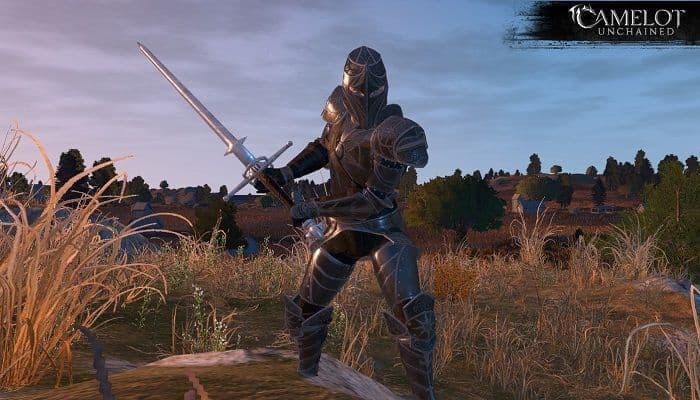
Three realms, one endless war — Camelot Unchained builds its entire MMORPG around Realm-vs-Realm conflict, with no PvE storyline competing for attention. Unchained Entertainment's Mark Jacobs, the des...
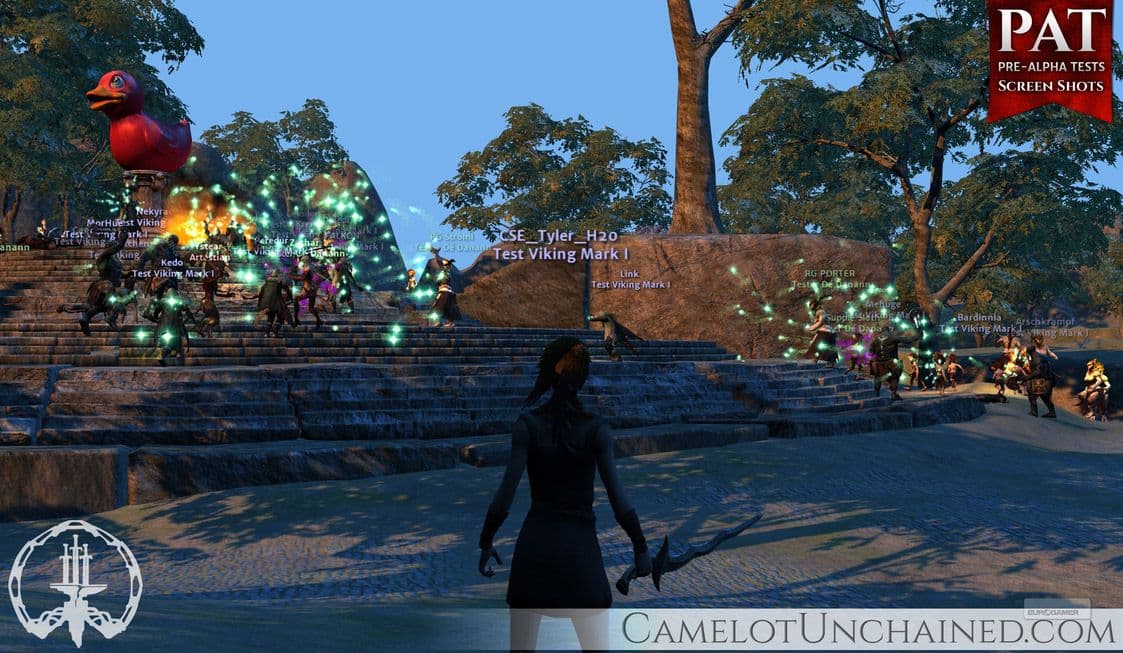
Camelot Unchained is a Realm-versus-Realm MMORPG from Unchained Entertainment (formerly City State Entertainment), the studio founded by Mark Jacobs, the designer behind Dark Age of Camelot. Kickstarted in 2013 and stuck in closed testing for most of the following decade, it finally opened to backers in March 2026 and reached Steam Early Access on June 2, 2026. This Camelot Unchained review sets aside the well-worn jokes about development time and looks at what's actually playable right now — and whether that's enough to justify buying in.
The pitch hasn't changed since the Kickstarter pitch video: three Realms, drawn from Arthurian, Norse, and Celtic mythology, locked in permanent war. A cataclysm called the Veilstorms tore the old world apart, and what's left is fought over by the Arthurians under a reborn Arthur, the Tuatha Dé Danann under the wise Lugh, and the Vikings under Sigurd the Dragonslayer. There's no fourth faction and no neutral ground — you pick a Realm at character creation and that choice is permanent on that server, since Realms can't mix in the same world.
Where the lore mostly stays in flavor text for the average player, the Realm identity does real design work. Each faction gets its own three races with distinct stat leanings — Arthurian Golems lean into raw endurance, Tuatha Dé Danann Luchorpán are built for evasive healing, Viking Jötnar are stat-stacked brawlers — and none of the classes mirror across factions. An Arthurian Blackguard and a Viking equivalent might both be described as archers on paper, but they play, look, and feel like different classes entirely. That's an unusually disciplined way to keep three-sided warfare from collapsing into re-skinned copies of the same five classes, and it's one of the few places where thirteen years of design iteration is visible in a good way.
Character creation in Camelot Unchained asks more of a new player than most MMORPGs do up front. You're choosing a Realm, a race within that Realm, and a class from one of seven archetypes — Heavy Fighters, Healers, Mages, Archers, Assassins, Performers, and the frontline-support Devout — with more than twenty hand-built classes spread across the three factions in the current build. There's no easy undo: pick a server, pick a Realm, and you're committed to seeing that world through the eyes of your chosen faction.
Once in, the loop is deliberately not a quest-marker treadmill. There's no traditional experience bar to grind. Instead, you improve by doing — swing a sword enough and your strength climbs, lean on a given ability and its underlying components sharpen. Progress gets reported back to you once per in-game day through a Daily Report rather than a stream of level-up pop-ups, and Realm-wide bulletins fold your Realm's collective wins and losses into the same feed. It's a quieter, slower kind of progression than the genre defaults to, closer to a skill-based sandbox than a leveling ladder, and it means the first hour looks less like "kill ten boars" and more like wandering your home zone learning what your abilities actually do.
Camelot Unchained's combat runs on a component system rather than a fixed skill list. Abilities are assembled from primary, secondary, modifier, and modal pieces — stack more components onto a skill and you get a stronger effect at the cost of a longer cooldown or a steeper resource hit. It's the game's most distinctive mechanical idea, and it shows up immediately in how classes read: an Arthurian Blackguard leans on Arcane-flavored components and a Siege Stance built for sustained damage, while a Viking Mjolnir stacks area components and shrugs off punishment the more enemies it hits. Each class carries three skill trees, and the game offers a default build or full manual point allocation for players who want to tune their own component loadouts from scratch.
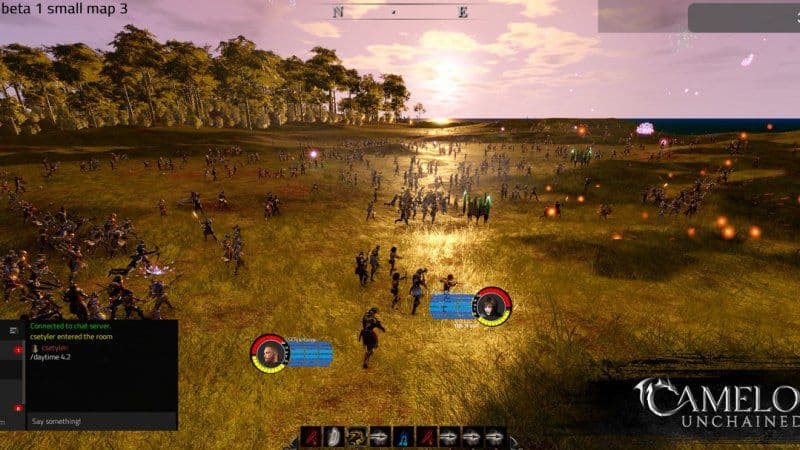
None of this exists to fight monsters. Camelot Unchained is built around Realm-versus-Realm warfare first, and everything about the ability system — the emphasis on sustained fights, the archetypes built around holding lines and breaking them — is tuned for large, organized groups clashing over territory rather than solo questing. Guilds recruit into warbands, warbands coordinate objectives across a contested zone, and a skirmish that starts as two roaming groups trading blows can escalate into a fifty-person brawl if both sides commit reinforcements. When that clicks, it's the kind of large-scale, player-versus-player spectacle this genre rarely delivers cleanly. Getting there, though, currently depends on population — and on a given weekend, that's not guaranteed.
The economy runs on a full gather-refine-craft chain: players pull raw materials from the world through fishing, herbalism, hunting, mining, logging, and prospecting, then refine those materials into usable components before a crafter turns them into gear. Cooking, alchemy, and enchanting are planned additions rather than current systems, so what's live right now is narrower than the eventual vision — but the core loop of mining ore, refining it, and handing it to a dedicated crafter class already functions, and equipment in Camelot Unchained is meant to be made by players rather than looted from a boss or bought from a shop.
Sitting alongside that is the CUBE, a block-based building tool that's existed in some form since the earliest backer builds and is meant to let players construct everything from workshops to full fortresses, complete with decay and destructibility tied into siege warfare. It's one of the project's oldest and most ambitious promises, and it's fair to flag that how deeply it's connected to the live Early Access map — as opposed to functioning as a separate sandbox space — is still a live question the community is actively poking at. Anyone buying in specifically for player-built siege fortresses should treat that system as a work in progress rather than a finished pillar.
Early Access currently ships with three home zones, one per Realm, and three contested zones where the actual RvR fighting happens, spread across more than sixty square kilometers of handcrafted map. That's a real, walkable world rather than a battleground stitched together from placeholder terrain, but it's also a fraction of what a finished MMORPG needs. Unchained Entertainment has been upfront that Early Access is intentionally incomplete: siege combat, additional zones, more archetypes toward a target of ten, and a reworked progression system are all still ahead, with the studio targeting roughly December 2026 to leave Early Access altogether.
The bigger practical catch is availability. Servers currently run on a weekend-only schedule — Friday afternoon through Monday afternoon, Eastern time — with occasional midweek test windows layered in. Launch week on Steam briefly ran the servers around the clock to let the flood of new players in, but that was explicitly temporary. For a veteran backer who's been checking in on Camelot Unchained for over a decade, weekend-only access is a milestone worth celebrating. For someone installing it cold off a Steam listing expecting a persistent world they can log into on a Tuesday night, it reads more like an extended beta test than a launched game — because, by the studio's own framing, that's essentially what it still is.
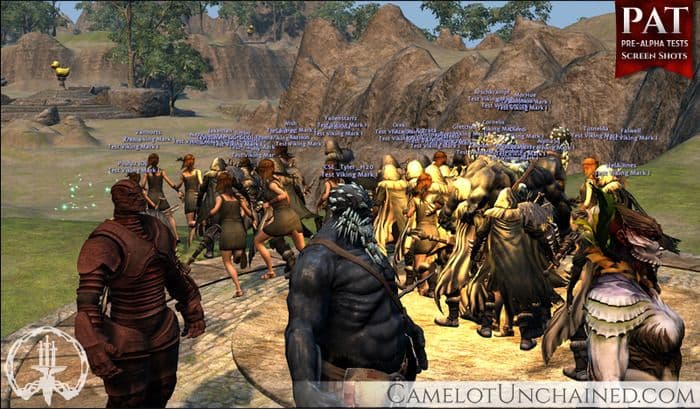
Guilds, parties, and larger warbands are the backbone of how Camelot Unchained expects to be played, and the studio's long-stated ambition — unlimited group sizes, with smaller sub-groups keeping their own identity inside a larger host — is aimed squarely at making mass battles legible rather than a screen full of anonymous health bars. This isn't a game with much for a solo player to do once the home-zone tutorial ends; the entire structure assumes you're logging in with, or to fight alongside, other people. If you don't already have a guild or aren't willing to find one through the game's Discord, the current build will feel emptier than it should.
Is Camelot Unchained pay to win? As it stands, no — there's no gacha, no loot boxes, and no cash-shop gear to speak of. The Early Access entry model is a straightforward buy-in: a Base Edition on Steam for $9.99, giving access to Realm selection, the full class roster, and current content, and a pricier War Unending Edition that guarantees every piece of content added through the rest of Early Access and into full release. Longtime Kickstarter backers already hold War Unending access for free through the studio's own launcher, a small nod to the people who funded this project over a decade ago and, in some cases, are still owed refunds from years of delay.
The studio has also been unusually direct about where monetization is headed: no subscription fee during the current weekend-only phase, but a monthly subscription is planned once servers move to full-time availability, and the studio says it will require players to opt in manually rather than auto-billing anyone. That's a promise worth holding them to rather than taking fully on faith, given the project's history, but as a stated model — buy-in plus an eventual subscription, no pay-to-win gear — it's a more conventional and less predatory shape than most modern MMORPGs land on.
It would be dishonest to review Camelot Unchained without acknowledging why so many people are watching it warily. The Kickstarter closed in 2013. Beta One didn't arrive until 2018. Along the way the studio spun up a second game, Final Stand: Ragnarok, on the same custom Unchained Engine, which drew resources away from Camelot Unchained for years before quietly underperforming and being wound down — and refund requests from backers who'd given up on the project sat unresolved for years at a stretch, souring a sizable chunk of the community in the process. None of that is ancient history to the players who lived through it, and Steam's current review tally reflects some of that skepticism: recent reviews sit in mixed territory while the lifetime score remains largely negative, weighed down heavily by that long backstory rather than by what's live today.
What's different now is that there's finally a real, running game to weigh against that history instead of a decade of promises. The Realm identity is distinct, the ability-component system is a genuinely interesting way to build a class, and the RvR-first design philosophy hasn't been watered down into a more marketable open-world formula the way some long-delayed projects eventually compromise. Whether that's enough to outweigh a decade of missed dates is a fair question with no single right answer — a burned backer and a curious newcomer are going to walk away from the same build with very different verdicts, and both of them would be right.
Here's the honest split: if you're a backer who's been waiting since 2013, you already know whether you're playing this weekend, and nothing in this review is going to change your mind either way. If you're coming to Camelot Unchained fresh off a Steam listing, treat it exactly like what it is — a nine-dollar ticket into an ambitious, unfinished RvR sandbox that's only playable a few days a week, with real strategic depth buried under systems that are still being built in front of you. Come back in December, when the studio's own target for leaving Early Access arrives, and this could read like a very different game. Right now, it reads like the most honest version of Camelot Unchained has ever been: not the MMO that was promised in 2013, but finally, unmistakably, a real one.