 F2P · Live
Lineage 2
Aden's castles never stay in the same hands for long, and Lineage II has built an entire twenty-three-year…
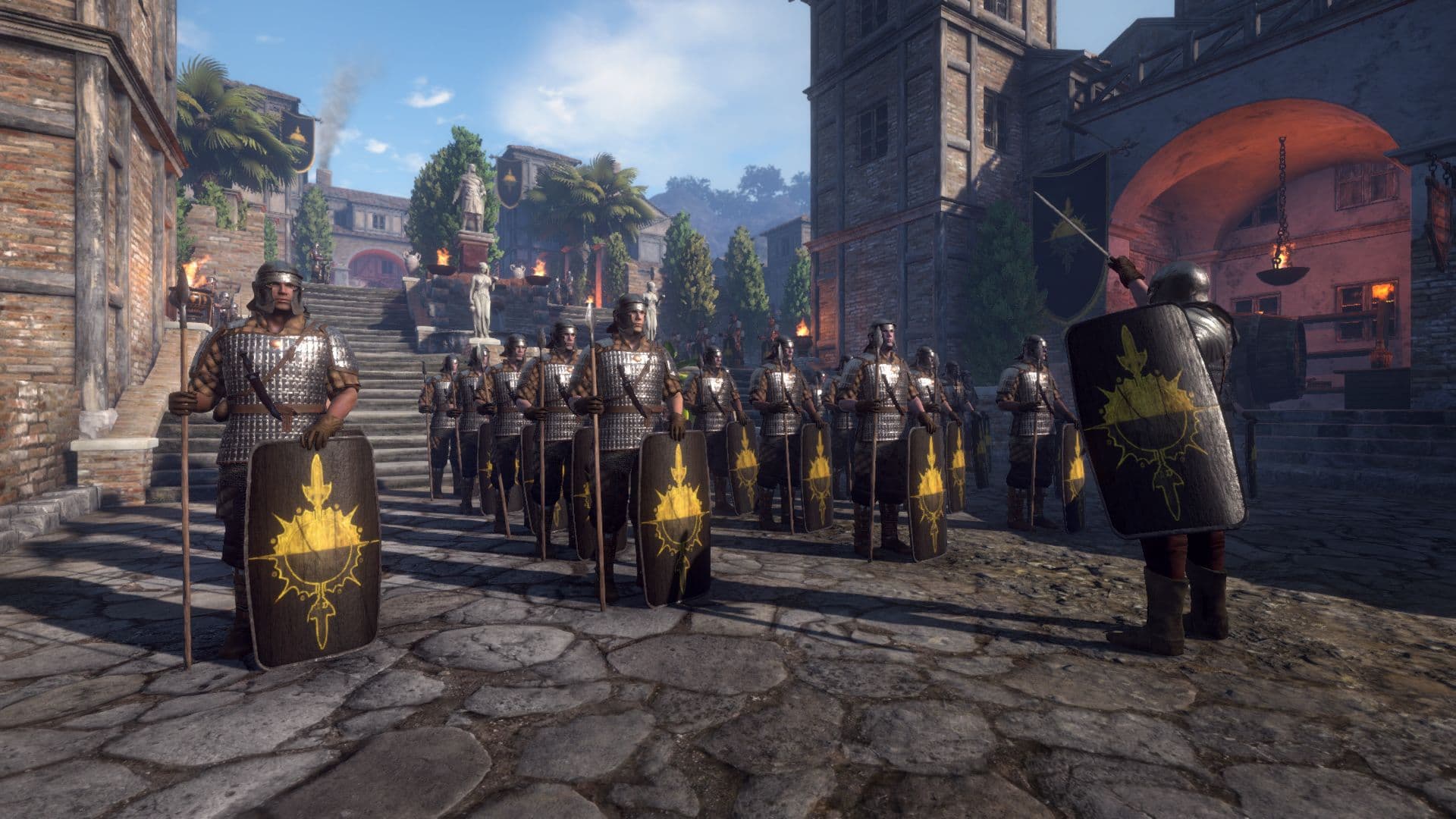
Gloria Victis is a low-fantasy medieval sandbox MMORPG where politics, territory, and siege warfare matter as much as combat skill. Guilds fight for control of castles and national fiefs through a lay...
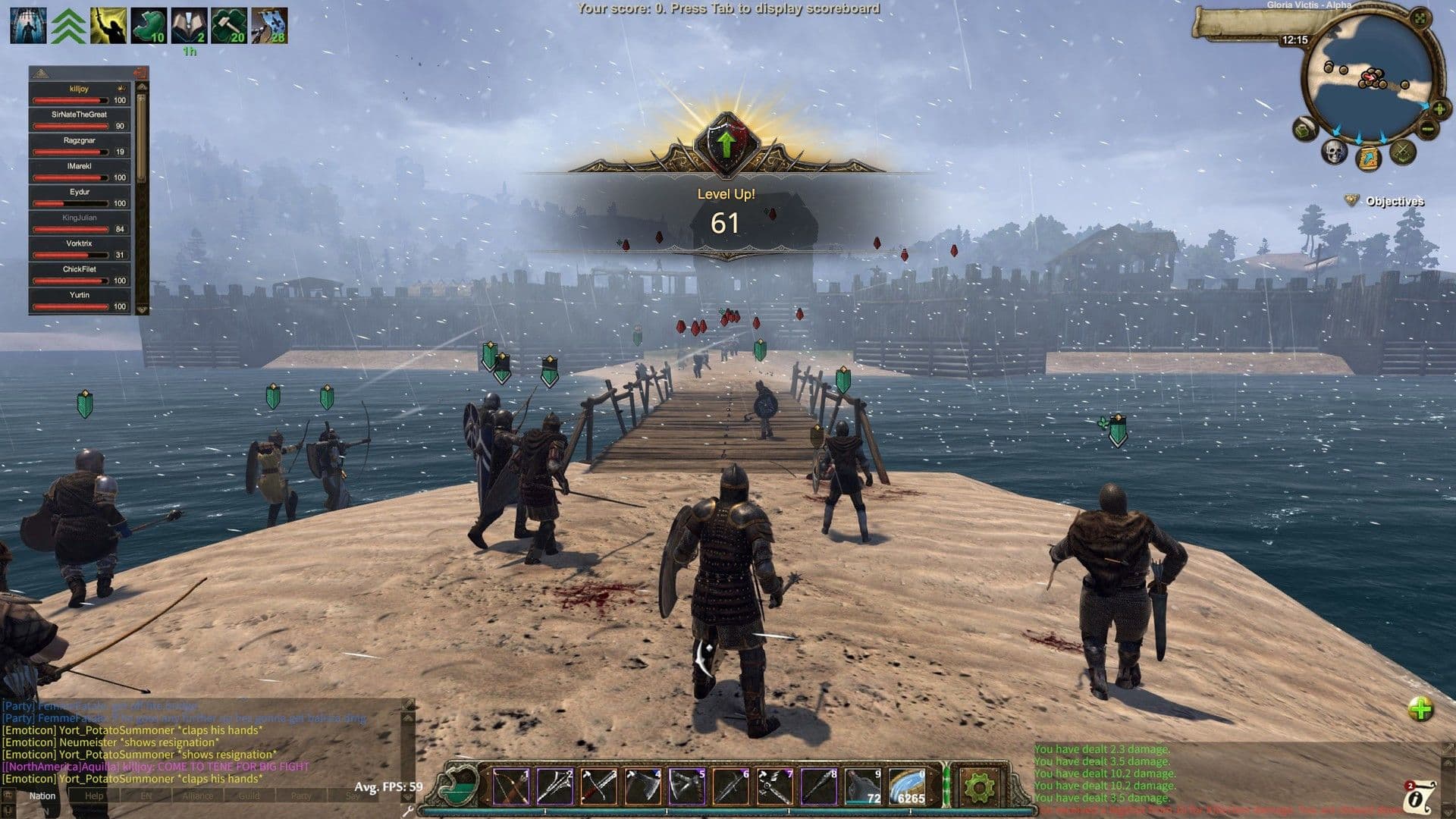
Gloria Victis began as a 2012 passion project from the small Polish studio Black Eye Games, crawled through Steam Early Access from June 2016, reached full release in January 2023, and then shut its doors that same year when the team ran out of money and energy to keep it running. In June 2026, publisher gamigo bought the license and brought it back from the dead as a free-to-play title, under a relaunch season the community has taken to calling Season of the Phoenix. This Gloria Victis review picks up the game where it stands right now: rebuilt economy, reworked onboarding, a guild-siege system still being finished, and a population that's already told its own story since launch day. Rather than walking through the feature list in order, it follows one representative session — login to logout — because that's the shape a sandbox like this actually takes.
The continent is called Stoneholm, and its politics are simple by design: three nations, one shared landmass, and a war that never formally ends. The Midlanders play as the closest thing to familiar medieval Western Europe — knights, farmland, feudal hierarchy. The Ismirs are a Norse-flavored people built around raiding and smithing, favoring bulk and brute strength in a fight. The Sangmar Empire leans Mediterranean and Roman, more interested in discipline and formation fighting than individual heroics. None of it is high fantasy — there's no magic system, no dragons, just a low-fantasy parallel to tenth- through fifteenth-century Europe where the stakes are land, food, and iron. It's a setting built to justify a war, not to tell a story, and it succeeds at exactly that job without overreaching into lore it doesn't need.
What sells that low-fantasy premise on a moment-to-moment basis is texture rather than spectacle. Weather rolls across Stoneholm dynamically, seasons shift the color of the fields and the difficulty of travel, and the map itself is stitched together from real biomes rather than a handful of copy-pasted zone templates — coastal fishing villages give way to interior farmland, which gives way to the kind of dense, foggy woodland where an ambush feels genuinely plausible rather than scripted. None of it is cutting-edge by 2026 standards; CryEngine's age shows in character animation more than in the landscapes it's rendering. But it's consistent, and consistency is what a game built around a persistent, non-instanced war actually needs — the world has to hold up under the same lighting and terrain whether it's hosting a quiet morning of foraging or a fifty-player field battle.
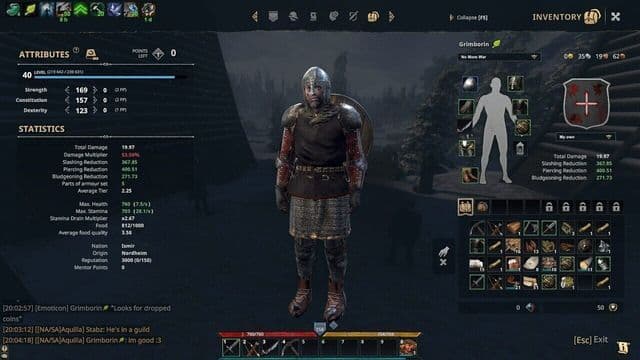
Booting in for the first time, there's no class list to scroll through. Gloria Victis builds a character from three core attributes, a spread of weapon skills, and a set of passive perks, and a short in-game questionnaire suggests one of six starting combat styles based on your answers — duelist, archer, cavalry, and so on — without locking anything in. Pick a nation next; that choice isn't permanent either, since a free nation switch is available before a character hits level 70. From there it's the Path of the Recruit, an onboarding quest chain that teaches the controls (a lot of players' first frustration is realizing the mouse cursor is toggled with a dedicated key, not free by default) and points you toward your nation's capital.
The early hour is deliberately unglamorous. You're handed a gathering tool set — pickaxe, hatchet, sickle, shovel, the herbs and flowers needing none of them — and sent out to collect the raw materials the game's entire economy runs on. A hunger bar sits quietly in the corner the whole time, and it isn't cosmetic: skip meals and your health, stamina, and regeneration all take a hit, which means even a fresh recruit's morning involves a stop at a cookfire before heading into anything dangerous. It's a small detail, but it sets the tone early — this is a game that wants basic survival upkeep to matter, not just combat.
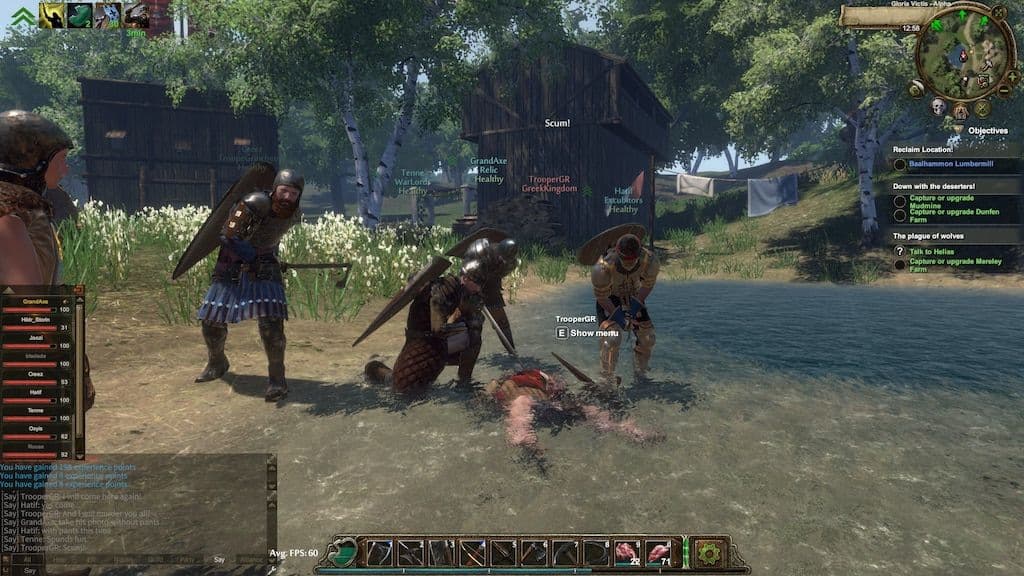
By midday you're actually fighting, and this is where Gloria Victis separates itself from most of the medieval-MMO field. Combat is fully non-target and directional — no tab-targeting, no auto-lock. Every swing has a direction you choose, every block has to be aimed at the incoming attack, and stamina drains with every swing, block, and sprint, so a fight against a competent opponent becomes a real-time negotiation over openings rather than a stat check. Chambering — intentionally taking a hit mid-swing to interrupt an opponent's attack — is a core advanced technique, and kicks can stagger a blocking enemy just long enough to land a follow-up. None of this reads well on a feature list; it reads well the first time a fight against another player goes to a stamina-drained standstill and gets decided by who flinches first.
The honest caveat: that same depth is a wall for anyone used to modern MMO combat conventions. There's no lock-on to lean on, no forgiving hit registration, and losing a fight often feels like a skill gap rather than a gear gap — which is either the appeal or the dealbreaker depending entirely on what you're looking for. Cavalry and archery add their own sub-skills on top, and warband tactics — coordinated group formations rather than solo duels — become the actual metagame once you're fighting alongside a nation instead of against a single opponent.
For players who want their duels to count for something beyond bragging rights, there's a structured layer sitting on top of all that open-world chaos. Ranked arenas track wins and losses outside the main war, and a seasonal Glory system scores nations against each other on a running scoreboard that resets at the end of each season — the current one closes out its final stretch with no further point gains or losses, a deliberate cooldown period before the next season's territory map resets and the fighting starts over. It gives the sandbox something themepark MMOs take for granted: a sense of a clock ticking down toward a result, layered over a war that otherwise has no finish line.
Combat pays the bills in one direction; crafting pays them in the other. There are no boss-dropped superweapons here — the best gear in Gloria Victis is made by players at workstations, using materials other players gathered, refined through professions like blacksmithing, armorsmithing, and cooking. Crafting skill directly affects the quality of what comes out the other end, so a veteran smith turning out superior weapons is a genuinely different economic actor than a novice producing serviceable but unremarkable gear. That's the loop: gather ore and hides in contested territory, haul them back through land your nation may or may not still control, refine them at a workshop, and either equip the result or sell it into a market other players are actually buying from.
Quality isn't binary, either. Push a crafting skill past a recipe's base requirement and the game rolls a chance at a superior result rather than a guaranteed one, so two smiths using the same recipe and the same ore can walk away with meaningfully different swords — one merely functional, the other worth a premium at the next trade post. There's no auction house smoothing that variance into a flat price list; deals happen through player-run shops and direct trading, which means reputation and relationships end up mattering almost as much as raw crafting skill once a guild's economy gets going.
The sharper edge of that loop sits in the Loot Zone, a central high-risk region where death carries a partial-loot penalty — lose a fight there and an opponent can take a portion of what you were carrying. It's not full-loot brutality, but it's enough to make every trip through the zone a real decision rather than a formality, and it's the clearest signal of who this game is built for: players who want their economy to have teeth, not just numbers going up in a menu.
As the session wears toward evening, the war stops being background flavor and becomes the actual objective. Territory control here is non-instanced — castles, forts, mines, and farmland exist on the open map and change hands through real sieges rather than queued instances, and whichever nation holds a location gets the workshops, farms, and area buffs that come with it. Guilds compete for ownership of these captured sites through a points system called Fief points, upgrading whatever their nation wins on the battlefield across several tiers of development — a captured mine or farm starts bare-bones and grows into a fortified, workshop-equipped stronghold only if the guild holding it can keep it long enough to invest in it. That's the tension the whole territory game runs on: holding ground is only half the job, because an undefended upgrade is just an invitation for the next raid. The centerpiece of that layer, once it's fully live, will be State of War — a guild-versus-guild siege mode built around player-constructed castles rather than the nation-level fighting that's active today.
That gap matters more here than it would in a themepark MMO, because territory war is the entire point of the sandbox rather than one system among many. The nation-versus-nation fighting over existing forts and resource nodes is live and functional right now; the guild-owned castle layer that's supposed to sit on top of it is the part still under construction.
Late in a session, the social layer takes over. Guilds in Gloria Victis aren't just chat tags — they're the organizational unit that competes for national location ownership, plans siege logistics, and coordinates the warband tactics that make open-field battles winnable instead of chaotic. An active guild is the difference between farming alone at the edge of contested territory and riding out with a dozen coordinated allies who can actually hold a resource node against a rival nation's raid. Because there's no auction-house convenience layer floating above the world — trade happens through player shops, direct deals, and workshop output — a guild with organized crafters is also, functionally, a guild with an economic advantage over one without.
It's worth placing Gloria Victis next to its closest neighbors for context. Chivalry and Mordhau share its commitment to manual-aim melee combat, but neither carries a persistent world, an economy, or a war that outlasts a single match. Mount & Blade's Bannerlord shares the medieval realism and the feudal power struggle, but it's still fundamentally a single-player or small-scale multiplayer campaign rather than a living, always-on MMO. The closer comparison, oddly, is something like Dark Age of Camelot's three-realm structure transplanted into a directional-combat shell — a small crowd of MMO veterans have been saying exactly that in Gloria Victis's own community spaces since the relaunch, and it's an apt way to describe what the game is reaching for even when its execution still shows its indie roots.
The short answer is no, not in the way that phrase usually gets used. Gloria Victis shifted from a $19.99 buy-to-play title to fully free-to-play with its June 2026 relaunch, and the storefront leans cosmetic — premium skins (including ones returning players can reclaim from before the shutdown), a Glory Shop tied to account progression, and optional starter and mount-themed bundles sold on Steam. There's no purchasable gear tier that outclasses what a skilled crafter can produce, and since combat outcomes lean so heavily on stamina management and reaction time rather than raw stats, spending money doesn't buy a better swing timing. What it does buy is convenience and cosmetics — the predictable trade for a niche sandbox that needs a sustainable revenue model without alienating the hardcore PvP crowd it depends on.
Reception since the relaunch has been genuinely split rather than uniformly positive: Steam's English-language reviews sit at a Mixed 67% positive across roughly six thousand reviews, and the most recent thirty days trend slightly lower, in the high 50s. Population tells a similar story of enthusiasm cooling into a smaller, steadier base — trackers logged a launch-week peak north of four thousand concurrent players, and by mid-July that number had fallen sharply, settling into the hundreds rather than the thousands. For a genre-defining feature set built on non-instanced open-world sieges, that's a real concern for how full the battlefield actually feels on a given night — worth going in with clear expectations rather than assuming launch-week numbers hold.
Here's the blunt version: if you want an MMO that respects your reflexes more than your play-time budget, and you're willing to accept that its biggest promised system is still being built in front of you, Gloria Victis is one of the few medieval sandboxes left actually trying to earn that description. It isn't for players who want guaranteed full servers or a safety net between them and a bad decision in contested territory — it's for the smaller crowd who wanted Black Eye Games' original vision to survive its own studio, and who're willing to fight in a war that's currently better staffed on some nights than others. gamigo gave this game a second life. Whether that life turns into a long one is still being decided by the players logging in to fight for it right now.