 F2P · Live
Lineage 2
Aden's castles never stay in the same hands for long, and Lineage II has built an entire twenty-three-year…
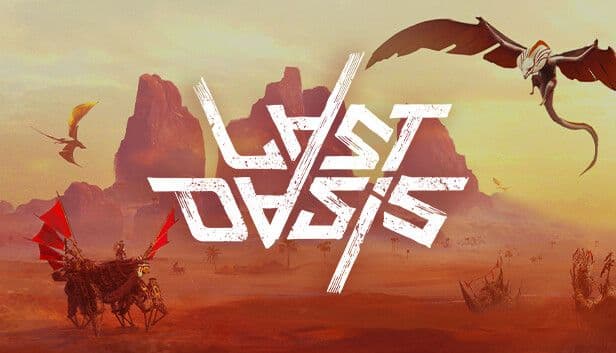
A post-apocalyptic nomadic survival MMO set on a dying Earth that has stopped spinning. Build and pilot massive wooden, wind-powered walkers, flee the scorching sun across a migrating Twilight Zone, m...
Last Oasis is a post-apocalyptic nomadic survival MMO developed by independent studio Donkey Crew, debuting in Steam Early Access in the spring of 2020. The core design team trace their lineage directly to the Mount & Blade: Warband modding scene, having authored the renowned cRPG mod. This background fundamentally forged the project's hardcore DNA: precision-based directional melee combat, high-stakes territorial warfare, and an unforgiving ruleset governing player encounters across an ever-shifting frontier.
The narrative unfolds on a far-future Earth devastated by cataclysm. The shattering of the Moon destabilized the planet’s gravitational balance, halting its axial rotation entirely. Trapped in a tidal lock with the Sun, the globe fractured into two lethal extremes: the sunward hemisphere was roasted into a radioactive desert wasteland, while the dark side froze under absolute zero and permanent blackness. Humanity's sole refuge is a narrow, moving strip of twilight nestled between fire and ice — the Twilight Zone. This habitable belt creeps slowly westward across the planetary surface as Earth completes its annual orbital voyage around the sun.
Civilization adapted to a relentless life on the move. Surviving humans constructed the Flotilla — a colossal floating aerial city that glides continuously along the front edge of the habitable zone. Yet, keeping this vast metropolis aloft demands hundreds of tons of timber, mineral ore, and fresh water. Players take up the mantle of a nameless Nomad cast down from the Flotilla onto the ruined surface. The directive is stark: forage across temporary frontier zones, brave hostile fauna and rival tribes, engineer mobile landships, and ferry resources back to the Flotilla before the encroaching solar inferno turns the terrain into glass.
The game's fundamental twist redefines conventional survival sandbox design: in Last Oasis, settling down in a permanent stone stronghold is impossible by design. Every oasis spawned along the migratory corridor carries an inescapable expiration date. Within days or weeks, each map is swallowed by the solar burn. The only path forward is perpetual migration, forcing players to pack their livelihoods onto mobile wooden platforms and flee toward the western horizon.
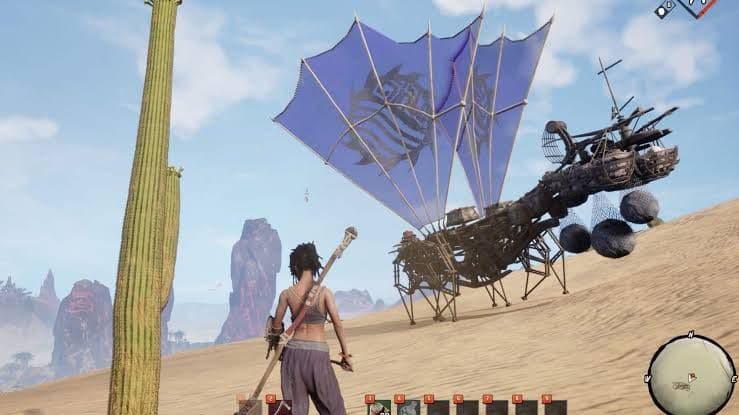
The definitive signature feature of Last Oasis, setting it apart from legions of cookie-cutter survival craft games, is its fleet of walking landships (Walkers). Eschewing wheels and steam engines, the developers embraced a kinetic wood-punk aesthetic inspired by Dutch artist and kinetic sculptor Theo Jansen’s celebrated Strandbeest — multi-legged mechanical creatures capable of walking across sandy beaches propelled solely by the wind. In the game, this engineering wonder becomes the center of gravity: gargantuan wooden arachnids and reptilian behemoths clatter to life through intricate articulated linkages, gear trains, and billowed canvas.
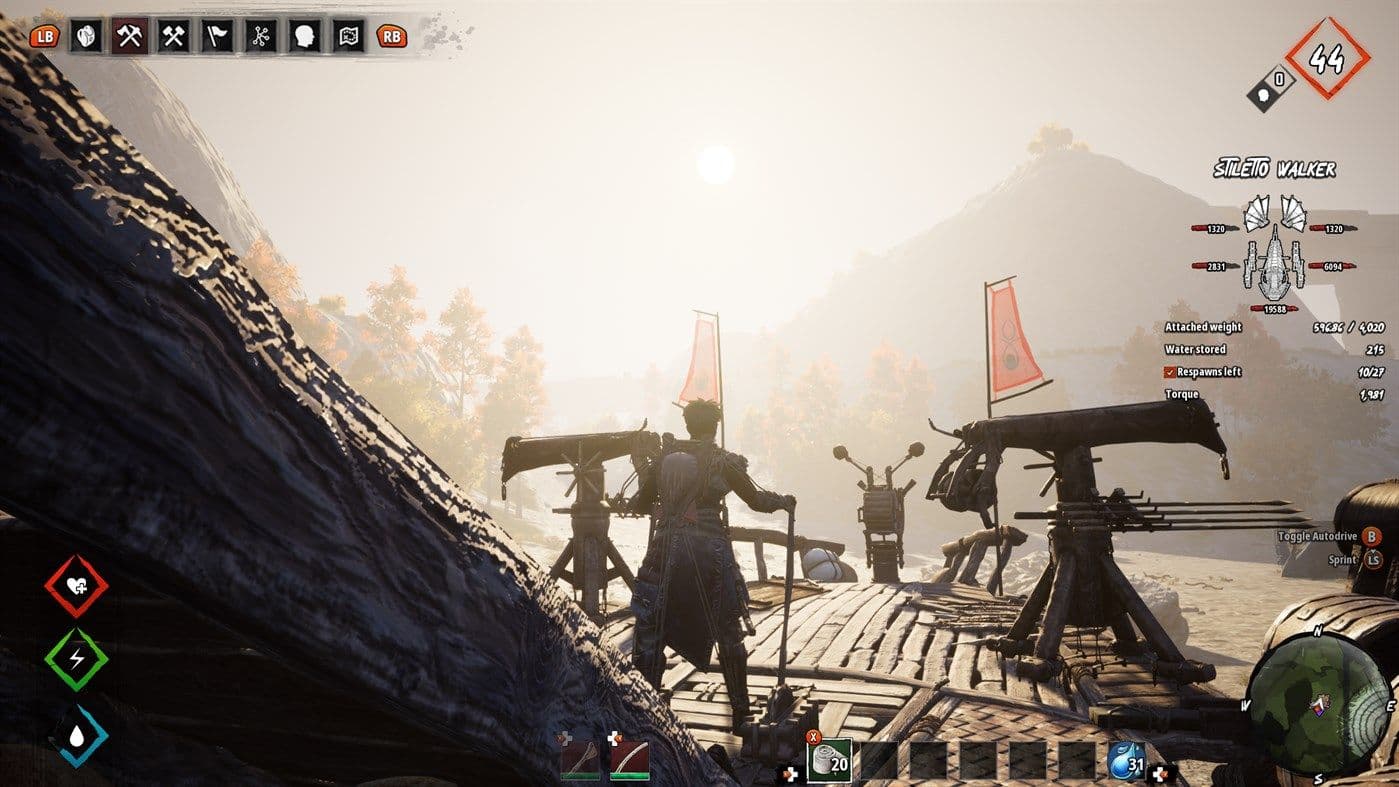
A walker is far more than mere transport: it is a mobile homestead, a cargo vault, a deployable industrial refinery, and a heavily armored warship wrapped into one. Assembled at the specialized Fabricator workstation, the roster caters to lone wolves and sprawling clan armadas alike. Solo scouts rely on the nimble «Firefly» (Firefly) or the agile, three-legged «Spider» (Spider), capable of scaling sheer cliffs and traversing narrow canyons where larger vessels cannot follow. Mid-tier nomads graduate to the swift raiding corvette «Stiletto» (Stiletto), the high-masted speedster «Falco» (Falco), or the workhorse «Buffalo» (Buffalo), whose immense cargo bay forms the backbone of regional water and ore logistics. At the apex dwell titans of war: the heavily reinforced «Tusker» (Tusker), the impregnable siege turtle «Silur» (Silur), and the majestic «Schmetterling» (Schmetterling), designed to glide across open sands on sweeping wooden wings.
Locomotion is governed by authentic sailing aerodynamics. Like maritime vessels, walkers must catch favorable gusts in their deployed sails (Wings) to reach top speed, kicking up blinding rooster tails of desert dust. Tacking against headwind requires mechanical propulsion powered by stored kinetic energy, known as torque (Torque). Generated through wind turbines or accumulated during high-speed downwind sailing, torque can be routed to leg transmissions for burst acceleration through windless valleys or diverted to drive onboard deck machinery.
Modular customization transforms every chassis into a bespoke war machine. Deck space and hardpoints support reinforced wooden and bone hull plating, enclosed cockpits, automated harvesters that sweep up fiber while driving, and an array of naval weaponry: heavy ballistas, repeating scatterguns, and winches that turn open-desert pursuits into brutal naval broadside engagements on dry land.
The catch lies in the severe vulnerability and steep replacement cost of these mechanical leviathans. Walkers are fully destructible: ballista bolts splinter chassis legs, scattergun pellets shred wings, and heavy ordnance breaches hull armor. Losing a flagship deep inside hostile territory without spare timber for emergency repairs results in immediate stranded disaster. Furthermore, the sheer bulk of capital walkers makes them juicy targets for boarding parties and renders navigating dense forest groves a pilot’s waking nightmare.
The open-world topology of Last Oasis hinges on a dynamic, interconnected server grid unlike anything seen in conventional MMO design. Instead of a monolithic, permanent landmass, the frontier takes the form of a roaming archipelago of regional instances known as oases (Oases). Spanning dozens of square kilometers each, these maps are governed by the inexorable ticking of an orbital clock. As Earth journeys around the sun, the scorching solar front encroaches from the east. Temperatures surge into incinerating hundreds of degrees, setting forests ablaze, evaporating lakes, and vitrifying sand dunes into glass. Every oasis is doomed from inception: its lifespan is strictly limited to days or weeks before it burns off the world map forever.
This impermanence fundamentally inverts the survival genre’s base-building trope, introducing an urgent extraction loop. Nomads cannot construct permanent feudal keeps; instead, they must keep a vigilant eye on the server’s countdown timer. As the fiery inferno paints the eastern horizon in apocalyptic crimson, crews dismantle camps, load gear, and drive their convoys toward the map border. Crossing the threshold packages the walker and its packed holds into a secure inter-server lobby, granting access to the global travel map to chart a course deeper into the safe Twilight Zone.
Regional progression is stratified across distinct biomes and risk profiles. Novice scavengers take their initial steps within «Cradles» (Cradle) — lush, temperate grasslands dotted with light bamboo groves and governed by opt-in PvP rulesets where packed walker inventories are safeguarded from catastrophic loss. Venturing westward unlocks arid slot canyons, treacherous dune seas plagued by blinding sandstorms, and high-altitude basalt mesas rich in iron ore, sulfur, and volcanic obsidian. In the late-game, contested event oases spawn intermittently, sparking full-scale fleet wars over forgotten vaults containing ancient technological schematics.
The lifeblood keeping this entire migratory economy moving is purified water (Water). In an arid wasteland, moisture serves three essential functions. First, it represents biological survival: characters dehydrate rapidly when sprinting beneath direct sunlight or wearing heavy armor. Second, water is the literal fuel for inter-server navigation on the world map: heavier hull tonnage and fuller cargo holds demand exponentially greater liters of water to execute an oasis hop. Finally, water functions as the universal currency of the Flotilla, used to lease long-term orbital storage vaults and trade for high-end schematics.
The catch of this nomadic cycle is relentless logistical stress. Missing the evacuation deadline before an oasis is incinerated wipes out everything left behind: ground camps, deployed machinery, and un-packed landships vanish into ash. Should your crew run dry of water while en route to a border crossing, your walker stalls out in the desert sands, leaving you stranded as easy prey for circling raiders or the onrushing solar wall.
The opening moments of Last Oasis adhere to survival sandbox orthodoxy while instantly establishing an unforgiving tempo. A freshly spawned nomad awakens amidst sun-bleached dunes and thorned scrubland stripped of gear, clutching an empty waterskin beneath a plummeting hydration bar. The initial directive is pure manual labor: snapping dry branches with bare hands, peeling bark from stunted trees, harvesting wild plant fibers, and chiseling stones from surface outcroppings. From this modest forage, players fashion their first rudimentary survival kit — a crude stone hatchet, a pick, and a bone club to fend off opportunistic wild fauna.
Quenching dehydration takes precedence over every predatory threat. In the early tiers, scavengers rely on improvised harvesting: slashing fleshy aloe leaves, crushing cactus pulp by hand, or assembling makeshift dew catchers that condense morning mist. Only later do nomads unlock industrial purifiers capable of boiling brackish swamp runoff and saline ocean brine into pristine drinking water, stored securely within heavy wooden casks.
The true turning point in the core loop arrives with the mastery of textile weaving. Raw plant fiber is processed on a manual loom into nomad cloth (Nomad Cloth). This composite fabric is the indispensable cornerstone of the game’s tech tree. Without it, you cannot stitch sails, tailor protective desert garb, or bind the articulated wooden joints of chassis frames. Once a nomad amasses several hundred bolts of cloth, seasoned hardwood logs, and refined resin, they deploy a field Fabricator and lay the keel of their very first «Firefly» (Firefly) walker. The second the machine rattles to life, unfolds its spindly legs, and catches the desert breeze, the experience transforms: you cease being defenseless prey on foot and become the captain of your own land vessel.
Base construction in Last Oasis diverges along two distinct philosophical paths: static versus mobile. Experienced veterans rarely invest heavy resources into sprawling stone fortresses anchored to the ground, fully aware that the sun will claim them within days. Instead, the walker's open timber deck becomes a masterclass in compact modular efficiency. Every square foot of planking is optimized, housing locked storage lockers, campfires, charcoal kilns, smelters, ammo crates, and respawn bedrolls that anchor crew members back to the ship upon dying in battle.
Character progression adheres to a clean, class-free system. By felling hostile beasts, gathering rare minerals, and uncovering forgotten landmarks, characters earn levels to distribute attribute points across core physical traits. There are no predetermined archetypes; each player freely tunes their balance between maximum health, stamina reserves, melee damage output, sprint velocity, and inventory carry capacity. Maxing out encumbrance is vital for solo resource gatherers, whereas boarding marine specialists funnel their stats into raw sprint speed and deep stamina pools to fuel relentless strike chains.
The catch of early progression lies in acute time pressure and naked vulnerability. While a solo nomad slowly hauls heavy logs across open ground to their crafting rig, they are completely exposed: a passing raider on a faster walker can flatten the construction site in seconds. Moreover, mishandling initial reserves of timber and cloth risks stranding an unpowered walker directly in the path of a choking dust storm, obliterating hours of hard-won progress in a heartbeat.
While walkers establish the strategic identity of Last Oasis, second-to-second adrenaline is dictated by the grappling hook (Grappling Hook). Far from an automated, button-prompt ledge assist commonly found in mainstream action games, this is a fully realized, momentum-driven physics tool. Studio Donkey Crew engineered one of the most mechanically tactile and rewarding spatial traversal systems in multiplayer history, rivaling dedicated web-slinging and aerial movement simulators.
Tether dynamics adhere strictly to pendulum physics. Firing a hook into an overhanging cliff face, the canopy of an ancient baobab tree, or the boom of a passing landship allows players to adjust rope length dynamically in mid-swing. Paying out slack broadens your centrifugal arc for maximum horizontal glide, while rapidly reeling in generates explosive vertical lift. By chaining swings, timing releases at the parabolic zenith, and re-anchoring on the fly, an expert nomad can slingshot across deep sandstone chasms at velocities easily outpacing a galloping scout walker.
Within the survival loop, the grappling hook obliterates vertical constraints. Scavengers scale sheer basalt pinnacles to pillage rare bird nests and tap inaccessible cliffside ore veins, vault clear over packs of ravenous desert predators, and arrest lethal freefalls into canyon rifts by firing a desperate lifeline into stone a split-second before ground impact. Yet the tool reaches peak glory when interacting with moving machinery: chasing down a full-throttle friendly cruiser, latching onto its stern strut, and hauling yourself aboard through a boiling sand wake is an unrivaled thrill.
In PvP encounters, the grappling hook elevates skirmishes into cinematic swashbuckling boarding raids. Attackers are not restricted to smashing through reinforced side armor; instead, an assault marine can launch a hook toward an enemy ship’s masthead, swing across the gap on a high arc, and touch down directly behind the enemy helmsman with a drawn scimitar. Defenders must actively sweep their airspace, shredding incoming boarders with point-blank scattergun blasts or slicing taut ropes with well-timed blade strikes before enemy boots strike the timber deck.
The dark side of this aerial ballet is zero margin for error. Misjudging a release angle at terminal velocity turns your character into a smear on the desert floor (Fall Damage). Furthermore, maintaining tension drains the character’s stamina bar: exhausting your pool during a deep gorge crossing causes your grip to fail instantly. Finally, a nomad swinging through predictable arc trajectories possesses minimal lateral evasion, rendering them an easy target for enemy ballista gunners and crossbow snipers.
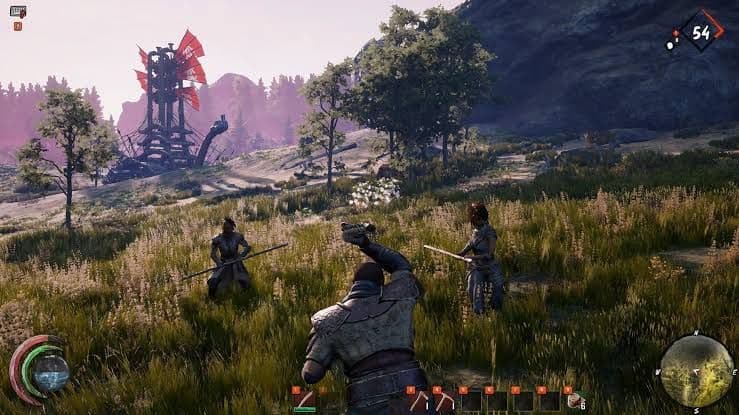
The combat engine of Last Oasis is an unapologetic love letter to hardcore medieval melee slashers like Mount & Blade, Chivalry, and Mordhau. Rejecting the target-lock mechanisms and passive hotbar rotations endemic to traditional MMORPGs, Donkey Crew engineered an authentic four-directional combat system (Directional Combat). Every strike and parry demands deliberate mouse movement across four quadrants: left swing, right swing, overhead chop, and forward thrust.
Dueling is a high-speed game of animation reading and nerve. To successfully neutralize an incoming attack, you must match your defensive stance precisely to the angle of the oncoming blade. Seasoned duelists treat melee encounters like kinetic speed-chess: executing deceptive feints (Feints) to bait out premature parries, rotating the torso into swings to accelerate hit registration (Accels) or turning away to delay impact timing (Drags). Masters rely heavily on chambering (Chambering), launching an identical mirrored strike into an incoming blade to parry and riposte in a single fluid motion.
Arsenal selection shapes tactical roles aboard land vessels and inside confined cabin spaces. Curved sabers and broadswords excel in rapid-fire close-quarters scuffles below deck. Heavy woodchopper axes inflict devastating structural damage against hulls and splinter defensive shields in two crushing blows. Long polearms, pikes, and glaives provide essential standoff capability, enabling defenders to stab leaping boarders out of midair before their feet touch the deck. The melee kit is rounded out by throwing axes and clay slingshots capable of chipping away enemy stamina at mid-range.
When capital walkers clash, hand-to-hand duels expand into epic desert naval engagements across surging dunes. Heavy cruiser decks serve as rolling artillery platforms equipped with specialized ordnance. Armor-piercing ballistas (Ballista) punch through reinforced hull plating, siege catapults (Catapult) bombard fortifications with fire bombs, and multi-barrel scatterguns (Scattergun) sweep exposed decks with lethal buckshot. Tactical dominance hinges on net throwers (Net Thrower): landing a weighted cable into the leg linkages of a fleeing hostile vessel snarls its kinetic transmission, dead-stopping the ship and leaving it paralyzed for assault boarding.
The downside of this uncompromising combat model is a brutal learning curve compounded by latency sensitivity. In an encounter between two evenly geared fighters, the nomad with superior directional blocking and footwork will claim victory ten times out of ten — high-tier chitin plate cannot mitigate three clean, unblocked axe strikes to the skull. However, during moments of high-ping packet variance or server-side desync (Desync), tight millisecond blocking windows destabilize, turning precision swordplay into an infuriating lottery.
Progression in Last Oasis is deliberately structured to prevent players from climbing the technological ladder merely by harvesting lumber and stones in safety. The sprawling tech tree (Tech Tree) is strictly gated by tiers, where advanced schematics for mid-tier corvettes, chitin composite armor, and siege artillery remain locked behind research thresholds. To graduate from a rickety «Firefly» to a battle-ready «Stiletto» or a dreadnought «Tusker», nomads must secure physical repositories of forgotten knowledge — research fragments (Fragments) and ancient tablets (Tablets). This mechanic forces players out of isolated frontier corners directly into highly contested hot spots.
The primary source of entry-level knowledge comes from the planet’s feral indigenous inhabitants — the simian Rupu. These vicious ape-like humanoids erect sprawling tribal compounds out of bleached bones, wicker, and timber around sacred tribal totems scattered across every oasis. Clearing Rupu encampments represents the core PvE loop of early and mid-game play. Encounters are chaotic: agile slingers pepper intruders with stone projectiles from perimeter watchtowers, heavy club-wielders charge aggressively, and Rupu Shamans (Rupu Shaman) lob explosive, toxic concoctions that ignite walker decks. Rasing their tribal shrines rewards nomads with locked loot caches brimming with scavenged components and vital technology fragments.
Ascending into the higher technological strata requires solid clay and obsidian tablets forged by an extinct civilization. Securing these artifacts demands venturing into the heart of high-threat oases. Players must either brave ancient ruins teeming with lethal traps and environmental hazards or operate industrial research fabricators that synthesize raw fragments and purified water into completed tablets over lengthy, vulnerable refinement cycles. These synthesis hubs naturally become zones of extreme tension, sparking fierce skirmishes between rival scouting parties over every newly minted blueprint.
The pinnacle of cooperative PvE ambition is the roaming world boss — the colossal desert worm Okkam (Okkam). Gliding through deep sand dunes like a mythical leviathan, this apex predator can bite an unprepared scout walker clean in half. Hunting Okkam requires an entire armada working in coordinated harmony: fast harpoon skiffs flank the monster to tether its thrashing body with heavy anchor cables, pinning it in place while heavy artillery cruisers pound the vulnerable soft tissue between its chitinous belly plates. Successfully felling the beast yields legendary chitin scales and pristine organ fluids required to fabricate top-tier hull reinforcement.
The risk underlying this research race is physical itemization. Unlike abstract XP pools stored safely on server databases, unlearned fragments and tablets exist as physical loot in character backpacks or walker cargo holds. Falling victim to a highway robbery or a well-placed boarding ambush on the return trek from a Rupu bastion instantly transfers hours of dangerous research progress into enemy hands.
The social architecture of Last Oasis was forged from the ground up for high-stakes guild politics and territorial warfare. The game’s clan system provides an intricate framework for communal logistics: shared asset banks, granular permission hierarchies for steering tillers, ballistas, and cargo chests, as well as distinct operational roles within crew rosters. Operating a capital walker solo is an exercise in futility: while the captain steers the hull, gunners align heavy artillery, riggers adjust sails for downwind boosts, and carpenters patch structural breaches with timber planks in the heat of incoming fire.
The primary catalyst for large-scale conflict is the territorial control mechanic. Within unaligned oases, a clan can plant and activate a territorial totem to claim sovereignty over the map. Maintaining ownership turns the oasis into an automated tributary state: the holding guild levies a percentage tax on all timber, stone, and rare minerals harvested by neutral nomads within the sector, while also taking a cut of transactions conducted at local trading posts. Maps harboring ancient tablet fabricators or obsidian quarries naturally evolve into militarized fortresses, bristling with wooden palisades, elevated watchtowers, and stationed patrol ships.
Yet, this unchecked freedom gave rise to the game’s defining historical crisis — the trauma of «mega-zergs». During the early months of Early Access, the official servers were engulfed by massive multi-hundred-player alliances. These monolithic coalitions locked down entire server clusters, deploying cordons of capital cruisers at cross-border map transitions. Solo scavengers and small trios were systematically eradicated: their light walkers were bombarded to splinters on sight, and extraction routes were barricaded, driving a massive exodus of casual and semi-hardcore players.
Faced with an existential threat to their player base, Donkey Crew initiated severe structural interventions. The studio introduced dedicated cap-restricted servers (Clan Cap) — offering 5-man, 10-man, and 20-man roster ceilings where formal alliance mechanics were disabled. To shelter peaceful nomads, developers added protected sanctuary oases boasting immunity from walker destruction and non-consensual PvP, carving out space for casual crews to master core crafting loops in peace.
The reality of clan warfare remains a brutal war of attrition. Maintaining an armada of dreadnoughts demands staggering quantities of water and constant replacement parts, turning guild membership into a demanding second job of non-stop harvesting. Furthermore, complacency invites disaster: an alert enemy commando unit equipped with grappling hooks can board a moored flagship under cover of night, assassinate the watch, and burn the vessel to its frame minutes before dawn.
The development trajectory of Last Oasis represents one of the most volatile and instructive case studies in the modern MMO landscape. Its arrival in Steam Early Access in March 2020 was a meteoric triumph: the game captured the global top-seller charts, attracted tens of thousands of concurrent viewers across streaming platforms, and mobilized established guilds eager for a novel sandbox paradigm. However, that unprecedented surge broke the backend architecture within hours: the master server collapsed under connection strain, locking thousands of nomads into infinite authentication queues.
Faced with technical catastrophe, Donkey Crew took an unprecedented step: the studio publicly acknowledged their server shortcomings, took the entire game offline for seven days to rebuild the networking stack from scratch, and offered unconditional refunds to all purchasers regardless of hours played. This remarkable transparency won widespread community goodwill. Following the reboot, the initial three seasons marked a golden age: thousands of landships traversed the migrating frontier, generating legendary cross-server naval campaigns.
Yet subsequent seasons endured severe game-design turbulence. The most divisive turning point arrived with the fifth season (Season 5: LSS). In a bid to protect casual nomads and temper oppressive raiding, the developers executed a radical overhaul: severely gating walker progression, mandating static ground base fortification, and reorienting the core loop toward a sluggish PvE grind. The veteran community rejected the update furiously, decrying the loss of the game’s core identity — its rapid nomadic pulse and wind-powered naval romance. Player counts cratered to historic lows as the studio shifted primary development resources toward their medieval settlement title, Bellwright.
Just as the project seemed relegated to the graveyard of abandoned sandbox ambitions, the team mounted an unexpected comeback in early 2026 with the debut of Season 6. The game adopted a cyclic chapter cadence (Chapter System) featuring structured eight-week server resets, restoring the thrilling land rush dynamics of early wipe cycles. The subsequent release of Chapter Two cemented this return to roots, polishing melee hitboxes, rebalancing water economics, and re-establishing walkers as the unquestioned rulers of the battlefield.
The asterisk on the game's current revival is its persistent niche status. While Season 6 successfully reunited a passionate core community, the title remains in Early Access under the stewardship of a small, split-resource team. The Xbox console edition remains stalled due to certification hurdles, and mandatory bi-monthly wipes, while essential for economic vitality, inherently alienate players seeking multi-year asset accumulation.
From an engineering perspective, Last Oasis is powered by Unreal Engine 4, a framework that dictates both its aesthetic triumphs and its underlying performance bottlenecks. Visually, the game achieves striking desert grandeur: wind-swept sand dunes cascade realistically beneath articulated walker legs, dynamic dust storms collapse visibility down to mere paces, and rays from the dying sun break dramatically through billowed sails. However, the primary computational weight falls squarely on the central processor and physics subsystems rather than graphical rendering.
Every walker in the game represents a complex kinematic assembly: dozens of mechanical joints, drive shafts, crankshafts, and modular deck stations are computed in real time. When three opposing clan flotillas collide inside a narrow canyon — with five capital cruisers per side exchanging hundreds of ballista bolts, catapult stones, and grappling lines — the physics thread encounters intense computational peaks. In such clashes, frame rates can buckle even on high-end multicore processors with high clock speeds. Maintaining fluid performance requires at least 16 GB of dual-channel system memory and deployment on a Solid State Drive (SSD) with 60 GB of space; spinning HDDs introduce jarring hitching during rapid zone transitions.
Network routing across European server clusters maintains stable pings between 45 and 70 ms for EU and CIS nomads, providing sufficient latency headroom for reliable melee parries. For handheld enthusiasts, the game runs on Steam Deck via Proton, delivering a respectable 35–45 frames per second on medium settings; however, operating a directional melee system and grappling hook on dual analog thumbsticks proves less agile than a dedicated mouse-and-keyboard setup.
Monetization remains refreshingly ethical by modern gaming standards through a classic Buy-to-Play model. A single purchase on Steam grants unrestricted access to all current and future content without mandatory monthly subscriptions, seasonal battle passes, or microtransaction storefronts selling stat boosts (Pay-to-Win). In the dunes of the Twilight Zone, a nomad's standing is determined entirely by piloting skill, combat reflexes, and crew cohesion.
In 2026, Last Oasis stands as a singular, audacious, and uncompromising achievement that weathered existential crisis to find renewed purpose in its sixth season. If you crave a distinctive wood-punk aesthetic, long to pilot wind-powered walking dreadnoughts across shifting dunes, appreciate skill-based melee combat in the vein of Mount & Blade, and welcome the poetic grit of perpetual migration before an encroaching solar inferno — it offers an experience unmatched anywhere in the MMO medium. Yet, if the thought of bi-monthly wipes, full-loot piracy, and steep combat learning curves fills you with dread, the unforgiving sands of the Twilight Zone are best left uncharted.