 F2P · Live
Lineage 2
Aden's castles never stay in the same hands for long, and Lineage II has built an entire twenty-three-year…
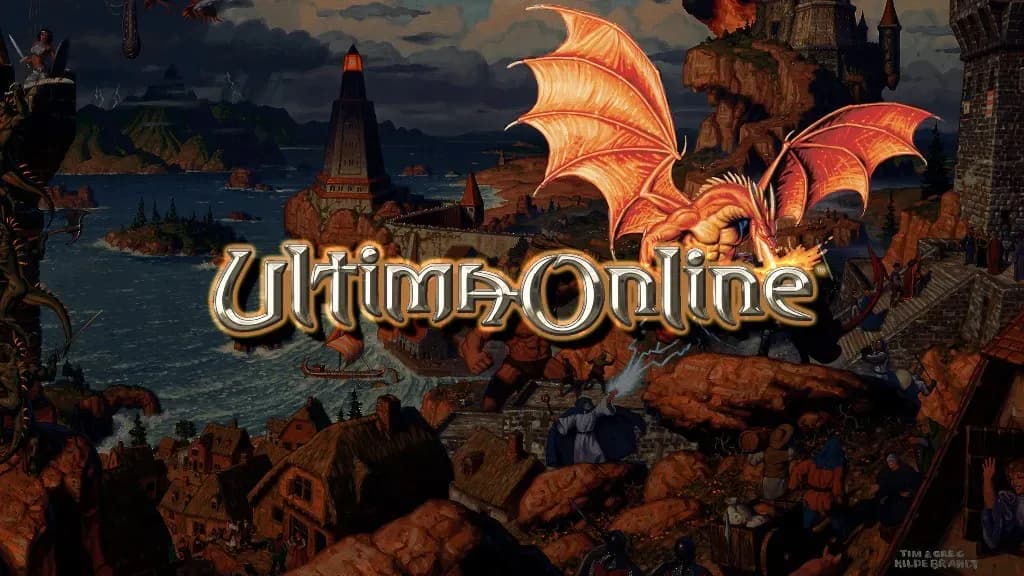
Ultima Online launched in 1997, predates the term "MMORPG" itself, and is still adding new content today, currently under Broadsword Online Games, who've kept the game going since 2014. Set in the wor...
Ultima Online is a sandbox fantasy MMORPG originally built by Origin Systems and released on September 24, 1997, making it one of the first graphical MMORPGs to find mass commercial success and one of the games that gave the genre its name. Electronic Arts still owns and publishes it, while day-to-day development has belonged since the mid-2010s to Broadsword Online Games, a small studio founded by former Mythic Entertainment co-founder Rob Denton that also maintains Dark Age of Camelot. Twenty-nine years on, Ultima Online is still a live, subscription-funded world receiving quarterly content publishes, and this Ultima Online review looks at what that longevity actually feels like to play through in 2026, not just what it used to mean in 1997.
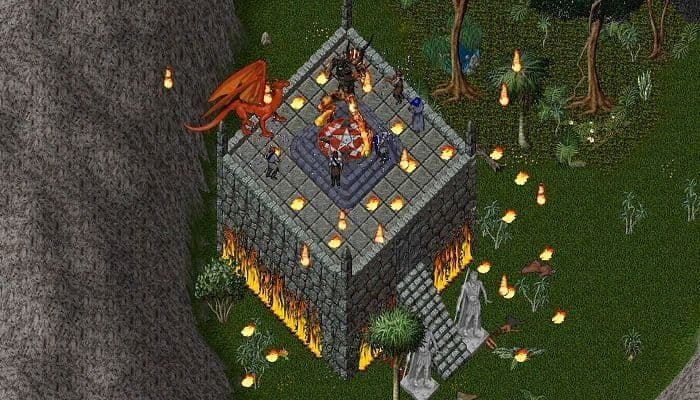
Britannia predates Ultima Online itself — Richard Garriott had already spent a decade building the world across the single-player Ultima series before turning it into a shared space. The result is a setting with unusual moral texture for an MMORPG: the Eight Virtues (Honor, Compassion, Honesty, and so on) aren't lore trivia, they're an actual in-game system tied to shrines, quests, and a title your character can earn. Layered on top of the original map are entire additional lands added by later expansions — Ilshenar, Malas, Tokuno Islands, Ter Mur — each with its own visual identity, from volcanic wastelands to a Japanese-inspired archipelago. None of it was designed around a single art director's vision; it was designed in the way a real city gets built, one expansion and one committee decision at a time, and the seams show if you look for them. They rarely bother anyone who's actually playing.
There's no class-selection screen in Ultima Online, and that absence is the entire pitch — the game runs on a skill-based, classless system instead. New characters choose a handful of starting skills from a shared pool of roughly fifty — swordsmanship, magery, tailoring, animal taming, whatever — and everything from there is built by use, not by menu. A character can pour points into seven skills and stop, or spread them thin across a dozen; the only hard limit is a 700-point skill cap, meaning true mastery of everything is mathematically impossible and every build is a set of trade-offs a player chose rather than one a designer assigned. New players land in a starting city, get a short guided introduction to the interface, and are then, functionally, on their own in a world that doesn't scale itself around them.
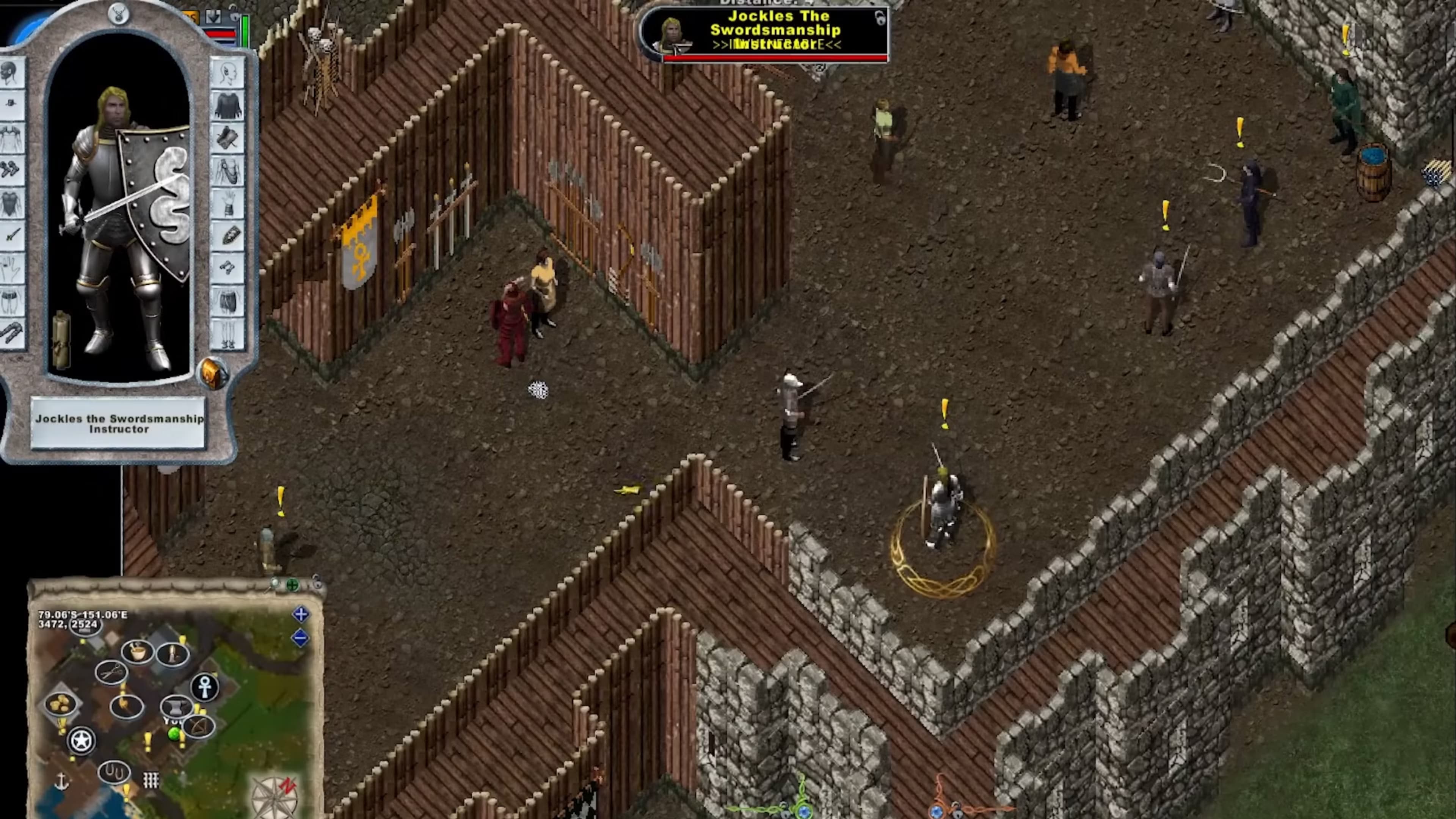
That freedom is also the game's first real obstacle. The interface — inherited largely intact from the original 1997 client, even in its modernized Enhanced Client form — throws hotbars, context menus, paperdoll equipment slots, and a skill list at a new player with almost no hand-holding about which of the fifty skills actually work well together. A returning veteran reads that as charming density. Someone who has never touched the game reads it as a control panel with the labels removed, and the honest truth is closer to the second reading for anyone under thirty who grew up on quest-marker MMORPGs.
Skill gain in Ultima Online happens through repetition with a chance of failure baked in — you learn swordsmanship by swinging a sword and sometimes whiffing, you learn mining by swinging a pickaxe into rock that occasionally yields nothing. It's blunter than a modern crafting tree, but it produces a specific, satisfying rhythm: the numbers creep up in real time while you're doing the thing, not while you're reading a quest log. Crafting runs on the same logic. A blacksmith mines iron ore, smelts it into ingots, and hammers those ingots into swords and armor that other players will actually buy; a tailor does the same with cloth and leather. Bulk Order Deeds — repeatable crafting contracts handed out by NPC vendors — turn that loop into a structured grind with real rewards, since turning in enough BODs is how crafters unlock the runic tools and rare resources that separate a decent smith from an exceptional one.
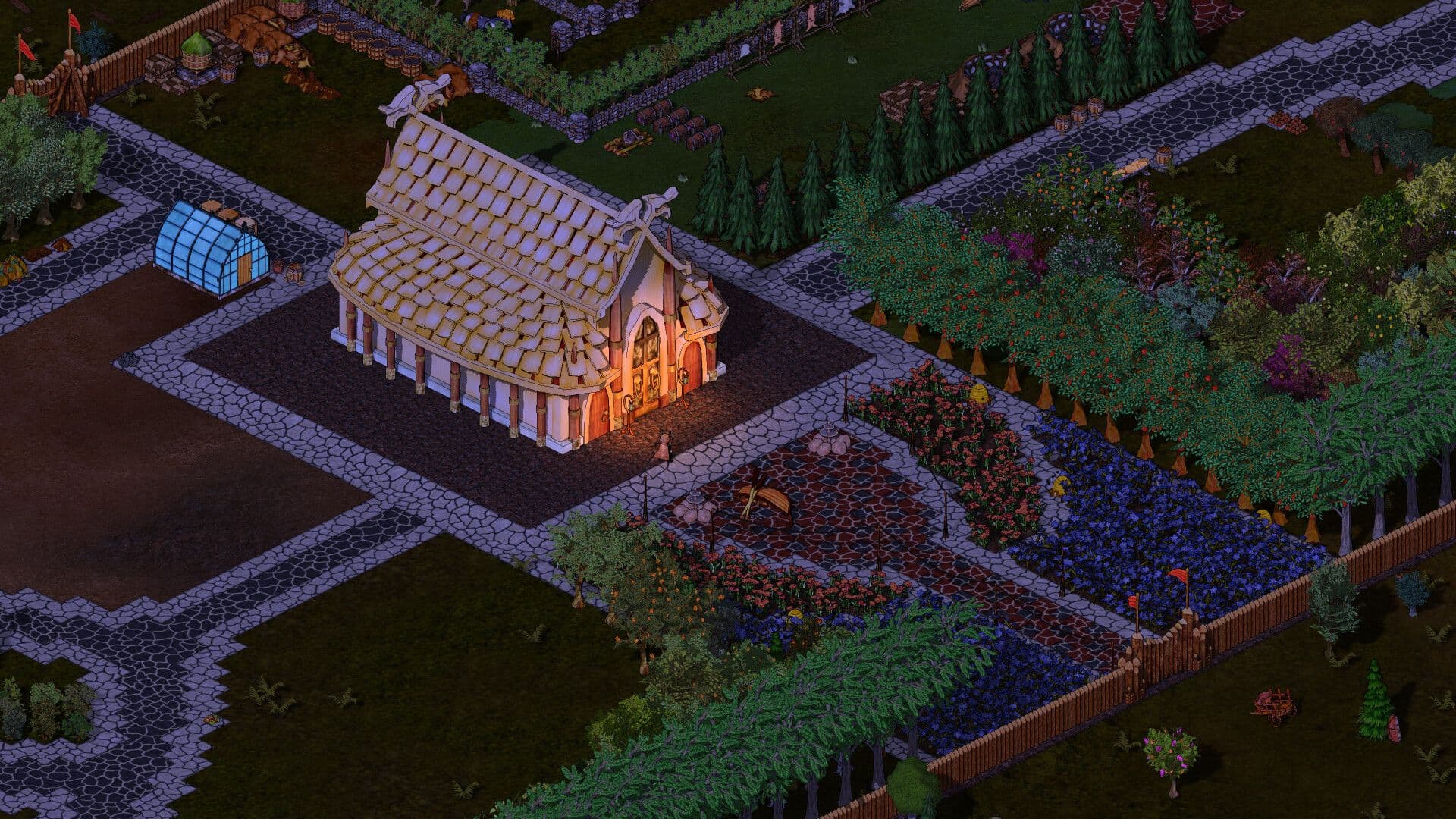
Housing arrives on roughly the same timeline for a patient new player, and it's where Ultima Online's sandbox instincts show up hardest. Houses are placed directly in the open world on finite land, not summoned from a menu, which means good real estate is scarce and existing houses that lapse — through unpaid upkeep or an inactive owner — eventually collapse and open a placement window the community calls an IDOC. Players genuinely camp these collapses, sometimes for real-world hours, to grab a coastal plot the second it opens. It's a strange, almost anthropological thing to watch happen in a nearly three-decade-old game, and it tells you plainly that the housing system was never rebalanced into something more convenient because the scarcity is the point.
Sounds like a purely cooperative sandbox so far? It isn't, and the split that keeps it from being one is baked into the map itself. Most of Britannia exists in two parallel versions occupying the identical geography: Trammel, where players can't attack each other without consent, and Felucca, the original ruleset, where anyone can be attacked, killed, and looted at any time. A separate, harsher shard called Siege Perilous strips out even more of the safety net for players who want the old-school risk permanently rather than as an opt-in facet. Factions — a guild-versus-guild system layered over Felucca towns — add territorial stakes on top of that, letting organized groups fight over town control and the bonuses that come with it.
The consequence is a game that runs two different emotional registers depending on where you're standing. Farming resources or running a shop in Trammel feels close to a cozy life-sim with combat bolted on. Sailing a cannon-armed galleon into Felucca waters, or getting jumped by a guild while hauling a backpack of loot back from a dungeon, feels like the genre's original, more dangerous promise — the one most modern MMORPGs sanded down decades ago. Naval combat specifically still holds up: multiple crewed ships, cannon broadsides, and the real possibility of losing your cargo to a boarding party is a system few current MMOs bother replicating at all.
There's no global auction house in Ultima Online, and that's a deliberate omission rather than a missing feature. Trade runs through player-placed vendor NPCs stationed inside player houses, which means shopping for a specific item means physically walking — or in practice, running a shard-specific price-check macro or community spreadsheet — between multiple player towns to compare stock. It's slower and more fragmented than a search-and-buy interface, and it's also the reason the in-game economy still feels like it belongs to the players rather than to a server-wide price bot. Gold sinks like house taxes, vendor rental fees, and cosmetic Ultima Store purchases exist specifically to keep three decades of accumulated player wealth from collapsing the currency entirely, and Broadsword has leaned on that toolkit rather than a hard reset for as long as the game has run.
Development hasn't stopped, even if it moves at a pace suited to a legacy game rather than a live-service tentpole. Publish 123 rolled out across the production shards through May 2026, delivering the new Spritelight system alongside a batch of veteran-reward housing decorations — an Angler's Stand for storing catches, a Refinement Cabinet for crafting materials, and a Ship Battle Lagoon deco piece — the kind of quality-of-life content that reads as minor individually but adds up across a year of quarterly publishes. Broadsword's own January 2026 roadmap update also promised new global events and continued "game integrity" work, developer shorthand for the perpetual fight against botting and duplication exploits that any economy-driven sandbox this old has to keep fighting.
The bigger recent experiment was Ultima Online: New Legacy, a separate shard launched on October 15, 2024 — the game's 27th anniversary — built around a redesigned, more RPG-focused version of the classic experience for both new and lapsed players. Its first season ran through a scripted finale called the Shattering across the second half of 2025, concluding that October, after which veteran characters could transfer their progress to a production shard of their choice. It was a genuinely interesting attempt to give newcomers an on-ramp without touching the systems veterans already know, and its seasonal, self-contained structure is worth watching if a second season is announced, though nothing broader has been confirmed as of this writing.
One more piece of context worth knowing about, even though it's a business story rather than a gameplay one: reporting from PC Gamer in June 2026 suggests Ultima creator Richard Garriott may attempt to reclaim rights to the series from EA under a copyright provision that activates after 35 years, which would apply to Ultima Online around 2027. Nothing has changed hands, and EA continues to publish and support the game normally today, but it's the kind of development that could matter to where Britannia goes next.
EA and Broadsword don't publish official subscriber or concurrent-player numbers, so any figure floating around is a third-party estimate rather than a confirmed count. Independent tracking sites put monthly active players somewhere in the tens of thousands as of mid-2026, down from a local peak in late 2025, with normal month-to-month swings of 10-20% that are typical for a subscription MMO this age rather than a sign of imminent shutdown. Every production shard remains operational, both the Classic and Enhanced clients are supported, and a browser-based ClassicUO client has recently been folded into the official patcher — hardly the footprint of a game coasting on inertia, even if it's honestly a fraction of its 1999-2000 peak of roughly 150,000 subscribers.
Full access to Ultima Online still runs on a monthly subscription, priced between $9.95 and $12.99 depending on account tier and length of commitment — old-fashioned by 2026 standards, and worth stating plainly for anyone searching whether the game is free. There is a free option: Endless Journey accounts can log in, walk the world, and participate in New Legacy's base content without paying anything, but they carry real restrictions on bank space, character slots, and access to Felucca and certain higher-end systems that make it a trial more than a genuine free-to-play tier. On top of the subscription sits the Ultima Store, selling character transfers, cosmetic items, and convenience purchases like extra bank space — none of it grants combat power a patient player can't earn through the game's normal systems, so the pay-to-win question that dogs most modern MMORPGs barely applies here. The honest complaint isn't predatory monetization; it's that a subscription model this old asks for a recurring commitment most 2026 players have gotten out of the habit of making.
Guilds remain the backbone of anything ambitious in Ultima Online — running a faction war, organizing a naval raid, or simply splitting up shard-wide resource routes all assume a guild structure behind them. What's unusual is how much of the game still works perfectly well without one. A solo player can craft, farm, build a house, and clear the vast majority of PvE content with nobody else's help, which makes Ultima Online one of the rare sandbox MMORPGs that's genuinely solo-friendly and genuinely social at the same time, depending entirely on which facet and which shard culture a player chooses to live in.
Here's the question that actually matters, more than any score: does a sandbox this uncompromising — no class balance patches, no quest-marker hand-holding, real risk in half the map — still have something to offer that current-generation MMORPGs quietly gave up on somewhere along the way? For anyone who's ever wanted to build a house, run a business, and choose their own danger level in a persistent world rather than have all three handed to them on rails, the answer is yes, and it has been yes for almost thirty consecutive years. For anyone who wants their first hour to feel guided rather than earned, Britannia will not meet them halfway, and it isn't going to start now.