 F2P · Live
Lineage 2 Essence
Lineage 2 Essence is NCSoft's free-to-play take on the classic Korean MMORPG Lineage II, built around faster…
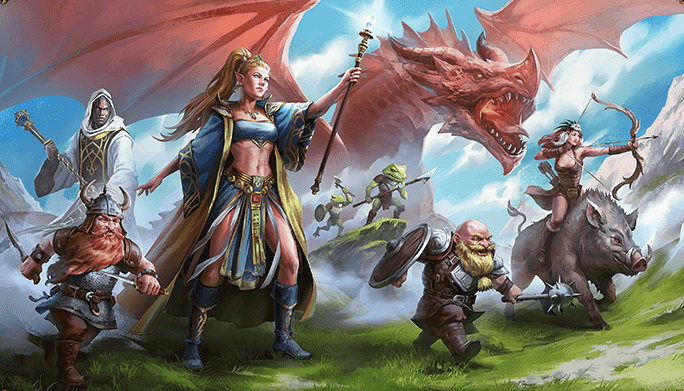
Released on July 28, 2026 by independent studio Game Jawn and publisher Daybreak Game Company, EverQuest Legends rebuilds the 1999 original around solo and small-group play while keeping its art, musi...
EverQuest Legends is a reimagined version of the 1999 original, developed by the independent studio Game Jawn and published by Daybreak Game Company, released for PC on July 28, 2026. It keeps classic EverQuest's art, music, zones and tab-target combat intact while rewriting the rules around solo and small-group play: three active classes on one character, five difficulty tiers in every zone, private instances of any dungeon, and no penalty for dying. The box costs $19.99 with the first month of subscription included, $9.99 a month after that, and it runs on its own servers with a subscription entirely separate from EverQuest's All Access plan.
The world is the original one, down to the polygons. Three continents ship at launch — Antonica, Faydwer and Odus, the pre-Kunark map — along with West Freeport, the deserts of Ro, Kelethin in the treetops of Greater Faydark, and the Erudite cities of Erudin and Paineel. The dungeon list is the one veterans recite from memory: Crushbone, Blackburrow, Lower Guk, Castle Mistmoore, Permafrost, Cazic-Thule — all three continents, unaltered. Nagafen's Lair and the Planes of Fear and Hate are open on day one, so the ceiling is in place rather than parked behind a future patch.
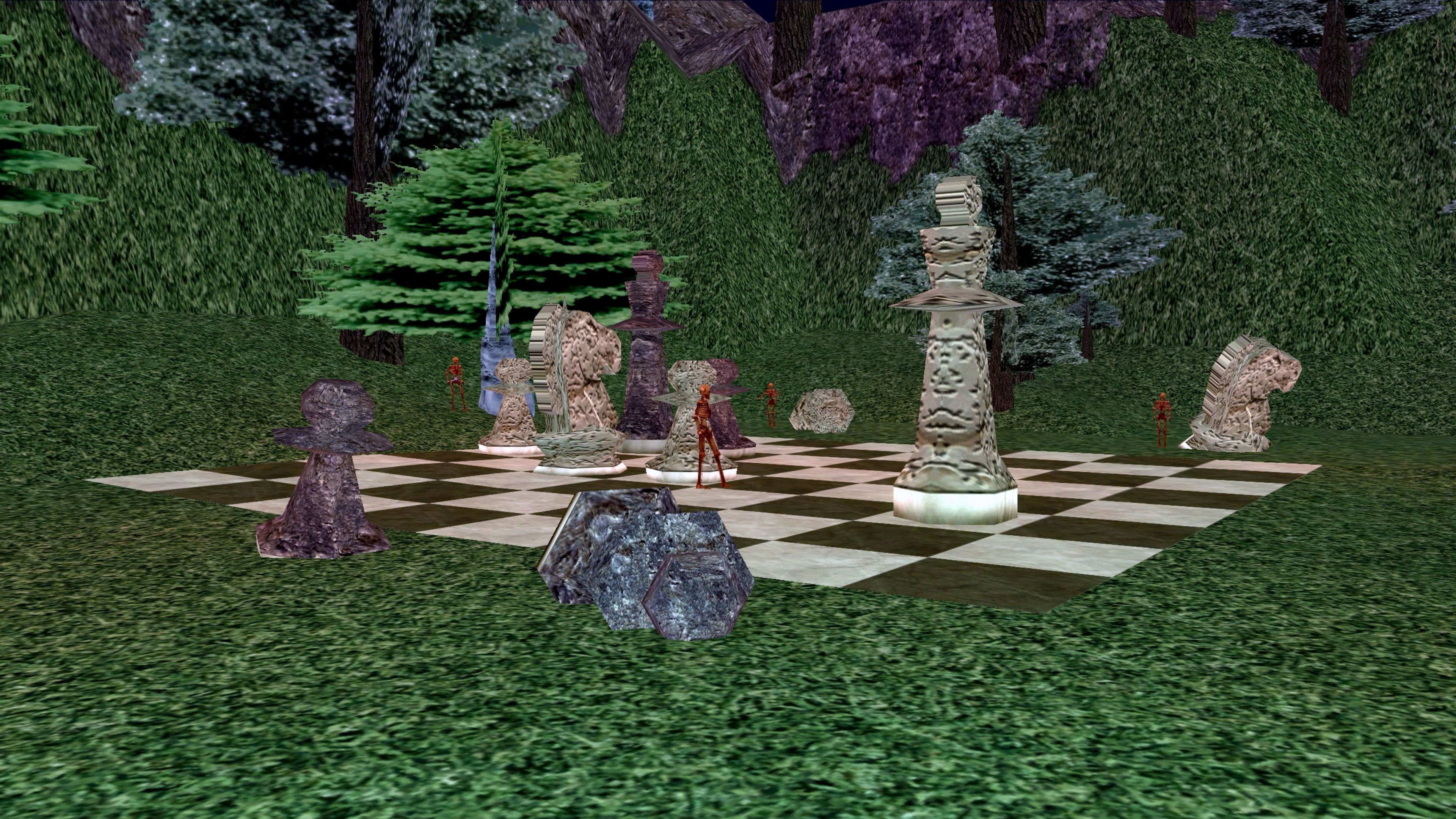
Nothing has been retouched visually. Blocky models, flat textures, no real-time lighting — the studio's argument is that this specific look is the product, and they aren't wrong about what people asked for. The nostalgia does wear off, though, and it wears off fast; after the first half hour you're simply looking at a game from 1999 and deciding whether you can live with it. The one concession to modern hardware is UI scaling for 4K displays, which the team shipped ahead of schedule after testers asked loudly enough.
The zone structure survived too. Loading screens between areas, no continuous overworld, no quest markers overhead. Lower Guk is still a maze and Mistmoore is still vertical, and the in-game map gives you an outline rather than a floor plan — detailed maps come from community sites, which is an odd gap in a game that otherwise smooths every corner it can find.
The opening minutes are gentler than the game's reputation implies. A short tutorial hands you to an NPC family named Doug, who covers hailing, equipping and opening the map — thin guidance, but the original gave none at all. After that the loop is the familiar one: leave the starting city, kill rats or gnolls or skeletons on the nearest stretch of ground, sell the scraps, buy the next spell scroll from a vendor, go back out. Levels one through fifteen play out in the starting neighborhoods before the mid-level outdoor zones open up and the first real dungeons appear around twenty-five.
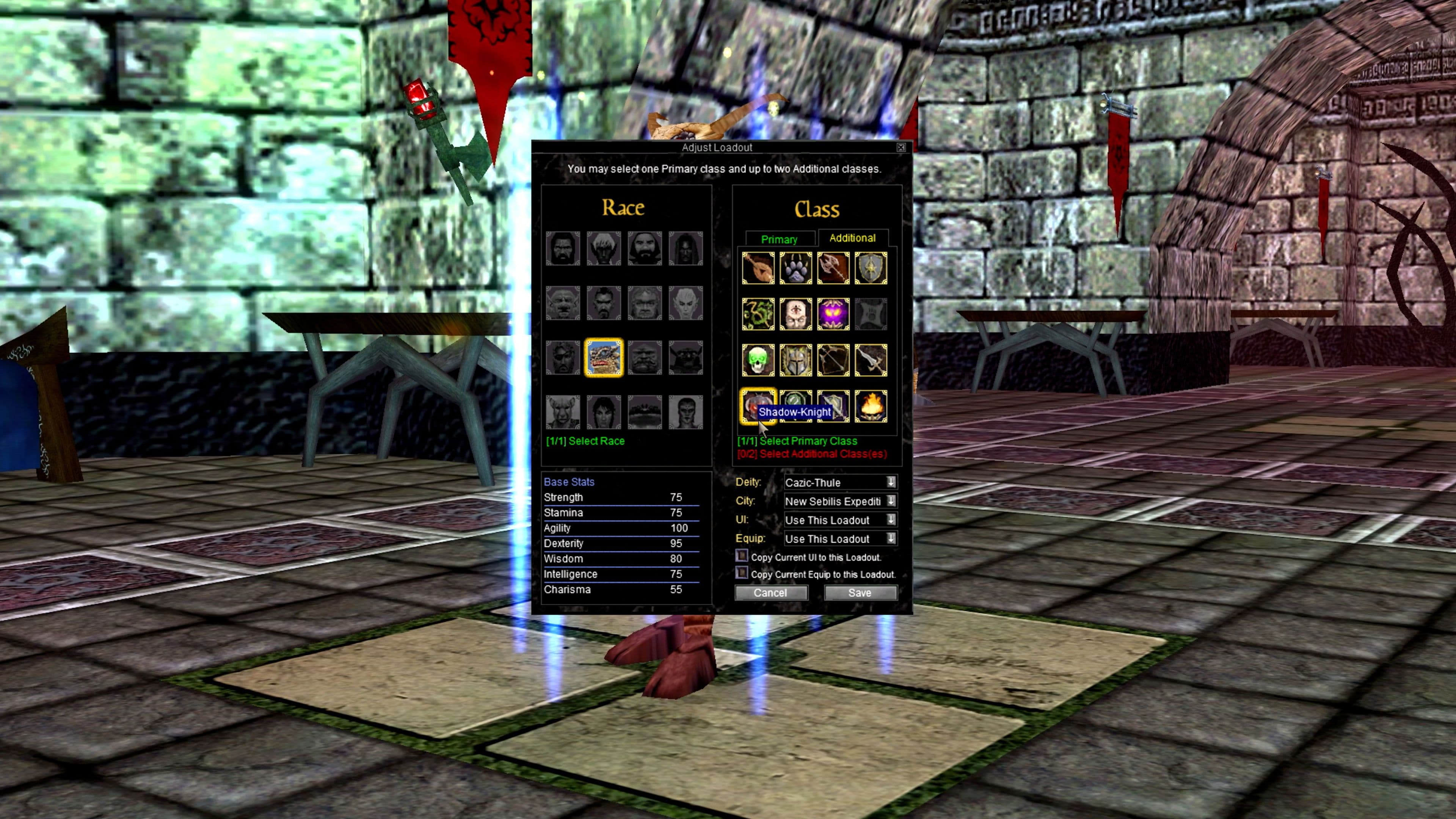
Your race picks your first class, you pick the other two, and all three run at once. A dwarf chooses among warrior, paladin, cleric, berserker and rogue for the primary slot; the secondary slot opens at level 1 with no racial restriction at all, and the tertiary opens at level 10. From then on the character is the sum of all three — every spell, skill and alternate advancement point stacks into a single loadout. The studio counts 560 possible combinations across fifteen playable races, including Kerran, Iksar and Froglok, none of which were selectable when EverQuest first launched.
The flexibility has a governor on it. Secondary and tertiary classes swap freely in a safe area, but your effective level drops to that of the lowest-level class in the loadout, and experience feeds only the laggard until it catches up. Swapping mid-dungeon isn't a thing. Building a second viable configuration is a project measured in evenings, not minutes — which is the design working as intended, but worth knowing before you plan around it.
Sitting on top of the class kit is a bar of stances and invocations, one of each active at a time. An offensive stance raises melee damage, a defensive one cuts incoming physical and magical damage, and invocations layer on effects like faster in-combat mana regeneration at reduced spell cost. Both drain endurance and both swap during a fight, so the habit forms quickly: open aggressive, catch an unexpected add, drop into defense. A melee hybrid running shaman and enchanter alongside its primary ends up with roughly six stances and eight invocations to pick from by mid-game.
Managing three classes at once sounds heavier than it plays, at least early. Classic EverQuest handed every class a small number of abilities in the first twenty levels, and three small numbers still fit on a hotbar. The new ability window, bound to L by default, searches spells and skills instead of making you page through a spellbook. Alternate advancement was thinned out to what the developers considered worth keeping, with passive lines available from level 1 and active ones unlocking as you climb.
The headline promise — the entire game is playable alone — holds up, and the mechanism doing the work is the difficulty selector. Every zone offers five difficulty tiers, from D0 up to D4, switched from a button in the UI. Alongside the tier you choose whether to enter the public version of the zone or spin up a private instance for yourself or your group, with monster respawns toggled on or off.
In practice that solves the oldest problem in EverQuest. Somebody is camped where you need to be? Make your own copy. Want to walk a dungeon end to end without pressure? Turn respawns off. Want faster experience and better loot? Push the tier up — and understand that higher tiers don't just inflate monster health, they give enemies their own class combinations and a wider toolkit to use against you. A launch hotfix on July 29 tied drop quality directly to the selected tier, so a D1 run rolls items at +1 or better and a D4 run rolls at +4 or better.
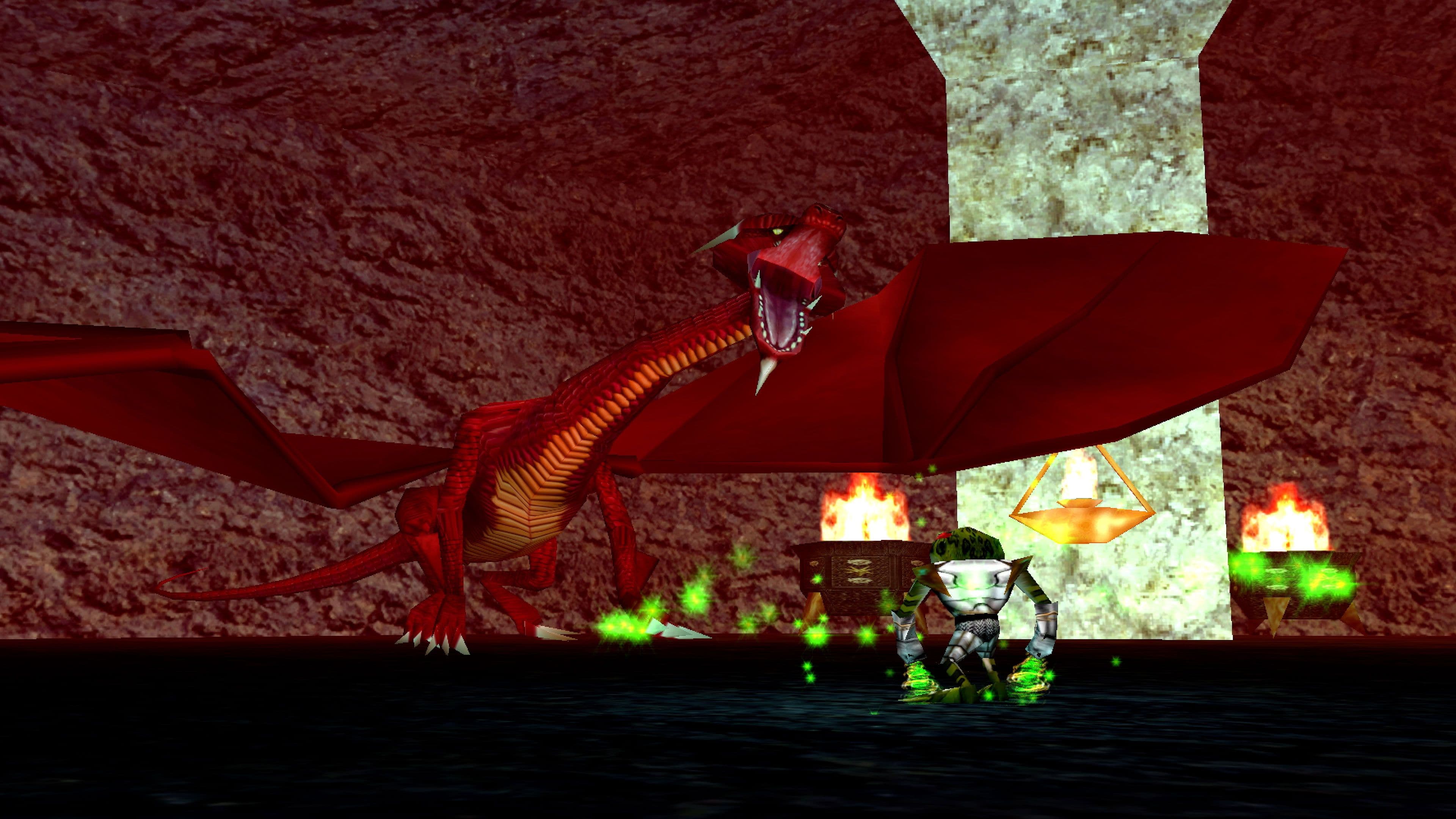
Group size was rebuilt to match. A party caps at four and a raid caps at eight, and the encounter math genuinely assumes those numbers — the dragons that once needed a full guild are tuned for eight players, or for one very well-geared character with the right three classes and enough magic resistance. That is the whole design thesis in one sentence, and it is also the bill: the shared world is what paid for it. The Lower Guk camp you had to queue for and negotiate over was an inconvenience, and it was also the only reason you ever met anyone. Legends chose convenience openly, and it is better to know that going in than to discover it around hour twenty.
Death costs nothing now. No experience loss, no corpse run — you pick a safe point in the zone or your bind spot and come back with all your gear. Meditation is gone; health and mana ramp up out of combat without sitting. Loot is personal, so a rare drop in a group rolls separately for every member instead of starting an argument. Hell levels are gone, and race and class experience modifiers were removed entirely. Experience comes in faster than 1999 and slower than modern EverQuest, which is roughly the right target.
What did not change is where experience comes from. There are more quests than the original had, and the dialogue system finally lets you click a highlighted keyword instead of typing it into chat, but there are no exclamation marks over anyone's head and no quest log to work down. Leveling is still killing things in the right room for a long time. Quests mostly hand out specific gear, faction standing, and unlocks for additional races. Anyone arriving from a modern themepark should read that plainly: the friction was removed from the penalties, not from the loop.
Gear farming got the most interesting rework. Duplicates of an item merge into each other, pushing it from +1 up to +10 and scaling both its stats and its attached effects — so killing a dragon once is no longer the end of that dragon's usefulness. At +3 or +4, Effect Extraction lets you pull a proc or focus off one magical item and move it onto another, which over a few dozen hours produces gear assembled by hand around whatever three classes you're running. The classic wardrobe is all still there — Journeyman's Boots, Ghoulbane, Executioner's Axe — with several of them moved out of tedious quest chains and into dungeon drop tables.
Storage keeps pace with all that: a fifty-slot Dragon Hoard tab, a hundred-slot tradeskill depot, an expandable character storage tab, and a bank search field. The crafting stations search recipes and auto-slot components. They also can't pull from the tradeskill depot yet, which is the clearest example of a broader pattern — the quality-of-life layer works, but it was bolted on in pieces and the pieces don't all talk to each other. The same goes for the pile of items and spells left functionally dead by the reworks, which a new player has no way to identify before hauling them to a vendor.
No. EverQuest Legends charges a box price and a subscription and sells no combat power on top of that, and it deliberately excludes Krono — the tradeable subscription token whose resale market shaped, and arguably distorted, the economy on Daybreak's classic EverQuest servers for years. That single omission does more for the game's economy than any anti-cheat rule.
The shop that does exist sells Iridium Coins at roughly $10 per thousand, and stocks bags, cosmetics, inventory expansions, respec items, and unlocks for primary classes, races and deities, the priciest of which currently runs 1,500 coins. Those unlocks widen your options rather than raise your numbers, and most of them are earnable in-game — race unlocks come through faction achievements, for instance. Experience potions are the one item that sits closer to the line. A subscription plus a storefront is still two tills instead of one, and part of the community has said so.
Guilds exist; guild halls don't yet. The East Commonlands tunnel took over as the meeting place, split into an instanced version for people who want to stand there trading and a normal one for people passing through, and housing hangs off that same hub — available at launch, purely social, with no bearing on combat progression. Multiboxing is off the table entirely under a True Box rule of one client per machine, backed by anti-cheat, which given how thoroughly bot crews have colonized older EverQuest servers reads as a considered choice rather than a bureaucratic one.
The most-cited omission is mentoring. Solo leveling moves quickly, friends log in at different rates, and a two-evening gap turns into a real one; EverQuest II has a level-sync feature for exactly this and Legends does not, though the developers have acknowledged it publicly. There is also one character per server, permanently, which is a deliberate constraint that makes the loadout system meaningful and will still frustrate anyone used to keeping a stable of alts.
Legends cannot be discussed without its prehistory. A rogue EverQuest server called The Heroes' Journey launched in 2024 with multiclassing and a solo-friendly ruleset; Daybreak sued in 2025, won a preliminary injunction that took the server offline, and the case ended in a settlement in spring 2026 with damages claims reported at $3.5 million. EverQuest Legends was announced shortly afterward, built by an independent studio staffed by developers from that same emulator scene, shipping a recognizably similar set of ideas under an official banner.
Plenty of players find that sequence hard to swallow, and the reasoning behind that reaction is not difficult to follow. What Legends has that an emulator could not is the other half of the picture: Daybreak's infrastructure, servers in the US and Europe, actual support, legal permanence, and a funded update schedule. Launch day on July 28 ran into login and tutorial-instance problems as demand outran the publisher's estimates, and by the second day the servers were steady, with patches arriving regularly since.
The level cap is 50, matching pre-Kunark EverQuest, and the endgame is the classic list: The Hole and Kedge Keep for epic components, Nagafen and Vox, the Temple of Solusek Ro, and the Planes of Fear and Hate for the best gear. All of it is approachable by four, by eight, or alone, gated by which difficulty tier you dare to run and how well you've capped resistances. Past that the progression turns horizontal — merging gear, shuffling effects between items, leveling the lagging class in a loadout, unlocking races and primary classes through faction, and a recently added option to reset a completed loadout back to level 1 with a raised stat ceiling.
The published roadmap covers deity achievements, the Rujarkian Hills open zone, a Nektropos Castle mini-expansion and a reincarnation system, with Kunark as the first full expansion targeted for this winter and five expansions planned in total, according to the developers' Discord. For a small independent team working on a twenty-seven-year-old client, the cadence since launch has been better than the circumstances suggested it would be.
EverQuest Legends is the most honest MMO release of the year, and honesty is not the same as ambition. It never claims to modernize EverQuest — it claims to make classic EverQuest survivable for someone with a job, and it does that with a precision the genre rarely manages. The combat rhythm is intact, the penalties that made 1999 famous are gone, and the systems that replaced them are more interesting than the ones they removed. Nothing here is a compromise made by accident.
What it is not, and never pretended to be, is a world. Groups of four, raids of eight, private copies of every dungeon and one character per server add up to a game built around the player rather than the population, and the thing veterans actually miss about EverQuest — being forced to depend on strangers — is precisely what got engineered out. Anyone who came for that will find the machinery excellent and the room empty. Anyone who came for the fights, at $19.99 plus ten a month, is getting an unusually fair deal on a very old idea.
No. EverQuest Legends costs $19.99 to buy, which includes the first month of subscription, and $9.99 per month afterward. The subscription is separate from EverQuest's All Access membership and does not carry over between the two games.
There is no PvP in EverQuest Legends and the developers have said no PvP servers are planned. All combat tuning assumes players versus environment, with parties capped at four and raids capped at eight.
No — the game was designed so that a single character running three classes can clear everything, including raid content, by adjusting the zone difficulty tier and using private instances. Groups make things faster, not possible.
Not at launch. The game is sold through its official site and runs on Daybreak's own 64-bit launcher, though the studio has said a Steam release may follow later.