 F2P · Early Access
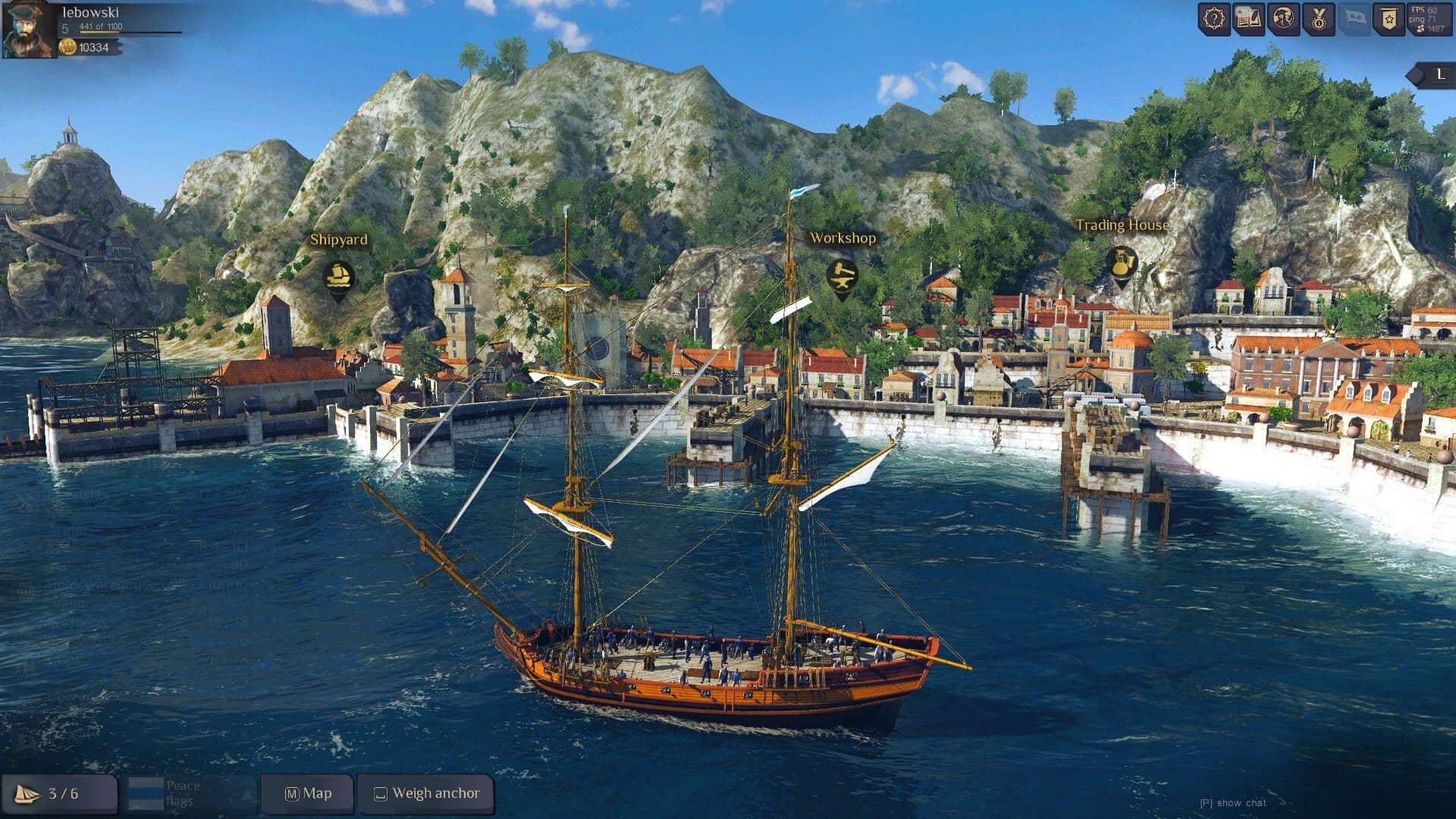
World of Sea Battle
A grand Age of Sail open-world naval MMO sandbox featuring authentic wind rose physics, manual broadside ballistics, and territorial port conquests.

A high-stakes multiplayer crime sandbox and extraction third-person shooter set in the sprawling coastal city of Looty Bay. ROB & RUN seamlessly blends stealth mask-up mechanics, high-profile bank and...
Quick take: The snap of a mask across your face turns the sun-drenched coastal avenues of Looty Bay into an unforgiving warzone in a split second. Developed and published by Kefir, ROB & RUN entered Steam Early Access on November 4, 2026, fusing the urban audacity of classic crime sandboxes with the paranoid adrenaline of a hardcore extraction shooter. There are no safe havens: player-controlled police officers hunt armed gangs, death triggers a brutal full inventory wipe, and a weekly Federal Raid purge resets accumulated fortunes to keep the economy hungry and dynamic.
The multiplayer crime sandbox genre has spent the better part of a decade stagnating in predictable design loops. GTA Online long ago morphed into a carnival of flying rocket bikes where death carries zero financial consequence. The aging engine of APB: Reloaded remains trapped in the early 2000s. Meanwhile, hardcore extraction titles like Escape from Tarkov alienate newcomers with spreadsheets of ammo penetration charts and punishing downtime. Studio Kefir, having built a mobile survival empire with Last Day on Earth, arrived on PC with a blunt mission: demolish that stagnation in a single strike. No compromises.
The arrival of ROB & RUN on Steam marks a pivotal leap for the developers, transitioning from top-down mobile survival into the high-stakes PC arena. Rather than reinventing the wheel, the team surgically spliced the urban mayhem of Payday and Rust with the relentless extraction tension of a modern looter. You will find no match lobbies or sanitized instanced arenas here. Players drop straight into a unified, seamless open-world metropolis where every passerby on the sidewalk can pull a shotgun on you at a moment's notice.
The core pulse of ROB & RUN is the total elimination of safe-pocket illusions. There are no invincible bank vaults shielding your hoarded gold forever. Either your crew launders dirty cash and welds thick steel plating onto your hideout within seven days, or the relentless juggernaut of the Federal Raid wipes the board clean at the end of the week.
The stage for this ceaseless territorial war is Looty Bay, a sprawling, neon-soaked coastal city engineered specifically for high-speed getaways and frantic indoor shootouts. The metropolis maintains an eerie veneer of normalcy. Civilians stroll along the oceanfront, security guards yawn outside jewelry boutiques, and thumping bass spills from open nightclub doors. But duck into any service alley — and the sharp tang of spent gunpowder and scorched rubber hits instantly.
The urban layout is structured with deliberate tactical contrast:
This ecosystem features zero designated safe hubs. Threat lurks around every corner. A gunfight can erupt over the cash register of a corner convenience store, on the steps of the police station, or at an intersection after two squads trade paint at eighty miles per hour.
You begin on the pavement with empty pockets and a rusted six-shooter. The clock is already ticking toward the seven-day server reset. In that window, you either forge an empire or bleed out on the asphalt.
Most competitive multiplayer shooters establish their rules the moment you spawn into the map: an enemy icon hovers over your head, and your sole imperative is to pull the trigger. ROB & RUN dismantles this convention through its core signature mechanic — the mask-up system (The Mask-Up System). This is not cosmetic flair or an idle idle-screen emote. It is the fundamental legal toggle that drives the psychological tension of the entire game.
As long as your face remains bare, the server registers you as an ordinary civilian (Civilian). You are free to wander past luxury storefronts, sip coffee at roadside diners, scout security camera blind spots, and monitor police patrol routes without drawing a single glance. Officers ignore you. Surveillance scanners stay silent. You are a ghost in the crowd. The ultimate reconnaissance asset.
The Heist Lifecycle in Three Stages:
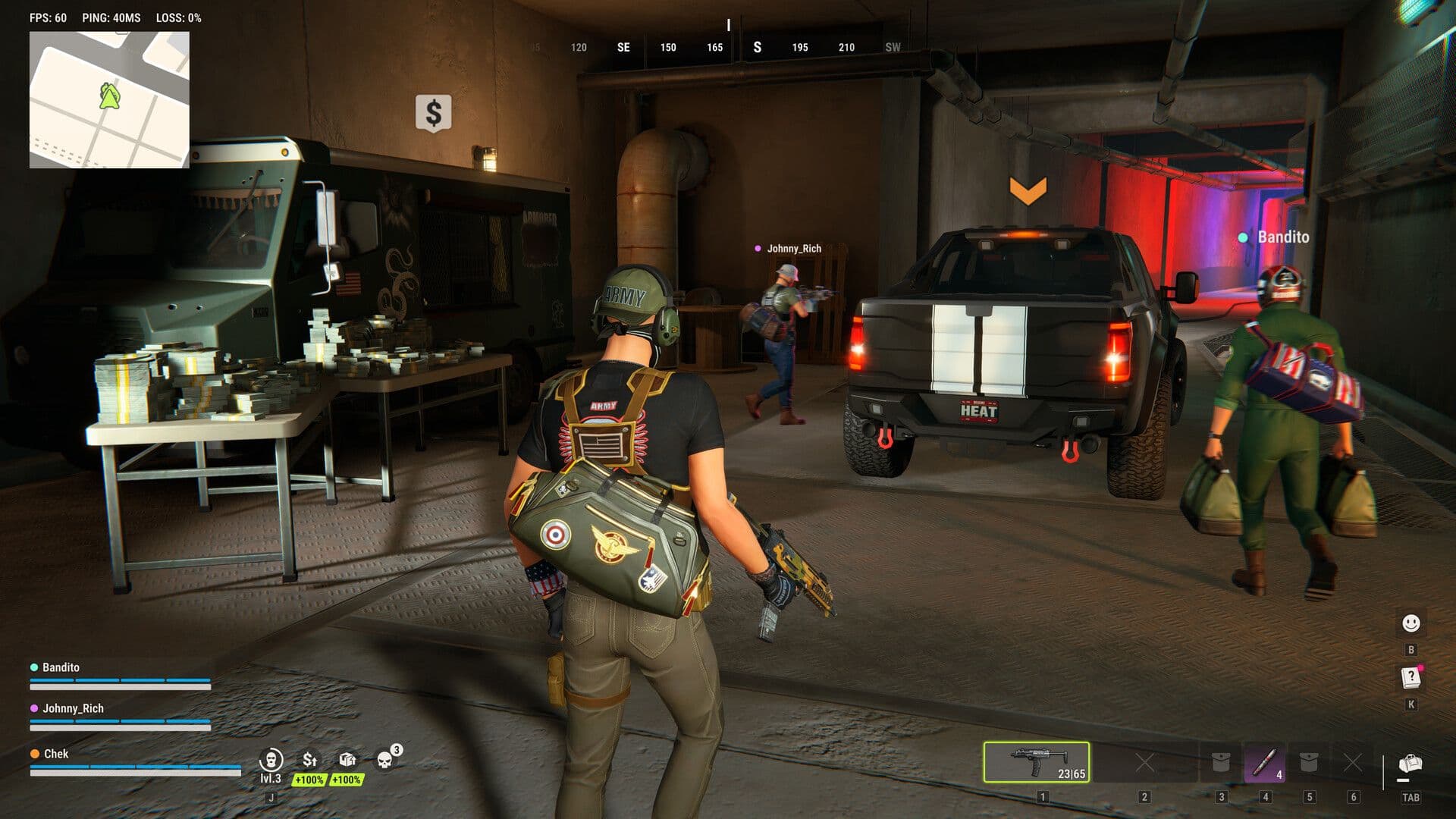
• Civilian Reconnaissance: mapping guard posts, timing security cameras, identifying secondary exits, and stashing a getaway car in a blind alley.
• Mask-Up Initiation: immediate transition to Criminal status, revoking civilian immunity and initiating vault breaches under screaming sirens.
• Extraction Rush: fighting through citywide blockades with heavy loot bags while every active player cop closes in on your signal.
Hold a key, pull the bandana over your nose, and the city fractures. In that single frame, you become an outlaw (Criminal). Your cover evaporates. A glaring red tracker pulses on every nearby squad car's radar, security klaxons wail across the block, and the police dispatcher broadcasts an all-units intercept. There is no turning back.
You cannot simply tuck the mask into your pocket inside a ransacked bank vault and play the innocent bystander. The city does not buy cheap excuses. With an active Wanted Level and a bag stuffed with gold bars, you become open game for the entire server. AI guards are merely an appetizer. The genuine nightmare comes from other players. Police patrols race toward your coordinates hungry for department bounties, while opportunist crews lie in wait to ambush you at the getaway car.
The catch is absolute irreversibility. Donning a mask in ROB & RUN is a one-way transaction. You trade your safety for the promise of a massive payout. You either fight your way back to your hideout through a storm of lead, or you lose every single piece of gear on your corpse.
This dynamic creates unbearable paranoia. Picture a quiet lobby in the city's central bank. You stand near the teller windows without a mask, quietly reviewing guard rotations. Three other players in street clothes linger beside the deposit boxes. Unarmed. Who are they? Newcomers trying to get their bearings? Or an organized assault team waiting for you to look away before detonating C4 against the vault door? Could one be an undercover officer running surveillance?
The air feels electric. A single sudden movement can turn the serene lobby into a slaughterhouse. Do you draw your weapon first and blow your cover? Or do you wait out the heist and execute the thieves as they drag the heavy loot bags toward the revolving doors? ROB & RUN weaponizes human hesitation, transforming social proximity into a perpetual standoff.
Urban backdrops in multiplayer titles too often serve as hollow cardboard sets — static facades, sealed doorways, and empty spawn corridors. Looty Bay operates on a fundamentally different philosophy. This is a dense, predatory concrete jungle where every architectural detail serves the logic of the heist, the ambush, and the high-speed getaway. Dead space does not exist here. Every fire escape offers a rooftop sniper nest, and an ordinary dumpster in an alleyway can hide you from an overhead police chopper.
The city's spatial blueprint follows a principle of radial escalation. The closer you push toward the glistening downtown core, the richer the potential scores and the more ferocious the automated defenses:
Architectural Verticality: the action in Looty Bay extends far above street level. Flat rooftops are linked by scaffolding, planks, and fire ladders, allowing coordinated squads to sprint across entire city blocks above patrol radar sweeps.
Every commercial property in Looty Bay functions as an interactive puzzle with multiple entry vectors. Planning to hit a corner jewelry store? The brute-force route is obvious: drive a sedan through the front window, smash the glass cases with a crowbar, and run. Fast and messy. But within three seconds, alarms will screech across the district, automated security shutters will drop, and the local precinct will mobilize. You are trapped like rats.
Experienced crews take a surgical approach. Cut the exterior breaker in the service alley to blind the surveillance feeds. Pick the reinforced deadbolts on the rear delivery door. Safe cracking (Safe Cracking) demands ice in your veins: turning the tumbler dials by sound alone while monitoring footsteps in the hallway tests your nerves to the limit. One clumsy slip, and the silence shatters.
The catch is sound propagation. The game's acoustic engine is ruthless. The crack of breaking tempered glass echoes across an entire city block. An angle grinder chewing through steel door hinges can be heard through concrete walls. You never rob in a vacuum. Every loud action serves as an open invitation to every scav-hunter and patrol unit in the vicinity.
Crime sandboxes have historically stumbled over the same design hurdle: leaving law enforcement entirely to primitive artificial intelligence. Scripted police bots either walk blindly into chokepoints or headshot players through solid masonry from four blocks away. ROB & RUN flips the dynamic by introducing a living, unpredictable counterweight onto the pavement: a dedicated faction of player-controlled police officers (Player Cop).
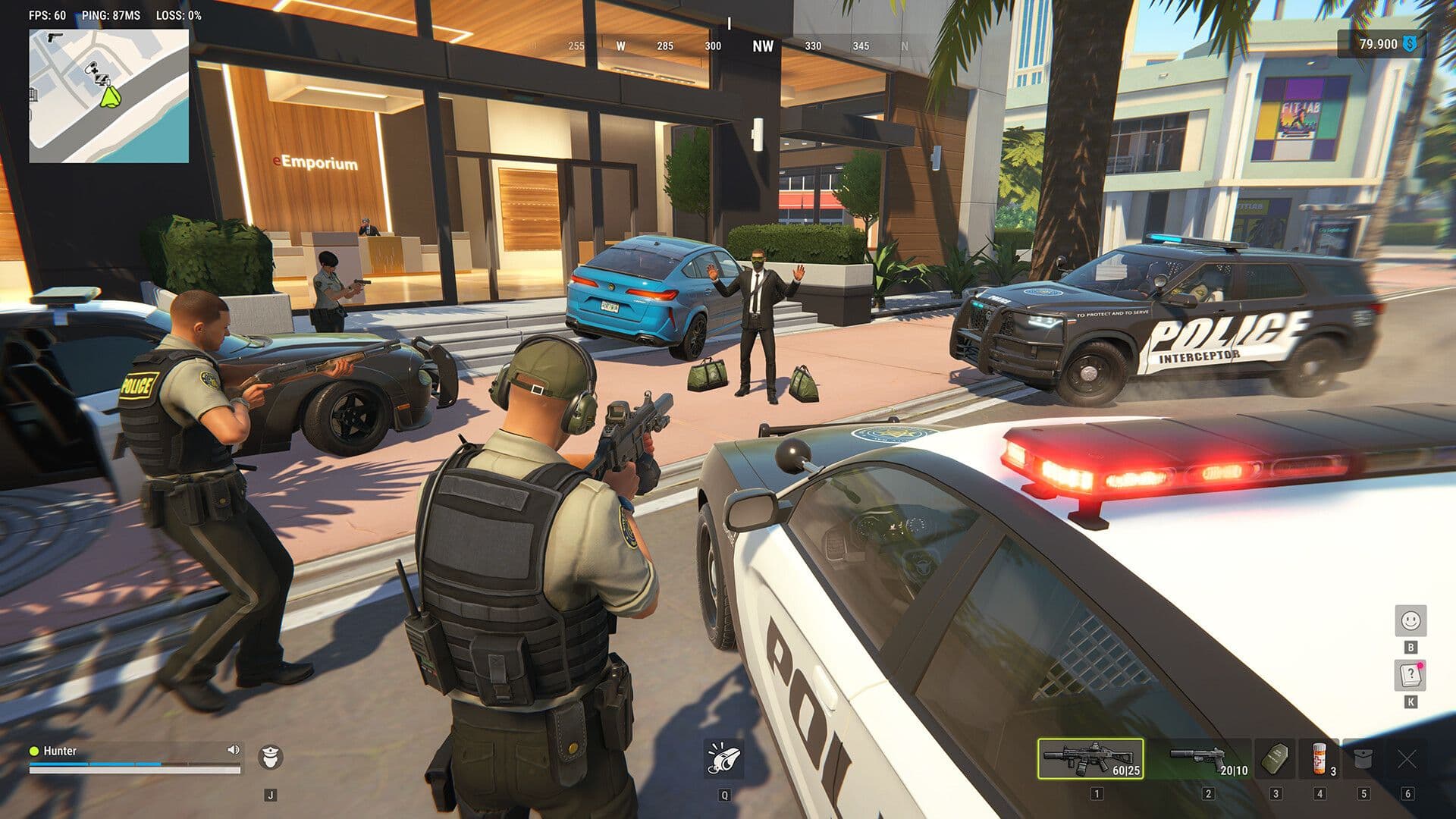
Trading an outlaw's bandana for a silver badge is straightforward: report to the Looty Bay Police Station. Signing on for active duty issues you an official squad cruiser with working sirens, a sidearm, body armor, and direct access to department dispatch frequencies. From that moment forward, your mission is to patrol the grid, answer distress beacons, and shut down criminal operations with extreme prejudice.
Badge Economics: player officers do not crack safes, but their earning potential rivals the wealthiest syndicates. Neutralizing wanted criminals awards direct cash bounties, while seized contraband and recovered bullion can be checked into the evidence lockup in exchange for departmental salary bumps and rank promotions.
Combat encounters between law and crime feel distinct from traditional team deathmatches. This is an asymmetric intelligence war. Criminal crews hold the initial initiative: they select the target, choose their entry breach, and prep the getaway route. But the second an alarm triggers, the clock pivots in favor of the badge.
Patrol tablets buzz with approximate district coordinates. Responding cruisers Converge on the scene. Competent officers do not charge blindly through the front lobby doors. They park cruisers to box in the getaway vehicles, secure crossfire angles on fire escapes, and wait for the over-encumbered thieves to stumble out into the street.
Officers are backed by citywide municipal assets:
Wearing a badge might appear safer on paper: you have institutional backing, department vehicles, and automated drone support. But the streets are lethal. Veteran heist crews regularly treat alarms as bait. They deliberately trip a pawn shop sensor, take up perches on opposite balconies, and wipe out responding squad cars through the windshield before the officers can even unholster their weapons. Quick and brutal.
Furthermore, officers operate under strict rules of engagement. Spraying lead into unarmed civilians (Civilian) triggers immediate departmental reprimands: stiff monetary fines, rank demotions, and in severe cases, badge revocation and an instant transfer to wanted criminal status. Enforcing the law in Looty Bay demands trigger discipline. Hesitate and die. Shoot wild and pay.
Gunplay in ROB & RUN shows zero tolerance for arcade spray-and-pray habits. The third-person camera perspective serves as a deliberate tactical tool rather than a cinematic indulgence. It provides essential situational awareness: letting you slice corners on masonry walls, lock down blind alley intersections, and spot approaching police flankers before they breach your room.
Weapons feel physical and grounded. Bullets follow genuine ballistic trajectories with travel time and noticeable drop over distance. Recoil on fully automatic rifles kicks violently toward the sky, punishing undisciplined trigger spam. The Time to Kill sits in a calibrated sweet spot: it avoids arbitrary one-shot deaths across town, but three or four center-mass rounds on an unarmored target will drop a player instantly. Dead on the pavement.
The Rule of the Pavement: Looty Bay rewards positioning over twitch reflexes. Anchoring behind concrete barriers, cutting sightlines with smoke canisters, and laying down suppressing fire while your partner drags the bags will win you fights where blind aggression guarantees death.
Gear progression follows a steep operational ladder. Fresh spawns start with bare-bones surplus: rusted snub-nosed revolvers, worn service pistols, and makeshift shivs. Hitting a bank with that loadout is pure suicide.
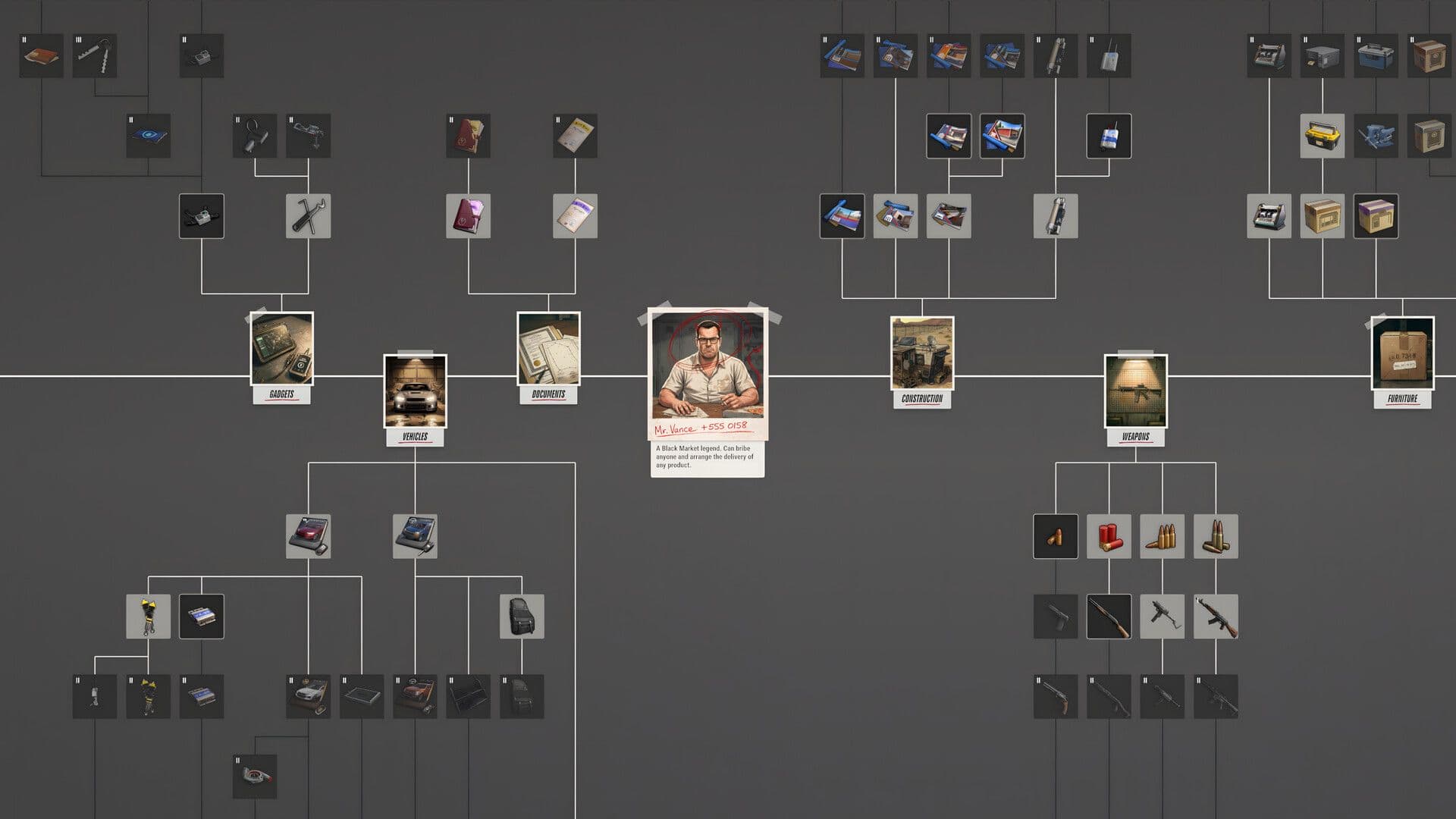
High-tier ordnance is acquired through warehouse raids or by dealing directly with the Black Market. The city's underground munitions trade is run by an elusive broker named Lenny (Lenny), operating out of concealed shipping containers in the harbor. Outlaws can also browse black-market supply networks via encrypted laptops inside their hideouts:
The catch to fielding expensive military-grade hardware is the unrelenting Full Loot penalty. Put on a mask and step outside, and you wager everything: upon death, your equipped rifle, body armor, packed magazines, and every piece of loot in your backpack spill directly onto the ground. No insurance policies. No secure container crutches.
Losing an upgraded assault rifle with thermal optics can set your crew back hours of grinding. This creates immense emergent tension. High-tier gear gives you overwhelming firepower, but it turns you into a walking payday. Every scavenger with a rusted pistol will happily risk a cheap respawn to put a bullet in your head and steal your king's ransom.
Developers at Kefir acted swiftly following early player feedback during launch week: base pistol prices were slashed, and starter ammunition spawn rates were increased across public zones. This softened the onboarding curve without compromising Looty Bay's fundamental law: whenever you cross your threshold, you risk everything you carry.
Travelling on foot in Looty Bay is a swift route to the morgue. In an extraction shooter where survival is measured in seconds, vehicles serve as mobile barricades, battering rams, and armored loot vaults rolled into one. The developers of ROB & RUN recognized early on that endless jogging across wide boulevards kills pacing, engineering a multi-tiered vehicle framework to keep the city in constant motion.
Penniless fresh spawns are not stranded on the sidewalk. Municipal parking terminals (Parking Terminals) are positioned across major transit hubs. Interacting with these terminals issues a complimentary loaner sedan. It groans during gear shifts, accelerates like molasses, and smokes after a few rifle bursts, but it fulfills its core purpose: hauling you and your crew to the heist location without foot-slogging through hostile sniper territory.
Vehicles as Mobile Vaults: a car's trunk is the only external container capable of carrying heavy, encumbering bags of gold bullion. The larger your crew's van, the larger the take. But if patrol officers detonate the fuel tank during your getaway, the vehicle and your entire score burn to ash.
High-stakes operations demand dedicated machinery. The urban fleet offers deep progression options:
The pinnacle of criminal transit belongs to aviation. Helicopters command extortionate purchase prices and constant aviation fuel upkeep, but they enable the game's most cinematic getaways. While your breach team detonates vault doors inside a high-rise penthouse, the pilot hovers over the helipad, suppresses responding SWAT snipers, pulls the crew aboard with their haul, and skims the ocean waves to safety.
Vehicle handling requires disciplined inputs. Cars do not ride on magnetic rails: rear-wheel-drive muscle cars break loose on rain-slicked asphalt, spinning into concrete lamp posts if you panic on the throttle. A high-speed collision crumples the engine block and jams the doors. Player cops exploit this ruthlessly: coordinated patrol squads perform textbook PIT maneuvers, pin fleeing vans against bridge dividers, and deploy spike strips across outbound highway lanes.
Stealing a million dollars in Looty Bay accounts for barely a third of the operation. The true test of criminal endurance begins when dye-stained bundles of stolen currency must be secured, washed, and forged into combat power. Every ambitious boss needs a private redoubt — a fortified hideout (Hideout).
This is far from a static storage locker with storage chests. It functions as your crew's operations bunker. Beginning in a damp slum basement lit by a single flickering bulb, players steadily upgrade the property into a high-security citadel: reinforcing entry bulkheads with blast plates, setting motion sensors across alley approaches, and installing backup power generators.
The Heart of the Den: hideouts house specialized workbenches (Workbench) that unlock high-tier manufacturing: pressing armor-piercing cartridges, forging heavy ceramic ballistic plates, and soldering electronic decoders designed to bypass high-end vault locking mechanisms.
The economy enforces a rigid dual-currency structure. Any banknotes pulled from cash registers, armored courier trucks, or subterranean bank vaults carry the status of dirty money (Dirty Cash). Attempting to purchase a performance car or assault rifle from legitimate vendors with this currency prompts an immediate SWAT dispatch: the serial numbers are flagged across state police databases.
Converting funds requires engaging with the money laundering framework (Money Laundering). The process demands patience, strategic investments, and nerve:
Behind the glittering neon facades of Ocean Boulevard lie the social epicenters of the city's underworld — subterranean nightclubs, strip venues, and illicit gambling parlors (Underground Casino / Nightclub). The developers lean into their mature rating with unapologetic confidence.
Virtual roulette tables can double a crew's nightly haul or wipe out days of sweat within minutes. In private upstairs VIP rooms, syndicate commanders carve up city districts, negotiate truces, and assemble coalitions for joint assaults against the central municipal depository. Lone-wolf gunfighters linger along the bar counters, eager to sell their trigger fingers for a percentage of the vault take.
Yet true safety does not exist. Your hideout remains vulnerable. If a responding patrol cruiser or surveillance drone trails your getaway car back to the safehouse, your coordinates leak. Setting claymore tripwires along stairwells and reinforcing deadbolts is the difference between keeping your fortune and waking up stripped on the sidewalk.
The perennial death sentence of open-world multiplayer sandboxes is economic ossification. Several months post-launch, entrenched mega-clans build impenetrable concrete redoubts, hoard thousands of military-grade firearms, and monopolize every lucrative trade artery. A rookie entering this stagnated ecosystem is nothing more than cannon fodder. ROB & RUN burns this rot out with industrial precision through its mandatory server wipe event — the Federal Raid (Federal Raid).
Every server runs on a strict seven-day calendar (7-Day Wipe Cycle). The clock ticks without interruption. From Monday through Thursday, crews play cautiously: accumulating baseline cash, setting up workbenches, laundering starter hauls, and probing bank security rotations. By Friday, the stakes detonate: armored trucks hit the asphalt, and Lenny's Black Market counters see desperate bidding wars for plastic explosives.
The Principle of Entropy: the weekly wipe is not lost progression; it is the ultimate economic cleanser. It obliterates asset inflation, crushes clan monopolies, and resurrects the genre's finest sensation: the raw thrill of a blank slate where every player stands on equal footing.
During the final twenty-four hours of the cycle, the city descends into utter bedlam. As the wipe countdown reaches the red zone, federal military contingents and armored national guard columns roll through the outskirts. The Federal Raid begins. Facial recognition scanners go dark. Law enforcement transitions to shoot-to-kill rules of engagement without warning.
Hoarding ammunition is pointless. Tomorrow does not exist. Gangs unleash their entire stockpile: rocket launchers, crates of C4, and heavily plated gun trucks. Total war consumes the avenues:
The wipe presents a psychological hurdle for traditional MMO veterans. Players accustomed to hoarding digital wealth across multi-year cycles struggle with the knowledge that their fortified safehouse and gold vaults turn to ash every seven days. No exceptions.
To offset the loss, the developers bifurcated progression into seasonal material assets and permanent account equity. The wipe demolishes physical wealth (guns, safehouses, cash reserves, vehicles). However, your account rank, season battle pass tier, underworld reputation, exclusive mask cosmetics, and leaderboard achievements endure across wipes. Hours after the raid settles, dawn breaks over Looty Bay. The streets are silent, pristine, and empty. Thousands of players step onto the pavement with empty pockets, ready to begin the hunt once more.
When a studio with extensive mobile development pedigree launches a free-to-play title on Steam, core PC communities brace for predatory monetisation. Industry history is littered with promising multiplayer sandboxes gutted by paywalled cooldowns, energy limits, and paid combat advantages. Kefir made its fortune on survival hits like Last Day on Earth, where microtransactions were never known for bashful modesty. Consequently, the financial blueprint of ROB & RUN was placed under a community microscope from the opening minutes of Early Access.
The studio's launch manifesto on Valve's storefront outlines a refreshingly disciplined philosophy: zero financial paywalls on gameplay systems, open access to all city districts, and an aggressive focus on visual customization. The developers were well aware that introducing mobile monetization tricks into a competitive full-loot PC extraction sandbox would trigger an immediate review-bombing campaign.
The Parity Principle: in a street-corner firefight, a bullet from a free starter revolver punches through a helmet just as lethally as a round fired from an ornate, real-money gold assault rifle. The game currently sells zero direct stats: no extra health, no reduced recoil, and no sprint speed buffs.
The commercial shop conforms strictly to prevailing Western shooter standards, monetizing personal aesthetic expression across three distinct tracks:
The principal risk resides along the murky boundary between convenience and unfair advantage (Pay-to-Win). The game currently offers purchasable wardrobe inventory slots and minor Battle Pass XP boosters. While neither alters combat ballistics directly, the community remains vigilant.
Players are intensely wary of potential future slippery slopes, such as paid backpack insurance or expedited money laundering timers. Any monetization of time in a game defined by seven-day wipes is fatal to competitive integrity: if a paying user can rebuild a Tier-3 workbench in two hours while an unpaid squad requires two days of grinding, the hardcore audience will depart en masse.
Early developer responsiveness, however, offers genuine encouragement. Listening to community complaints regarding early-game gear disparity, Kefir immediately deployed a hotfix cutting starter weapon prices and boosting contraband turn-in payouts for officers. The studio is visibly adapting to PC standards. Fast and responsive. For now, the economic balance remains remarkably fair.
ROB & RUN is an aggressive, audacious, and surprisingly mature PC debut from Kefir. The project successfully pinpoints a rare equilibrium point between the urban freedom of GTA Online, the white-knuckle extraction dread of Escape from Tarkov, and the fast-paced server resets of Rust.
ROB & RUN refuses to be another tranquil MMO about picking flowers and watching pastel sunsets. This is a lean, mean, high-tempo crime simulator where every sortie past your safehouse threshold feels like crossing a live minefield. If you are exhausted by the consequence-free immortality of modern open-world sandboxes and crave genuine adrenaline as you race an armored trunk full of gold through screaming police sirens, grabbing a ticket to Looty Bay is well worth the plunge right now.
F2P · Early AccessA grand Age of Sail open-world naval MMO sandbox featuring authentic wind rose physics, manual broadside ballistics, and territorial port conquests.
 F2P · Live
Lineage 2 Essence is NCSoft's free-to-play take on the classic Korean MMORPG Lineage II, built around faster…