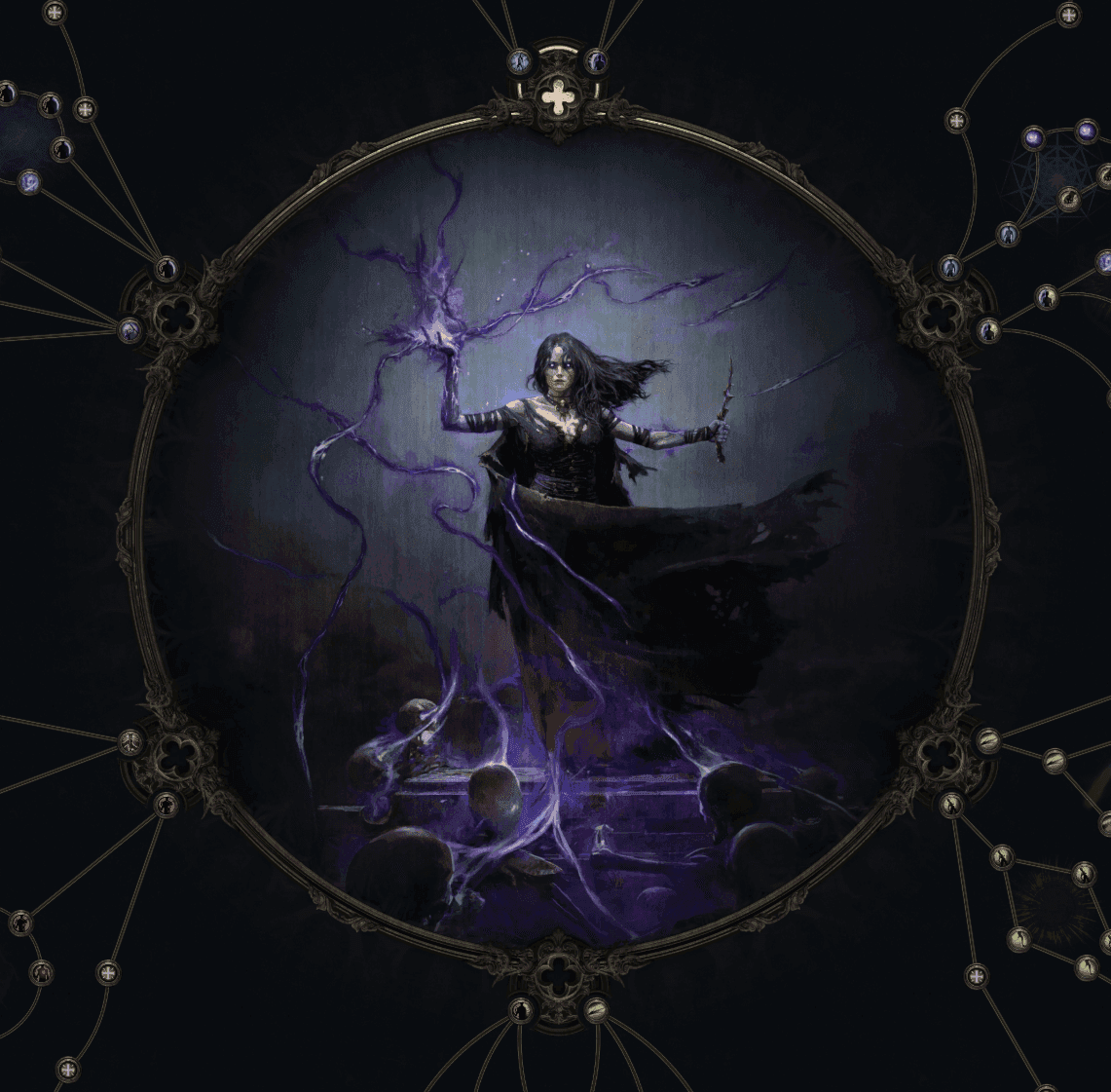
Witch in Path of Exile 2: Complete Class Guide, Ascendancies, and Builds for Infernalist, Blood Mage, and Lich
The Witch in Path of Exile 2 represents the quintessential master of pure Intelligence, commanding legions of the undead, devastating chaos entropy, and forbidden blood magic. Unlike the original game, one-button summoning of infinite zombies is gone. Her combat paradigm revolves entirely around managing a brand-new primary resource: Spirit, which strictly caps permanent minions and active permanent auras.
Quick take: The Witch starts in the northern Intelligence quadrant of the passive skill tree, prioritizing raw Intelligence, deep Energy Shield pools, and minion damage scaling. Every Sceptre intrinsically provides Spirit: 100 base alongside a built-in minion skill. The campaign awards another 100 permanent Spirit across quest rewards, and high-tier sceptre prefixes push this capacity further with up to +65% increased Spirit.
Class Fundamentals: Intelligence Attribute, Passive Tree Origin, and Defensive Layers
The starting node of the Witch sits at the absolute north of the global passive skill tree. Every 10 points of Intelligence grant +20 maximum Mana and +2% increased Energy Shield, naturally establishing the character's primary defensive buffer.
Unlike Strength-based juggernauts or high-dexterity rangers, the Witch begins with the lowest starting base Life pool. However, she compensates for this fragility with three layered lines of defense:
- Energy Shield (ES) — the primary protective barrier absorbing all incoming damage before it strikes Life. Energy Shield begins recharging automatically after a brief pause without taking damage;
- Meat Shield of Minions — Skeletal Brutes, Hellhounds, and bound Spectres intercept enemy projectiles and clog narrow choke points;
- Dodge Roll and Evasion — the universal roll on Space provides crucial invulnerability frames, letting you roll straight through devastating boss slams.
Never ignore hybrid gear bases during Acts 1 and 2. Equipping body armour with combined Armour/Energy Shield or Evasion/Energy Shield will save you from sudden physical one-shots far more effectively than stacking pure Energy Shield without early tree scaling.
The Spirit System Overhaul: Why Minions Are No Longer Free and How Sceptres Work
In Path of Exile 2, developers completely overhauled minion economy: you can no longer maintain a permanent zombie horde for zero ongoing cost. All persistent companions and permanent auras require reserving Spirit.
The mechanics operate under strict mathematical guidelines:
- The character possesses a dedicated Spirit counter completely independent of current Mana;
- Every persistent minion skill gem (such as skeletal warriors or a bound spectre via Bind Spectre) reserves a flat amount of Spirit — typically ranging from 15 to 100 units;
- While the minion is active, that reserved Spirit remains locked. If the minion dies in combat, the reservation stays active, and the entity automatically resurrects after a short timer;
- Unequipping a gem or unslotting gear that provides bonus Spirit will immediately despawn excess minions due to exceeding your Spirit cap.
The foundational weapon for every necromancer in the game is the Sceptre. Unlike wands, sceptres feature a critical implicit base property: every single sceptre (including a plain white Rattling Sceptre available at level 1) carries Spirit: 100 base and grants a built-in skill (such as Level 3 Skeletal Warrior). Magic and rare sceptres can roll high-tier prefixes granting up to +65% increased Spirit and hybrid Spirit/Mana modifiers (up to +38%), weapon quality applies a multiplicative % MORE Spirit scalar, and sockets holding Soul Cores add an extra +15 Spirit per socket. For an in-depth breakdown of socket links, meta-gems, and companion scaling, consult our dedicated guide on Skill Gems, Support Gems, and the Spirit System in Path of Exile 2.
Spirit Caps and Expansion Vectors: Scaling from 100 Base to Endgame Thresholds
Without an equipped sceptre, a new character starts with zero Spirit before quest rewards. Equipping a basic sceptre instantly yields 100 Spirit. Throughout the storyline campaign, you earn an additional 100 permanent Spirit across quest rewards (30 in Act 1, 30 across Acts 2–3, and 40 in the later chapters), setting a firm baseline of 200 Spirit before item affixes come into play.
- Permanent Campaign Quest Rewards — completing the storyline awards a guaranteed 100 permanent Spirit (30 in Act 1, 30 in Acts 2–3, and 40 in later acts);
- Equipping High-Tier Sceptres — all sceptres grant a base of 100 Spirit, while magic and rare rolls with % increased Spirit and quality scale this weapon contribution to 160–200+ Spirit;
- Infernalist Ascendancy Passives — the keystone node Beidat's Will reserves 25% of your maximum Life in exchange for +1 maximum Spirit per 25 maximum Life;
- Amulets and Distilled Emotion Anoints — endgame jewelry rolled with percentage Spirit modifiers and distilled emotion anoints pushes your Spirit pool beyond 400–500+ units in late-game mapping.
Mastering this resource economy defines your build path. A minion-focused Witch must constantly chase Spirit modifiers to field larger armies, whereas elemental spellcasters and blood mages redirect their Spirit into cast speed auras and defensive heralds.
The summoner's arsenal in Path of Exile 2 completely moves away from archaic generic zombies and uniform bone minions. Instead, necromancers command a versatile modular minion system where every undead variant fulfills a distinct tactical role — from frontline meat-shielding and elemental ailment infliction to sniping dangerous enemy spellcasters from afar.
Quick take: The game introduces 8 specialized skeleton skill gems alongside the advanced Bind Spectre mechanic that permanently preserves captured monsters within the gem itself. Pairing heavy frontline tanks with ranged elemental casters and the suicidal Detonate Minion spell forms the foundation of endgame map clearing.
The Complete Skeleton Roster: Warriors, Arsonists, Snipers, Brutes, Clerics, Mages, and Reavers
Every skeleton variant is an independent skill gem that requires reserving a specific amount of Spirit. You can combine multiple squads based on your available Spirit pool and specific build synergies.
| Skill Gem | Combat Role | Primary Damage | Key Tactical Utility |
|---|---|---|---|
| Skeletal Warrior | Line Infantry | Physical | Summoned rapidly from nearby corpses; forms an immediate physical meat shield and absorbs single-target strikes. |
| Skeletal Brute | Heavy Tank | Physical / Bludgeoning | Possesses a massive Life pool, executes sweeping circular slam attacks, and reliably stuns dangerous rare enemies. |
| Skeletal Arsonist | Support Grenadier | Fire | Hurls explosive incendiary bombs dealing area damage, ignites packs of enemies, and synergizes heavily with Infernalist builds. |
| Skeletal Sniper | Long-Range Artillery | Physical Piercing | Snipes priority targets from maximum range, punching clean through the enemy front line with heavy piercing arrows. |
| Skeletal Cleric | Medic & Aura-Bot | Light / Healing | Projects a continuous rejuvenation aura healing adjacent minions and the player, drastically reducing flask pressure. |
| Skeletal Frost Mage | Crowd Control | Cold | Casts cones of piercing ice shards, chills rushing monsters, and freezes threatening blue packs solid. |
| Skeletal Storm Mage | Shock Debuffer | Lightning | Unleashes chaining lightning strikes that reliably shock targets, amplifying all incoming damage dealt to them. |
| Skeletal Reaver | Shock Duelist | Physical / Bleed | Charges aggressively into enemy clusters with whirlwind slash combos, inflicting deep bleeding on vulnerable foes. |
Never allocate your entire Spirit budget purely to archers or mages. Without a durable shield of two Skeletal Brutes or a squad of four Skeletal Warriors, aggressive leaping beasts will instantly close the gap and delete your Witch in milliseconds.
The Bind Spectre Mechanic: Corpse Preservation, Resurrections, and Monster Archetypes
The Bind Spectre skill gem operates fundamentally differently than in the original game. In Path of Exile 1, spectres were tied to corpse mechanics: while saved monsters could be desecrated in your hideout, dying in combat or swapping gear frequently disrupted your minion roster. In Path of Exile 2, the mechanic is completely autonomous: the defeated monster is permanently bound to the gem itself. As long as you maintain the required Spirit reservation, the spectre automatically resurrects on its own after dying or changing zones, requiring zero corpse management or auxiliary Desecrate spamming.
The binding process follows a clear sequence:
- Locate a defeated rare or elite humanoid/monster possessing high-impact abilities;
- Hover your cursor over the corpse and activate Bind Spectre on your hotbar;
- The entity rises as a luminous phantom, permanently recording the monster's name and skill set onto your gem;
- If the spectre falls during a hectic boss encounter, it is never permanently lost; a hidden revival cooldown begins, automatically rematerializing the spectre at your side once complete;
- Spirit reservation for spectres scales from 50 units for standard casters up to 100 units for massive elite commanders.
To maximize the survivability of high-value phantoms, pair the gem with the Corpse Conservation support and specialized minion defense charms. For a complete analysis of defensive item bases and rare amulets, consult our detailed guide on Equipment, Item Bases, Charms, and Uniques in Path of Exile 2.
Sacrificial and Suicide Synergies: Detonate Minion and Profane Ritual
In high-tier necromancy, minion death on the battlefield is never a loss — it is a deliberate detonation. Developers embedded multiple destructive sacrificial mechanics directly into the base class toolkit.
Leading this archetype is the Detonate Minion spell. Upon activation, the Witch violently ruptures the nearest skeleton, firing an expansive burst of pure Fire damage scaled directly from the exploded minion's maximum Life. Pairing this spell with high-health Skeletal Brutes allows you to wipe entire map packs in a single keystroke.
Detonate Minion targets the nearest ally in your character's facing direction. Watch your positioning closely: accidentally detonating your prized Powered Zealot puts it on a lengthy resurrection timer, stripping your build of its primary single-target damage engine during a boss encounter.
The second essential synergy is the Cast on Minion Death support gem. An attached utility spell (such as widespread poison contagion or a protective frost dome) triggers automatically whenever the frontline skeleton wall collapses under enemy pressure. Paired with Profane Ritual, which consumes leftover bone fragments to grant rapid cast speed bonuses to the caster, the battlefield turns into an endless engine of death and explosions.
Among hundreds of capturable monsters available through Bind Spectre, the uncontested meta frontrunner of early access is the Powered Zealot. This elite humanoid turns the entire screen into an inescapable electrical storm, shredding mob density in seconds and melting pinnacle bosses within enclosed arenas.
Quick take: The Powered Zealot variant casting Spark is located in the windswept snowy crags of Etched Ravine. Coupled with Pierce and Wildshards supports, this spectre blankets the terrain in bouncing lightning projectiles, creating massive multi-hit shotgunning damage overlap.
Why the Spark-Casting Powered Zealot Breaks the Meta: Bouncing Projectile Mechanics
The secret behind the Zealot's devastating efficiency lies in how Spark projectiles interact with level geometry. Unlike fireballs or arrows that dissipate upon hitting solid objects, electrical sparks bounce off walls, pillars, and terrain contours, continuing to deal damage throughout their entire flight duration.
This behavior unlocks massive combat advantages:
- Shotgunning Overlap — a single monster or boss can be struck by multiple projectiles from the exact same volley if sparks ricochet off adjacent walls back into the target's hitbox;
- Corridor Dominance — inside caves, tombs, narrow corridors, and tight Abyss cracks, projectile density reaches critical mass, wiping packs before they even enter your visual field;
- Safe Passive Clearing — the Witch never needs to aim or step into melee danger. You simply take cover behind your skeletal wall while the spectres fire endless torrents of lightning.
Exact Spawn Location: Etched Ravine and How to Avoid Capturing the Wrong Variant
Locating the correct Powered Zealot is one of the most common stumbling blocks for new summoners. The monster spawns within the harsh snowy transition zone of Etched Ravine.
- Travel to the Etched Ravine waypoint and advance along the rocky mountain passes;
- Scout for packs of elite Vaal zealots. Pay close attention to their equipped weapons: you are looking for a humanoid wielding a two-handed lightning staff crackling with blue electricity;
- Defeat the pack carefully without triggering corpse-destroying abilities (Detonate Minion or bone explosions);
- Hover your cursor over the fallen corpse: the tooltip must strictly display the exact name Powered Zealot;
- Press your Bind Spectre hotkey. If the monster rises and immediately discharges a fan of blue sparks, the capture is successful.
The same zone spawns other tribal zealots wielding bows and heavy axes. If you accidentally bind an archer, your spectre will shoot single physical arrows instead of electrical sparks. If this occurs, unslot the Bind Spectre gem from your gear to purge the binding, re-equip the gem, and track down the staff-wielding lightning caster.
Support Gem Setup: Pierce, Wildshards, and Vilenta's Propulsion
Base Spark damage is modest on its own; true endgame scaling unlocks when socketing the optimal support gem links:
| Support Gem | Mechanical Impact on Spark | Link Priority |
|---|---|---|
| Pierce | Prevents sparks from fizzling upon striking the first target, punching clean through dense monster swarms. | Mandatory (1st Slot) |
| Wildshards | Significantly multiplies the number of projectiles discharged per volley, widening the arc to a full 180-degree fan. | Mandatory (2nd Slot) |
| Vilenta's Propulsion | Dramatically increases projectile velocity. Sparks cross the entire screen in fractions of a second and bounce 4–5 times before expiring. | High Priority (3rd Slot) |
| Chaos Attunement / Added Lightning | Provides a massive damage multiplier to each spark hit, melting beefy rare enemies and map bosses. | Endgame (4th Slot) |
FPS Drops and Visual Clutter: Optimizing Graphic Settings for Spark Spam
The primary drawback of this build is severe visual clutter. When two or three Powered Zealots simultaneously fire 30 sparks per second with projectile acceleration, the entire screen becomes a blinding sea of blue electricity. In this chaos, it is remarkably easy to miss lethal red boss void-zones or on-death exploding corpses.
Furthermore, on budget to mid-range graphics cards, calculating hundreds of bouncing particle physics reflections causes noticeable framerate stutter. To safeguard your character and preserve input responsiveness, disable motion blur, lower particle effect detail, and enable dynamic resolution scaling. For a complete optimization breakdown, consult our guide on System Requirements, FPS Boost, and Graphics Settings in Path of Exile 2.
Conquering the Trial of the Sekhemas and Trial of Chaos grants the Witch access to three fundamentally distinct Ascendancy specializations. Each radically redefines her core resource economy: one manipulates hellfire and Spirit reserves, the second fuels spells directly with vital blood, and the third immerses her in endless curse entropy behind an impenetrable Energy Shield.
Quick take: The Infernalist commands the summoner meta through Beidat's Will, converting maximum Life into record-shattering Spirit thresholds. The Lich delivers peerless Chaos damage scaling with permanent curses and Unholy Might, while the Blood Mage creates a formidable battlecaster boasting 5,000+ HP and a guaranteed 15% base spell critical strike chance.
Infernalist: Spirit Stacking via Beidat's Will, Loyal Hellhound, and Demonic Possession
The Infernalist Ascendancy has emerged as the definitive choice for minion commanders. Its passive progression directly solves the universal bottleneck of necromancer builds: severe Spirit capacity constraints.
Key Infernalist Ascendancy Passives:
- Beidat's Will — the foundational of the minion meta. This keystone reserves 25% of your maximum Life, granting +1 maximum Spirit for every 25 maximum Life. Scaling your Life pool to 3,000–4,000 points yields an astronomical 120–160 bonus Spirit out of thin air;
- Loyal Hellhound — summons a permanent fire hound that requires zero Spirit reservation. The beast aggressively taunts rare enemies, reduces enemy fire resistance, and pulls lethal boss attacks away from the Witch;
- Demonic Possession — enables a temporary transformation into a Demon, supercharging cast speed and imbuing all attacks with devastating Fire damage;
- Pyromantic Pact — replaces standard Mana with an Infernal Heat gauge. Spells generate heat, discharging thermal excess in a massive area-of-effect blast upon reaching peak capacity;
- Altered Flesh — a premier defensive node that converts 20% of Physical damage taken to Chaos, and 20% of Cold and Lightning damage taken to Fire, significantly easing elemental resistance gearing.
Blood Mage: Sanguimancy, Crimson Power Armour Conversion, and Lethal Criticals
The Blood Mage subverts the archetype of the fragile caster in threadbare robes. This is a heavily fortified combatant who draws destructive energy straight from her own Life globe, transforming physical spellcraft into a relentless barrage of critical strikes.
Key Blood Mage Ascendancy Passives:
- Sanguimancy — grants all skills a base Life cost equal to their original Mana cost, completely removing Mana flasks and the need for mana sustain;
- Crimson Power — converts 100% of Energy Shield granted by your equipped body armour directly into maximum Life. Equipping high-tier armour with 1,500 ES immediately rewards the Blood Mage with a massive +1,500 flat Life;
- Sunder the Flesh — locks the base critical strike chance of all spells to 15% (replacing the standard 5–6% baseline), making critical strike cap effortlessly achievable with basic tree investment;
- Grasping Wounds — a vital damage buffer: mitigates 25% of damage taken from hits and spreads it over 4 seconds as life loss, preventing abrupt one-shots;
- Whispers of the Flesh — prevents cursed enemies from regenerating Life and forces them to reserve at least 15% of their maximum Life.
Lich: Permanent Curses, Unholy Might, and the Immunity of Eternal Life
The Lich Ascendancy revolves entirely around dark entropy, corpse manipulation, hex application, and absolute protection through a self-replenishing energy barrier.
Key Lich Ascendancy Passives:
- Incessant Cacophony — your applied curses gain infinite duration and permit applying +1 additional curse simultaneously;
- Necromantic Conduit — as long as your Mana remains above a critical threshold, you and nearby allies within your Presence gain the coveted Unholy Might aura, granting 30% of Physical damage as extra Chaos damage;
- Eternal Life — a radical defensive keystone: your current Life cannot change as long as you have at least 1 point of Energy Shield remaining. While your shield holds, you are completely immune to direct Life damage;
- Crystalline Phylactery — unlocks a specialized socket for a standard jewel, doubling (+100%) the numerical value of all its explicit modifiers.
To master trial trials and claim all 8 Ascendancy points, read our comprehensive walkthrough on Ascendancy Classes and Trials in Path of Exile 2.
MMO Chronicles Signature Ascendancy Tier List: Matching Playstyles
While every Ascendancy dominates its intended niche, ranking them by campaign versatility and late-game scaling establishes the following hierarchy:
The undisputed king of the summoner meta. Beidat's Will inflates the Spirit pool to unprecedented heights, fielding three Powered Zealots, a full skeleton wall, and protective auras without sacrificing personal survivability.
The premier choice for hybrid chaos and corpse clearing. Infinite curse uptime, Unholy Might damage buffs, and chaining minion explosions deliver top-tier clear speed across narrow map layouts.
A tanky battlecaster designed for players moving beyond minion armies. Converts armour into an enormous Life pool, caps spell criticals with ease, and facetanks endgame boss mechanics.
The Infernalist Spark-Spectre summoner build is widely recognized as the gold standard for high-tier Atlas map progression in Path of Exile 2. This setup unites absolute player safety, automated off-screen screen-clearing, and reliable survivability behind a layered physical meat shield.
Quick take: The build expands the Spirit pool to 380–450+ units via the Beidat's Will keystone and a high-tier sceptre, fielding three Powered Zealots, two Skeletal Brutes, and a free Loyal Hellhound simultaneously. Thousands of ricocheting sparks obliterate map packs and melt boss health bars in enclosed arenas.
Build Mechanics: Life-to-Spirit Conversion via Beidat's Will and Stacking 3+ Spectres
The classic limitation of early summoners is the inability to field more than one high-tier spectre without sacrificing all defensive auras. The Infernalist bypasses this bottleneck through elegant mathematical scaling:
- We scale flat Life across gear affixes and passive tree nodes, reaching a comfortable 3,500–4,000 HP;
- The Ascendancy keystone Beidat's Will reserves 25% of this pool, granting +1 maximum Spirit per 25 maximum Life, which injects +140 to +160 flat Spirit into your reservation pool;
- An equipped sceptre provides 100 base Spirit, while high-tier percentage prefixes push weapon contribution past 160+ Spirit. Storyline campaign quests contribute another 100 permanent Spirit;
- Your total pool effortlessly exceeds 400–450+ Spirit. This comfortably accommodates three Powered Zealots (reserving 65–75 Spirit each), two heavy Skeletal Brutes (30 Spirit), and a defensive resistance aura.
Complete Action Bar Setup: Zealot Spectres, Hellhound, Skeletal Brutes, Warcries, and Auras
For seamless combat execution, the skill bar is strictly configured to divide responsibilities between minion AI and player positioning:
| Hotkey / Slot | Skill Gem | Support Gem Links | Tactical Purpose |
|---|---|---|---|
| Primary Skill (Q) | Bind Spectre (3x Powered Zealot) | Pierce + Wildshards + Vilenta's Propulsion | Primary damage engine. Fires an unrelenting stream of ricocheting sparks that clears entire screens. |
| Secondary Skill (W) | Skeletal Brute (2x Skeletal Brute) | Hulking Minions + Minion Life | Frontline tanks. Absorbs lethal boss slams, stuns rare mobs, and acts as a physical wall. |
| Passive Minion | Loyal Hellhound | Automatic Ascendancy Skill (0 Spirit cost) | Aggressively taunts priority targets, inflicts Flammability, and strips fire resistance from vanguard mobs. |
| Mouse 2 (RMB) | Command Minions | Unlinked | Designates target priority for Zealot sparks and repositions minions out of lethal ground degens. |
| Defensive Utility (E) | Infernal Cry | Increased Area of Effect | Taunts flanking packs and covers enemies in combustion ash, causing them to explode on death. |
| Mobility (Space) | Dodge Roll | Base Mechanic | Instant distance creation against charging bosses and evading telegraphed projectiles. |
Step-by-Step Combat Rotation: Pack Initiation, Choke Point Control, and Boss Positioning
The combat rotation is remarkably fluid and does not require frantic keyboard piano:
- Pack Initiation — as you approach a mob cluster, issue a Command Minions order via RMB. The Hellhound charges forward first, taunting high-threat targets;
- Spectre Volley — the trio of Powered Zealots sets up behind the Brutes, firing a crossfire fan of Sparks that punches through frontliners and bounces down the corridor;
- Positioning Buffer — maintain a safety buffer of roughly one screen. If swift beasts attempt to flank, pop Infernal Cry on E and dodge roll backwards;
- Boss Optimization — direct your minion focus cursor not directly at the boss, but at a nearby wall or corner immediately behind them. Bouncing sparks will reflect straight back into the boss's hitbox for immense shotgunning burst.
Passive Tree Allocation Priorities: Spirit Nodes, Minion Life, and Elemental Resistances
Passive tree progression follows a strict hierarchy: we avoid investing in personal spell damage nodes, directing every point into minion stats and maximum Life scaling.
Prioritize allocating into these core passive clusters:
- Maximum Life Nodes — northern and northeastern Life wheels fuel Beidat's Will Spirit conversion;
- Minion Cast Speed — directly multiplies the firing cadence of Zealot Spark casts;
- Minion Resistances and Durability — ensures your frontline Brutes and Zealots withstand high-tier map boss damage;
- Lightning Penetration — bypasses elemental resistance on rare monsters and map modifiers.
For complete tree progression paths, jewel placements, and gold respec mechanics, consult our guide on the Path of Exile 2 Passive Skill Tree, Dual Spec, and Gold Respecs.
While the Infernalist leverages an electrical storm of spectres, the Lich Ascendancy champions the doctrine of total corruption. This build marries the crushing physical brutality of a frontline skeleton horde with an overwhelming Chaos damage amplifier, permanent curses, and cascading corpse detonations.
Quick take: The Lich empowers the minion swarm with permanent Unholy Might, granting +30% of Physical damage as extra Chaos damage. With the Eternal Life keystone, the Witch's Life globe becomes completely untouchable behind a massive Energy Shield, while corpse explosion passives dissolve entire monster clusters in fractions of a second.
Build Core: Chaos Damage Conversion via Unholy Might and Melee Swarms
At the center of this setup lies the Ascendancy node Necromantic Conduit. As long as the Witch maintains her Mana above the low-mana threshold, the player and all surrounding allies within her Presence receive a continuous offensive powerhouse buff: Unholy Might.
This delivers exceptional damage scaling specifically tailored for melee minions:
- Skeletal Warriors deal high base Physical damage. Adding +30% of Physical as extra Chaos damage allows a squad of 6–8 warriors to instantly shred through heavily armoured knights and stone constructs;
- Skeletal Reavers apply deep bleeding with their whirlwind combos, cleaving packs while discharging waves of Chaos energy;
- Unlike elemental damage, Chaos damage bypasses the vast majority of standard monster resistances across the campaign, ensuring stable clear speed across high-tier map mods.
Dual Permanent Curse Engine: Incessant Cacophony Mechanics
Standard spellcasters must constantly recast hexes every few seconds, breaking combat cadence and risking lethal counterattacks. The Ascendancy keystone Incessant Cacophony eliminates this chore entirely.
The keystone provides two extraordinary advantages:
- Infinite Duration — once applied, curses remain active on bosses until they die, even during multi-phase encounters lasting several minutes;
- +1 Curse Limit — allows stacking two simultaneous hex debuffs without needing elusive curse modifiers on rare rings or amulets.
The premier curse pairing for this build combines Chaos vulnerability with Physical armour reduction. Casting both at the start of a boss fight allows you to focus purely on positioning and dodge rolling while your minions do the rest.
Defensive Architecture: The Eternal Life Keystone and Energy Shield Scaling
The Lich's defensive identity centers on the radical keystone Eternal Life. Its mechanic is uncompromising: your current Life cannot change in either direction as long as you maintain at least 1 point of Energy Shield.
As long as your Energy Shield has not dropped to absolute zero, the Witch completely ignores health damage penetration, poison damage over time, and bleeding punctures. Every incoming blow hits your ES first. Your primary gearing objective is maximizing flat and percentage ES across your body armour, crown, and focus shield, pushing your blue buffer to 3,500–4,500 units.
To amplify your shield pool, allocate the Ascendancy node Crystalline Phylactery. Socketing a standard jewel with percentage ES and elemental resistances doubles (+100%) all of its numerical stats. To further boost your vital passives, consult our complete guide on Amulet Anointing, Distillates, and Delirium Liquid Emotions in Path of Exile 2.
Corpse Detonation Rotation: Triggering Chain Reactions with Rupture the Soul
The signature visual and tactical thrill of playing a Lich is watching a single fallen monster trigger the explosive annihilation of the entire surrounding room. This chain reaction stems from the synergy between the Rupture the Soul Ascendancy passive and Chaos damage-over-time spells.
| Combo Step | Skill / Mechanic | Visual and Mechanical Execution |
|---|---|---|
| 1. Pack Contagion | Contagion | The Witch casts a wave of corruption across the front line, applying Chaos degeneration. |
| 2. Minion Strike | Skeletal Warriors | The Unholy Might-empowered horde collapses onto the first infected target, killing it within half a second. |
| 3. Detonation | Rupture the Soul | With a 33% chance, the cursed corpse detonates, dealing 25% of its maximum Life as Chaos damage in a wide area. |
| 4. Cascading Wipe | Corruption Spread | The blast instantly kills adjacent infected targets, firing a room-clearing chain reaction of corpse explosions. |
Against isolated bosses without summoned adds, the Lich sustains steady pressure by casting Profane Ritual and weaving Chaos Bolt volleys while the skeleton wall pins the boss in place.
For players weary of passive minion management who want to obliterate pinnacle bosses with devastating self-cast spells, the Blood Mage offers one of the most aggressive and visceral playstyles in Path of Exile 2. Known colloquially as the "Gorehound" or "Gore-Bone" build, it leverages the lethal synergy between vital blood magic, an enormous Life buffer, and a physical tempest of bone shards dischargeed through Bonestorm.
Quick take: The Blood Mage completely abandons Mana via Sanguimancy, inflates her Life pool to an unprecedented 5,000–6,000+ HP through body armour Energy Shield conversion, and locks her base spell critical strike chance to an astonishing 15%.
Build Mechanics: Bypassing Mana with Sanguimancy and Stacking 5,000+ HP via Crimson Power
Traditional spellcasters constantly struggle to balance mana costs, cast speed, and defensive layers. The Blood Mage resolves this dilemma with brutal efficiency:
- The Ascendancy keystone Sanguimancy converts the base resource cost of all abilities directly into Life. The blue Mana globe is completely disabled, freeing your flask slots exclusively for defensive utility and offensive concoctions;
- The keystone Crimson Power takes 100% of the Energy Shield value granted by your equipped body armour and converts it into pure maximum Life;
- By equipping a heavy hybrid armour or regalia granting 1,500–1,800 ES, the Witch gains an equivalent boost to her red Life globe, easily surpassing the 5,000–6,000 HP milestone.
When piloting a Blood Mage, evaluate chest armour exclusively by its raw Energy Shield number. The higher the base ES on the item prior to socketing runes, the greater the flat Life pool granted upon allocating Crimson Power.
Bonestorm Skill Setup: Physical Burst, Aggravated Bleed, and Leech Synergies
The primary offensive weapon is Bonestorm. Upon activation, the Witch fires an expansive vortex of razor-sharp bone fragments, dealing heavy Physical damage in a wide radius around herself.
The skill's damage engine operates across three interlocking layers:
- Aggravated Bleeding — through the passive node Blood Barbs, any bleed applied to a cursed target automatically becomes Aggravated, dealing maximum damage-over-time regardless of whether the enemy is moving or stationary;
- High-Velocity Leech — the Ascendancy node Vitality Siphon returns 20% of spell damage dealt as instant Life Leech. Because Bonestorm hits dozens of enemies per cast, your Life globe tops off instantly with every activation;
- Gore Remnants — slaying enemies with blood magic drops vitality orbs that temporarily amplify movement and cast speed when collected.
Lethal Criticals: Leveraging the 15% Base Spell Crit from Sunder the Flesh
In most action-RPGs, baseline spell critical strike chance is strictly constrained between 5% and 6%. The Ascendancy passive Sunder the Flesh shatters this design paradigm, fixing base spell crit at a staggering 15%.
| Critical Metric | Standard PoE 2 Spellcaster | Blood Mage | Combat Performance |
|---|---|---|---|
| Base Spell Crit Chance | 5.0% – 6.0% | 15.0% | Starting baseline is nearly three times higher. |
| Final Crit with Tree Investment | 25% – 35% | 75% – 90% | Virtually every Bonestorm cast lands as a devastating critical strike. |
| Critical Damage Multiplier | Standard (150%) | +100% Bonus Damage (+1% per 50 HP) | At 5,000 HP, critical strikes obliterate rare packs instantly. |
Grasping Wounds Defensive Buffer and Flask Charge Management
The Blood Mage's vast Life pool is reinforced by the layered mitigation of Grasping Wounds. A quarter (25%) of all incoming hit damage is immediately absorbed and converted into damage-over-time spread across 4 seconds. In tandem with continuous Life Leech from Bonestorm, this prevents abrupt boss one-shots.
Tying the defensive package together is Sanguine Tides: Life flasks cease healing directly, but recharge whenever Life is spent on casting spells. Striking enemies at full charges automatically discharges accumulated energy into bonus Physical damage. To optimize your weapon and armour sockets with high-tier runewords, review our comprehensive guide on Runes, Runeforging, and Bonded Socket Mechanics in Path of Exile 2.
Leveling a Witch through the Path of Exile 2 campaign provides an unmatched sense of power progression: evolving from a fragile castaway desperately fending off shambling corpses into an all-powerful harbinger commanding plagues and legions of the undead. However, inexperienced exiles frequently hit brutal difficulty filters throughout the storyline, none more notorious than the Act 2 gatekeeper — The Aberration.
Quick take: The key to effortless Witch leveling is purchasing a Sceptre from the town blacksmith at level 1 for the essential Spirit base, completing every side quest awarding permanent Spirit, and micro-managing minion positioning on The Aberration using Command Minions to pull them out of deadly caustic acid.
Act 1 Progression Route: First Sceptre Purchase, Starter Skeletons, and Kiting
Upon washing ashore, newcomers often fall into a major itemization trap: picking up a caster wand with spell damage bonuses and wondering why they cannot summon an additional squad of undead. In Path of Exile 2, wands are designed for direct spellcasters, while the dedicated tool of the summoner is the Sceptre.
- Upon reaching the initial survivor encampment, immediately check the weapon vendor's stock;
- Purchase the simplest available Sceptre (even a basic normal Rattling Sceptre intrinsically features Spirit: 100 base and grants Skeletal Warrior);
- Equipping the sceptre instantly unlocks 100 Spirit, while finding a magic sceptre with a percentage Spirit prefix expands this capacity further, letting you maintain a full skeleton vanguard alongside an active defensive herald;
- Keep a ranged targeting spell on your bar (such as Chaos Bolt or Spark) to pick off priority targets safely from behind your skeletal line.
The Aberration Boss Strategy (Act 2): Caustic Pools, Slam Telegraphed Dodges, and Minion Repositioning
The Aberration, guarding the threshold of Traitor's Passage in Act 2, represents the premier hurdle for summoner builds. Death statistics on this encounter are staggering: unprepared summoners routinely lose their entire minion army within five seconds and perish immediately afterward.
The encounter's lethal threat stems from three mechanics:
- Caustic Spew — The Aberration periodically vomits massive pools of concentrated acid. Unmanaged minions will stand in the degen and melt in 2–3 seconds due to lacking baseline chaos resistance early on;
- Telegraphed Heavy Slam — the boss rears up on its forelegs before smashing the ground. This physical shockwave instantly crushes fragile skeletons;
- Brood Swarms — during phase two, the boss spawns swarms of skittering parasites that steal minion aggro, pulling them out of position.
Never remain stationary. Circle the outer perimeter of the arena counter-clockwise. The instant the boss begins vomiting acid, press RMB (Command Minions) to target safe ground behind the beast, forcefully pulling your minions out of the caustic sludge. When the boss rears up for the slam, roll directly through its body model with Space to land safely in its blind spot.
Permanent Campaign Spirit Rewards: Collecting Hidden Reservation Capacity
Many players enter early endgame mapping with barely 130–150 Spirit and wonder why they cannot sustain a full spectre setup. The reason is simple: skipping hidden storyline side quests.
Across the campaign acts, several key milestone quests permanently expand your Spirit capacity via permanent quest elixirs:
| Campaign Chapter | Quest Source | Permanent Spirit Reward |
|---|---|---|
| Act 1 | Primary storyline and hidden regional trials | +30 Maximum Spirit permanently |
| Acts 2 and 3 | Freeing captives and ancient ancestor shrines | +30 Maximum Spirit permanently |
| Later Chapters (Late Acts) | Final trial milestones of the campaign storyline | +40 Maximum Spirit permanently |
For a complete speed-route covering every permanent stat elixir, skill book quest, and secret encounter, review our step-by-step Path of Exile 2 Campaign Walkthrough and Permanent Bonuses Guide.
Five Critical Mistakes Every New Witch Player Must Avoid in PoE 2
To ensure a smooth leveling journey without frustrating death penalties, remember these core principles:
- Wielding Wands Instead of Sceptres — forfeiting the innate Spirit base prevents you from summoning resilient frontline skeleton tanks;
- Neglecting the Command Minions Hotkey — minions will blindly stand in boss ground degens without manual repositioning orders;
- Ignoring Hybrid Gear Bases — wearing exclusively pure Energy Shield cloth in early acts leaves you vulnerable to physical projectile one-shots;
- Over-Investing in Ranged Minions — fielding only archers and mages without Brutes or Warriors leaves you defenseless against fast leaping beasts;
- Rushing Past Side Quests — running strictly along the golden path starves your character of critical permanent Spirit rewards.
In the endgame of Path of Exile 2, gear progression for the Witch transcends simple resistance capping and armour totals. For both summoners and direct spellcasters, every equipment slot serves as an active engine for direct minion scaling, Spirit expansion, and converting defensive ratings into overwhelming damage output.
Quick take: The equipment foundation of a necromancer revolves around a high-tier Sceptre (Spirit: 100 base) rolled with % increased Spirit prefixes, a pure Energy Shield chest regalia, and the iconic unique boots Bones of Ullr. In-game trading via Faustus allows filtering and buying ideal bases instantly using accumulated gold.
Item Base Priorities: Sceptres for Spirit (+Spirit), Wands for Gem Levels, and Body Armour
When assembling your gear set, follow a strict hierarchy of modifier utility across each specific slot:
| Equipment Slot | Priority Base Type | Key Prefixes | Key Suffixes |
|---|---|---|---|
| Main Hand Weapon | Sceptre (Summoner) / Wand (Caster) | Spirit: 100 base, % increased Spirit (up to +65%), hybrid Spirit/Mana (up to +38%), +to Minion/Spell Gem Levels | Cast Speed, Spell Critical Damage, Chaos Damage Multiplier |
| Off-Hand | Focus or Energy Shield Shield | +to Spirit, Flat Energy Shield, Maximum Life | Elemental Resistances, Spell Block Chance |
| Body Armour | High-Tier Pure ES Regalia | High Flat Energy Shield (% and flat), Maximum Life | Chaos Resistance, Elemental Resistances |
| Helmet & Gloves | Pure Intelligence (ES) Bases | +to Socketed Gem Levels, Flat Energy Shield, Life | Cast Speed, Elemental Resistances |
| Amulet & Rings | Crystal & Unset Rings, Paua Amulets | % increased Maximum Spirit, Maximum Life, Minion Damage | Missing Attributes (Strength/Dexterity), Chaos Resistance |
Meta Uniques for Necromancers: Bones of Ullr and Complementary Relics
Among unique items available to summoners, the legendary Bones of Ullr boots occupy a revered status. This artifact provides a suite of critical build stats:
- Increases the maximum Life pool of all summoned minions by 15–20%;
- Reduces the Spirit reservation requirements for persistent minion skills;
- Provides crucial bonus Movement Speed, allowing the Witch to reposition away from telegraphed boss slams;
- Adds flat Energy Shield and Mana sustain.
Never rush to buy this unique at inflated early-campaign prices. Basic Skeletal Brutes and a single Powered Zealot wielding a well-rolled rare sceptre will carry you smoothly through Tier 10+ maps. Purchase Bones of Ullr when pushing into red maps and tackling endgame pinnacle bosses.
Runeforging and Sockets: Optimal Runewords for Summoner Equipment
The Runeforging system turns empty equipment sockets into hidden engines of customized build power. Depending on your chosen Ascendancy, socketing strategies split into two paths:
- For Infernalists and Pure Summoners — socket runes that amplify minion physical and elemental damage into your weapon, while using chest and helm sockets to cap Fire, Cold, and Lightning resistances at 75%;
- For Blood Mages and Liches — prioritize flat Energy Shield runes in your body armour and crown. On a Blood Mage, this ES immediately converts into maximum Life via Crimson Power, while on a Lich it bolsters the Eternal Life protective barrier.
For complete rune lists, bonded resonance mechanics, and advanced crafting strategies, explore our comprehensive guide on Crafting, Currency Orbs, Runes, and Item Affixes in Path of Exile 2.
Trading via Faustus: Search Filters for Sceptres and Spirit Amulets
The in-game auction house operated by Faustus frees players from tab-alt browsing on external trading websites. You can acquire high-tier sceptres and jewelry directly from your hideout using in-game gold.
- Open the Currency Exchange and trading menu at NPC Faustus;
- Under item category, select One-Handed Weapons → Sceptres;
- In the stat filter tab, enter the modifier: #% increased maximum Spirit;
- Add a secondary filter for minion gem levels (+1 or +2 to Minion Skill Gems);
- Sort results by instant buyout price and claim your item immediately without waiting for player invites.
All transaction mechanics, gold commission rates, and currency exchange arbitrage are detailed in our guide on Trading and Currency Exchange via Faustus in Path of Exile 2.
While mastering the Witch and her Ascendancies, players inevitably encounter nuanced questions regarding hidden gem interactions, minion AI behavior, and resource optimization. Below are answers to the most frequent questions asked across the community.
Quick take: Spectres in Path of Exile 2 do not despawn upon changing acts or dying; they are permanently bound to the gem. Fielding multiple Powered Zealots requires expanding your Spirit pool via the Infernalist Ascendancy, while the Blood Mage's Sanguimancy never expends Life for persistent minion reservations.
Frequently Asked Questions: Witch Mechanics, Spectres, and Build Nuances (FAQ)
Why is my Powered Zealot attacking in melee or shooting arrows instead of casting Sparks?
The Etched Ravine zone spawns three tribal variants of the same zealot monster. You captured an archer or a melee warrior by mistake. To fix this, unslot the Bind Spectre gem from your equipment to purge the current binding. Return to the zone and locate the humanoid wielding a crackling two-handed electrical staff surrounded by blue lightning discharges.
What happens to my spectre when my character dies or travels to a new Act?
Unlike the original game, spectres in Path of Exile 2 are permanently saved within the gem itself. Upon player death, logging out, or transitioning between campaign chapters, the spectre never disappears. If it dies in combat, a revival cooldown triggers, rematerializing the phantom at your side automatically with full health.
Can I maintain two or three Powered Zealots simultaneously?
Yes, but each Powered Zealot reserves approximately 65–75 Spirit. An equipped sceptre intrinsically provides 100 base Spirit, and completing the campaign awards another 100 permanent Spirit (200 baseline). Selecting the Infernalist Ascendancy with Beidat's Will (converting 25% Life into Spirit) and wielding a sceptre with % increased Spirit prefixes scales your pool to 380–450+ Spirit, comfortably fielding three to four spectres.
How do I defeat The Aberration if my skeletons die within two seconds?
Skeletons die not from the boss's basic attacks, but from standing in caustic acid pools that The Aberration vomits onto the floor. Use the Command Minions command on RMB to forcefully relocate your minions to clean ground behind the beast. When the boss rears up for its heavy physical slam, dodge roll through its body using Space.
Does the Blood Mage's Sanguimancy spend Life to reserve persistent auras and minions?
No. Sanguimancy replaces Mana costs with Life only for active spellcasts (such as Bonestorm). All persistent auras, heralds, and minions continue to reserve capacity from the dedicated Spirit gauge, preserving your maximum Life globe.
How can I fix FPS stutter and lag when Powered Zealots spam Sparks?
In graphics settings, disable Motion Blur, set Particle Effect Quality to Medium or Low, and enable Dynamic Resolution Scaling with a 60 FPS target. This relieves the GPU when calculating hundreds of physics particle reflections in enclosed map rooms.
Can I respec my Ascendancy class from Infernalist to Lich later on?
Yes. In Path of Exile 2, passive skills and Ascendancy points are refunded using in-game gold at town alchemists and elders. To change your Ascendancy, refund all 8 allocated points in your current branch and interact with the altar in the Trial halls. For detailed costs and dual-spec mechanics, consult our guide on Passive Skill Tree Respecs and Dual Spec in Path of Exile 2.