 F2P · Live
Lineage 2
Aden's castles never stay in the same hands for long, and Lineage II has built an entire twenty-three-year…
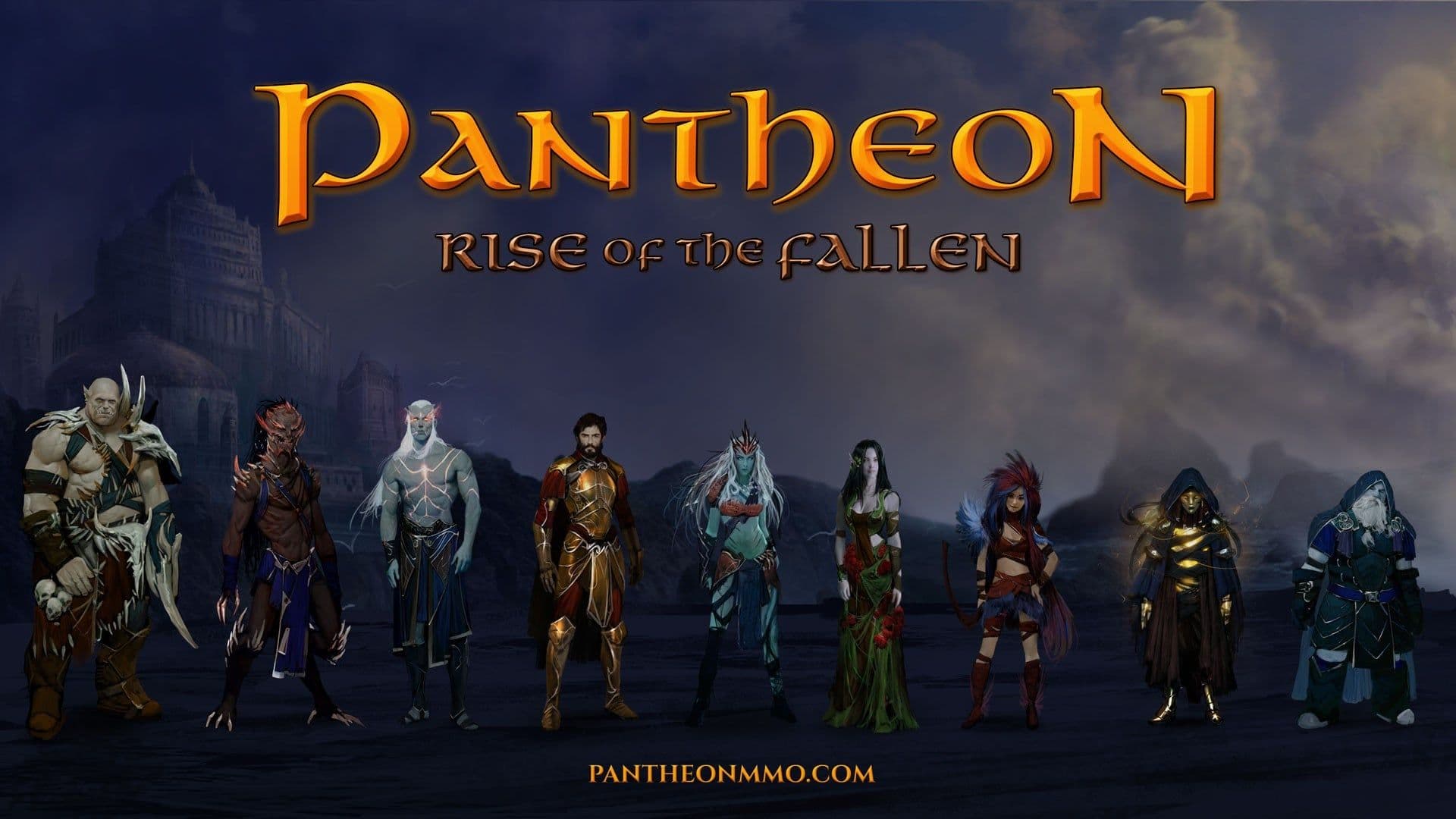
Pantheon: Rise of the Fallen is a group-focused fantasy MMORPG from Visionary Realms that rebuilds the design language of late-1990s EverQuest for modern hardware. Explore the stitched-together world ...
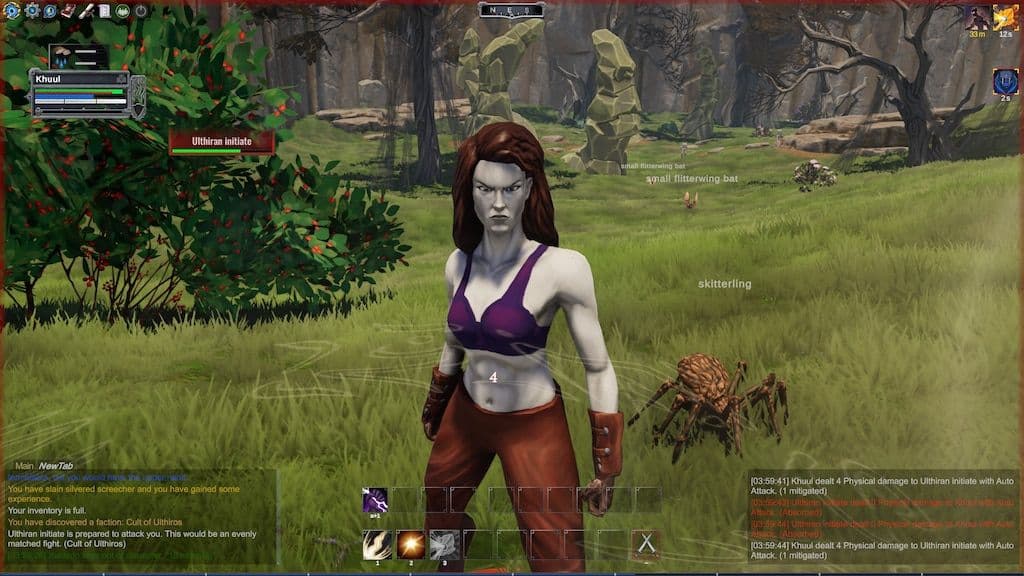
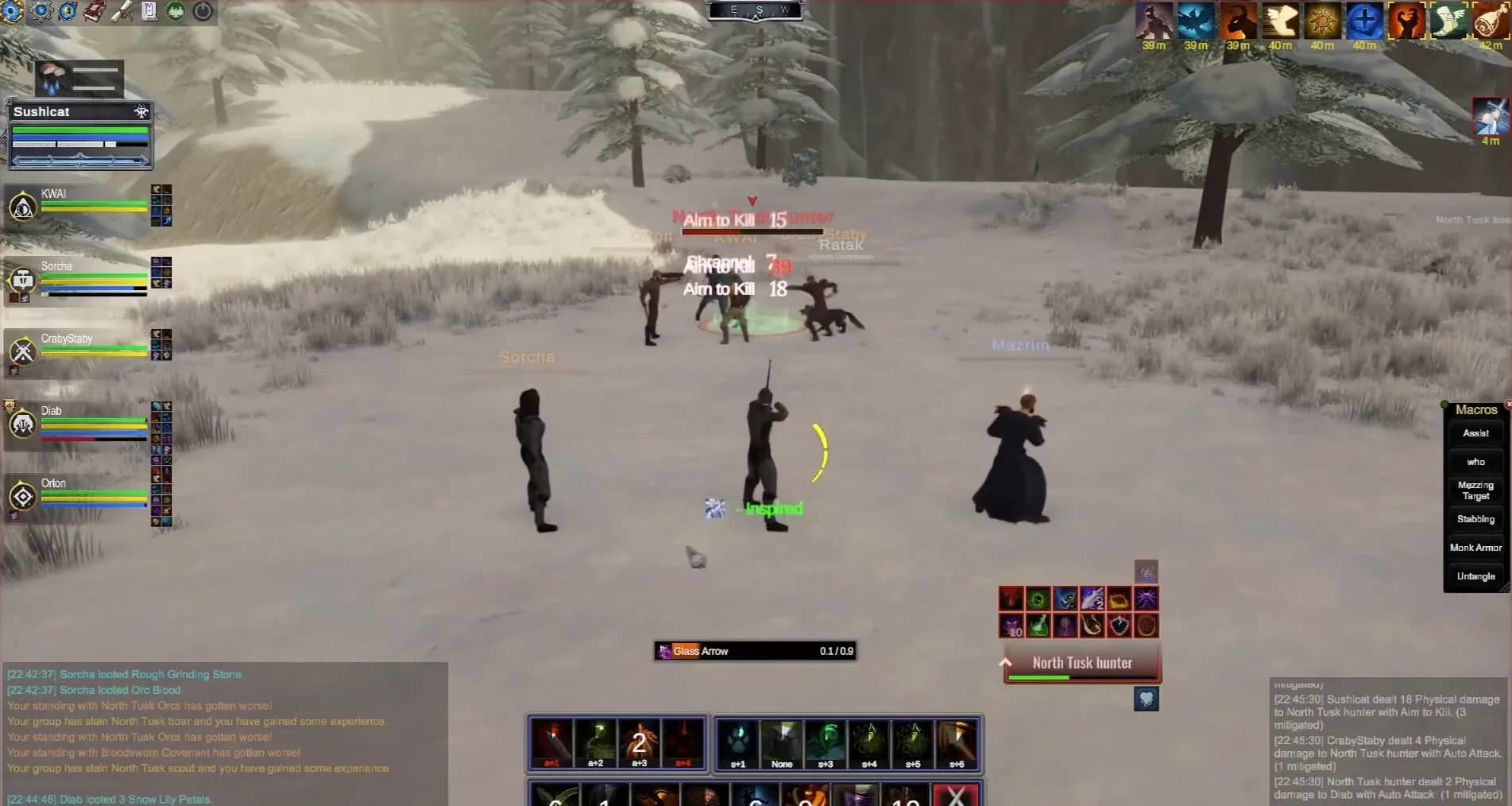
Pantheon: Rise of the Fallen is a group-focused fantasy MMORPG from Californian studio Visionary Realms, released into Steam Early Access on December 13, 2024 after more than ten years of crowdfunded development. It rebuilds the design language of late-1990s EverQuest — contested spawn camps, punishing deaths, parties assembled by asking strangers in chat — on top of modern movement and a hand-painted art style. Nearly two years into Early Access it is still unfinished, and the biggest update since launch is sitting on a public test server rather than on the servers people actually play.
Quick take: Pantheon: Rise of the Fallen does deliver the classic-EverQuest experience it spent a decade promising, and its community is among the most welcoming in the genre. It is also small, thinly populated, and about to reset every character on the live servers. Buy it if slow, group-dependent play is the point rather than the obstacle; otherwise the Combat and Progression Update is the moment to check back.
Terminus is a stitched-together planet, and the game commits to that premise more thoroughly than most fantasy MMOs commit to anything. Whole civilizations were torn out of their own worlds by planar collisions and dropped onto one landmass, which is why a dwarven hold, an ogre warcamp and a drowned Dark Myr city can share a coastline without the setting apologising for it. Five hundred years before the game opens, a war between mortals and gods severed the connection between them, and the pantheon the title refers to has been silent ever since.
The world is delivered through geography and item text rather than cutscenes. The quest log is thin by design; what Terminus tells you, it tells through a ruined watchtower you climbed to reach or an NPC who mentions something odd about the caves to the north. Players coming from story-driven MMOs will find this austere. Players who remember reading zone names off a paper map will find it familiar.
The visuals are where long-time backers and newcomers diverge hardest. In 2023 Visionary Realms abandoned the semi-realistic look it had shown for years — largely assembled from purchased Unity Store assets — in favour of a cheaper, faster hand-painted style the studio said its roughly 30-person team could actually sustain. Backers who had pledged in 2014 on the strength of the old screenshots took it badly, and comparisons to cartoon MMOs still surface in Steam reviews today. The current build looks cohesive and reads clearly at distance, which matters more in practice than fidelity does, but it does not look like the game that was sold in the Kickstarter pitch.
The opening hour is deliberately unhelpful, and that is the first thing a modern MMO player has to make peace with. You pick a race and class, land in a starting town such as Thronefast, and receive no golden path, no marker chain, and no escort to your first objective. What you get instead is a handful of abilities, a binding stone to set your respawn point, and the expectation that you will walk out of the gate and find out where the level 3 wildlife lives.
Movement carries more of the early experience than the combat does. Sprint is limited by stamina, there are no mounts at low level, and nearly any surface can be climbed — cliff faces, tower walls, the underside of overhangs — which turns the terrain into a puzzle rather than a corridor. Climbing is one of the systems Visionary Realms shipped complete, and it does real work: shortcuts, hidden ledges and back entrances into dungeons are all reachable if you are willing to look up.
Progression is slow in a way that is measured in evenings, not minutes. Abilities are bought from class trainers rather than granted automatically at level-up, which means levelling has an ongoing gold cost attached to it. The live servers cap at level 40, with 50 currently being trialled on the test realm. A veteran of the era this game is imitating will recognise the pacing immediately; anyone arriving from a game with a levelling boost in the cash shop should understand that reaching the cap here is a project measured in weeks.
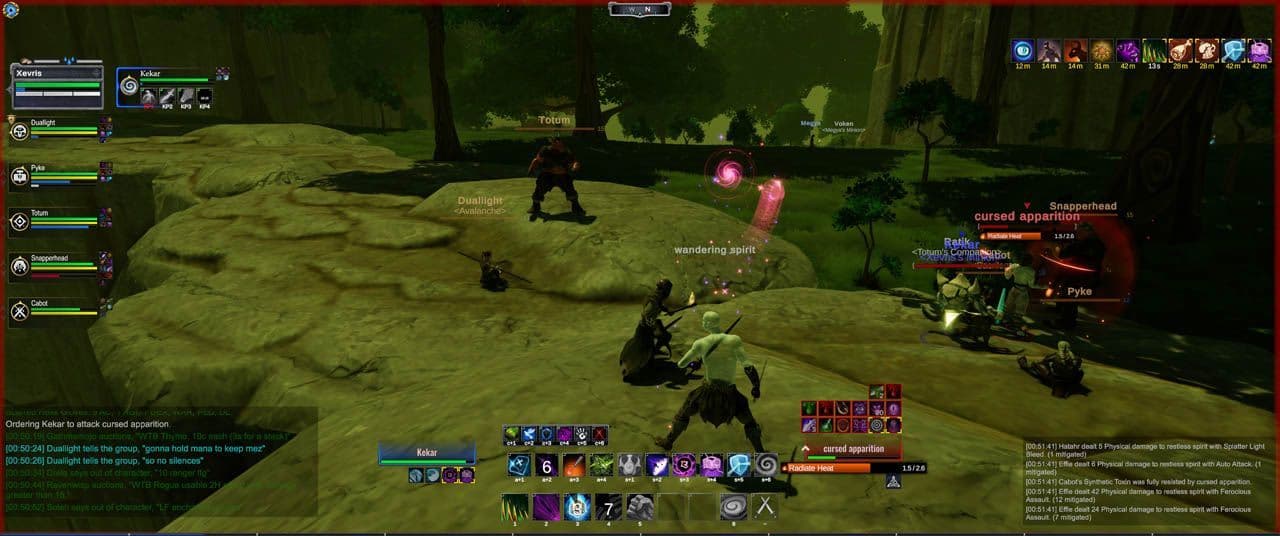
Combat is tab-target and deliberately slow, built around resource management rather than reaction speed. Fights last long enough that mana, stamina and cooldown timing decide outcomes, and a caster who burns through their bar in the first thirty seconds becomes dead weight for the rest of the pull. Between fights, groups sit and recover — the downtime that modern MMOs engineered out of existence is present here on purpose, and it is where most of the socialising happens.
The Limited Action Set is the structural idea underneath all of it. Rather than accumulating a bar of forty situational buttons, you slot a restricted number of abilities before you head out, which forces a real decision about what job you intend to do that evening. Enemies push back against that with dispositions — behavioural templates that determine whether a mob flees at low health, calls for help, focuses the healer, or coordinates with the pack around it. Two encounters against the same creature type can go very differently depending on what rolled onto them.
Visionary Realms lists fourteen classes and nine races for the finished game; the current build runs a subset of those across four roles — tank, healer, damage and support. Support is the interesting one, because Pantheon restores a role most MMOs deleted. Enchanters mesmerise and charm rather than deal damage, Summoners handle corpse recovery and pets, Necromancers trade health for utility, and the recent Wizard rework split that class into an elemental caster and a melee-oriented Spellblade path. Crowd control is a genuine job description again, not a talent point.
Yes, for the most part. Pantheon: Rise of the Fallen can be soloed in the first ten or so levels and by certain self-sufficient classes beyond that, but the experience curve, the enemy density and the death penalty all assume a party of five or six. Players report that solo levelling past the mid-teens slows to a crawl and that most of the worthwhile content — dungeon camps, named spawns, anything with a group tag — is tuned to be unreachable alone.
Dying is where the design states its position most plainly. Past level 5, death costs experience loss, a possible delevel, and a corpse run back to wherever you fell to recover your general inventory; equipped gear stays on your character, which is the one concession the system makes. The studio has softened this over time — the experience penalty was halved from its original figure, and Summoner and Necromancer corpse summoning was added specifically to defuse the worst retrieval nightmares — but the intent is intact. A bad pull costs you your evening.
What makes this workable rather than miserable is the population it selects for. Reviewers and forum regulars consistently describe the in-game community as unusually patient: strangers stop to resurrect, groups form in chat within a few minutes at the busier camps, and the sort of speedrun impatience that dominates modern group finders barely exists here. That is partly design and partly demographics — a game this demanding filters its own audience. It is also fragile, and it depends on there being enough people online to form a party in the first place.
Crafting is present, functional, and the weakest major system in the game. Over ten professions were available at Early Access launch, from weaponsmithing to artificer work, with gathering feeding the usual chain of ore into ingots into equipment. What is missing is a reason to care: crafted gear rarely competes with what drops in dungeons, and the economy has no auction house to move goods through.
That last point is being addressed. The 2026 update introduces a player market with buy, sell and request orders, alongside item binding that stops used equipment from recirculating forever — a standard set of tools arriving late, but arriving. Visionary Realms has also outlined a crafting and gathering revamp intended to make professions matter beyond consumables. Until that lands, trading happens through direct player-to-player deals and shouting in chat, which some old-school players consider a feature and most people consider friction.
The content on offer is narrow and vertical rather than broad. Early Access opened with six zones — Thronefast, Avendyr's Pass, Halnir's Cave, Silent Plains, Eastern Plains and Wild's End — and the map has grown incrementally since, with the Badia de Cara zone and the elven city of Faerthale queued behind the pending update. Dungeons are open-world rather than instanced, which means a camp belongs to whoever is holding it, and contested spawns are a normal part of an evening.
Endgame in the traditional sense does not exist yet. There is no raid tier, no seasonal structure and no gear treadmill beyond the level cap; the top of the game is currently dungeon camps, named spawns and rare drops. Two supporting systems that were meant to add texture — Perception, which surfaces hidden lore and encounters based on what your character has done, and the six-climate Acclimation gear requirement — are partially implemented, and the Fracture system is still absent entirely.
PvP exists as an opt-in server type rather than a feature of the main game. In April 2025 the studio opened two lawless PvP servers with no developer moderation — Dead Vault and Union of Shadow — where combat is enabled from level 5 within a five-level range, general inventory can be looted from player corpses, and Visionary Realms has stated it will not adjudicate disputes or balance classes for player-versus-player. Everywhere else, Pantheon is a cooperative PvE game.
Not many, and the exact figure is harder to pin down than the tracking sites suggest. Steam concurrency peaked near 6,900 players in January 2025 and has fallen a long way since; through mid-2026, third-party trackers have reported anything from double digits to a few hundred concurrent depending on the hour and the source, with monthly estimates around the low hundreds. Those numbers move enough between snapshots that any single figure should be treated as a range, not a measurement.
Two caveats matter before reading that as a verdict. Pantheon requires a separate Visionary Realms account and has a standalone client, so long-time backers who never bought through Steam are invisible in Steam data. The public test realm also ships as its own Steam application, which means the players most engaged with the game right now — the ones testing the update — are being counted somewhere else entirely, or not at all.
Steam review sentiment tells a similar story of a small, committed group. The game sits around 73% positive across roughly 5,000 reviews lifetime, while the trailing 30-day score has slipped into mixed territory on a sample of under twenty reviews — a figure too small to carry much weight, but consistent with a playerbase waiting out a long testing cycle rather than logging in.
The single most important fact about buying Pantheon in 2026 is that every character on the live servers will be deleted. Visionary Realms announced in December 2025 that the Combat and Progression Update would ship with a full character reset, because the changes to progression render existing character data unusable. The studio said plainly that there was no alternative and acknowledged how badly it would land with players who had invested hundreds of hours.
The update itself is a rebuild rather than a patch. Kill times get longer to push combat further toward resource management; the NPC chevron difficulty indicator is being removed and enemies unified into narrower templates; the three separate ability bars collapse into one 14-slot hotbar; leashing, experience formulas, armour and resistances are all reworked, with resistances driven negative now creating outright vulnerability. A first-to-engage system settles kill credit and loot rights. Layered on top is the Mastery system, a per-class progression tree meant to differentiate two players of the same class.
It has taken far longer than planned. Targeted for spring 2026, the update went onto a public test realm in early May and was still there at the start of August, thirteen weeks of weekly builds and repeated test-server wipes later. The studio has been candid about why — it conceded in July that Mastery introduced enough complexity to delay implementation across all eleven classes, and added designers and internal testing in response. Transparency of that kind is worth something. It does not change the fact that the version of Pantheon the developers consider launch-ready is not the version currently being sold.
Pantheon: Rise of the Fallen costs $39.99 once, with no subscription during Early Access. There is no cash shop, no battle pass and no premium currency; the box price is the entire cost of entry as things stand today.
The monetisation model for the 1.0 release has not been decided. Visionary Realms has said it originally considered a subscription and is still evaluating options, and its Steam page states the Early Access price will carry over to full release with no additional costs — a commitment it also flags as subject to change. Given the studio's history, that ambiguity is worth taking seriously rather than assuming the best case. Development has been funded through a failed 2014 Kickstarter, direct pledge sales, several private investment rounds, and a further multimillion-dollar round announced in November 2025; a subscription at launch would not be a surprising outcome for a company that needs recurring revenue to keep a live MMO running.
Pantheon: Rise of the Fallen has spent twelve years asking to be judged on what it will eventually become, and in August 2026 it is asking again. The strange thing is that the request is more defensible now than at any point in that history. A studio willing to delete every character on its servers rather than ship a compromised progression system is not a studio coasting on goodwill — it is one that finally believes it knows what the finished game should be, and would rather take the reputational hit now than build another year on top of a broken foundation.
That same fact is the reason to stay away for the moment. Everything a new player would do this week gets erased, the population is thin enough that the group-dependent design fights itself at off-peak hours, and half the systems that distinguish Pantheon from a competent EverQuest emulator are still marked as coming. The forty dollars buys admission to a testing process, and the honest version of the pitch says so out loud.
So here is the uncomfortable conclusion: the most convincing argument for Pantheon in 2026 is not any single thing it does well, but the fact that nobody else is even attempting this. If the Combat and Progression Update lands and the population comes back with it, this becomes the only modern MMO built for players who think convenience ruined the genre. If it does not, a decade of stubbornness ends as a footnote. Nothing in between is on the table.
No. It is a buy-to-play title at $39.99 on Steam, with no subscription and no cash shop during Early Access. The studio has not confirmed what the model will be after the 1.0 release.
Partially. Solo play works through roughly the first ten levels and remains viable for a few self-sufficient classes, but experience rates, enemy density and the death penalty are all tuned around a party of five or six.
Yes. Visionary Realms has confirmed a full character reset on live servers when the Combat and Progression Update ships, and wipes have been official Early Access policy since launch.
Only on two dedicated lawless servers opened in April 2025, where players can attack each other within a five-level range from level 5 and loot general inventory from corpses. The standard servers are PvE only.
There is no announced 1.0 date. Visionary Realms said at Early Access launch that it expected to stay in Early Access for at least two years, and the major 2026 update was still in public testing as of August 2026.