 F2P · Live
Lineage 2
Aden's castles never stay in the same hands for long, and Lineage II has built an entire twenty-three-year…
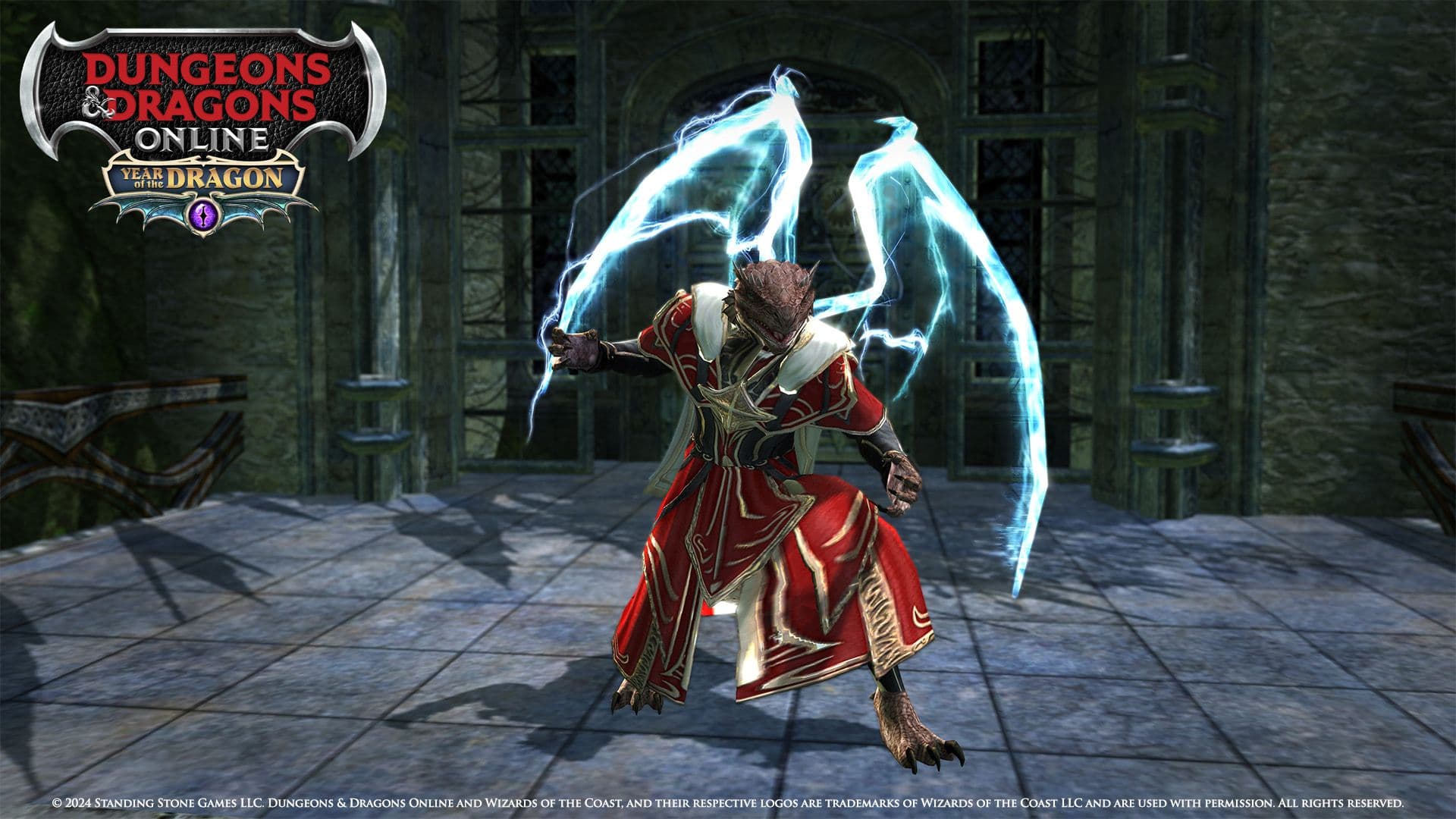
Dungeons & Dragons Online turns the D&D 3.5 tabletop ruleset into an MMO built almost entirely from instanced dungeons, complete with Dungeon Master narration, real traps to spot and disable, and char...
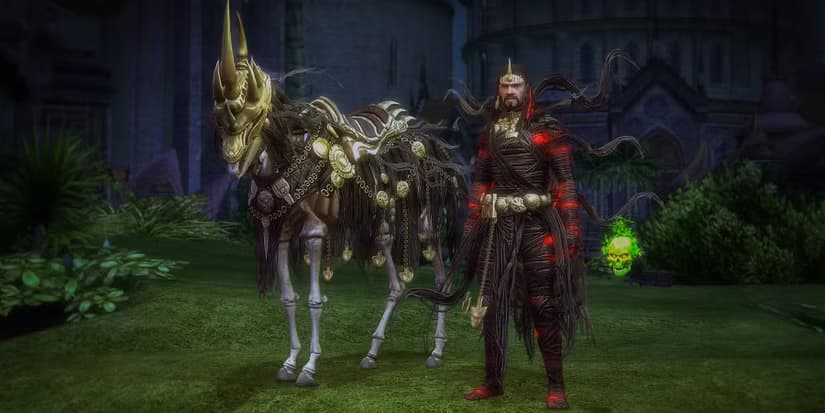
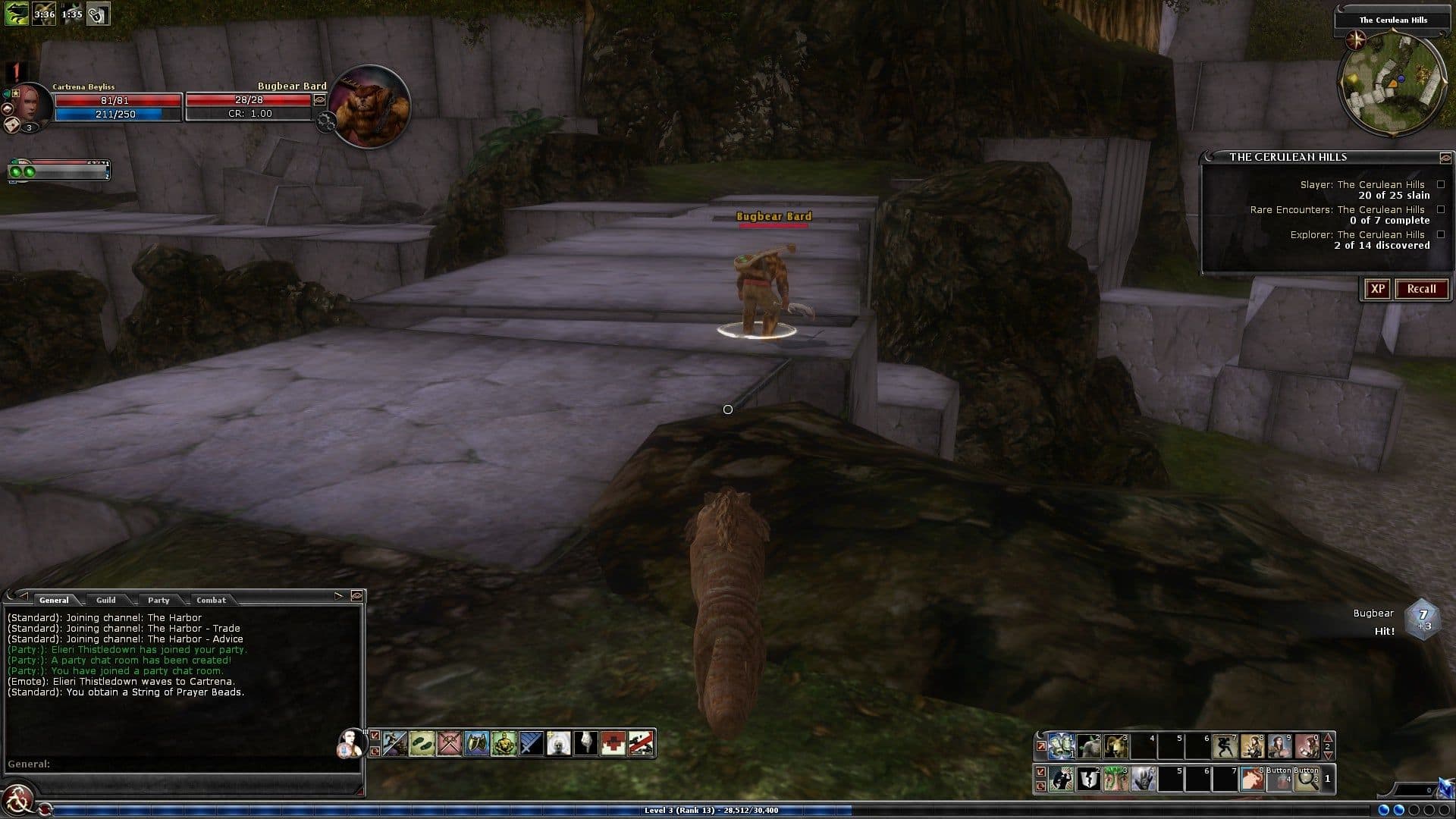
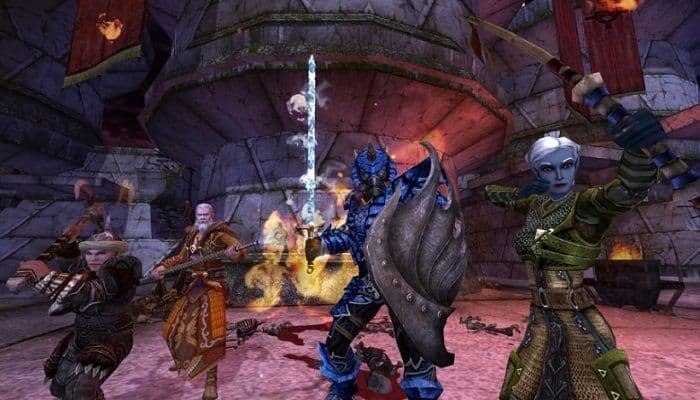
Dungeons & Dragons Online is a free-to-play MMORPG built on the D&D 3.5 tabletop ruleset, developed by Standing Stone Games and published by Daybreak Game Company. Turbine released it in February 2006 as Dungeons & Dragons Online: Stormreach, and it switched to a hybrid free-to-play model in September 2009 — a change that almost certainly saved it. Twenty years on, the game still ships expansions: Terror of Demogorgon arrived in July 2026 and pushed the level cap to 36.
What sets it apart from every other fantasy MMO is the shape of its content. Dungeons & Dragons Online is built almost entirely out of instanced dungeons, each narrated by a Dungeon Master voice, each stuffed with traps you have to spot before they fire, secret doors you have to search for, and skill checks a party can simply fail. It runs on D&D 3.5 rules, not 5th edition, so saving throws, armor class and a genuine character sheet matter more here than twitch reflexes do.
Quick take: Dungeons & Dragons Online remains the most literal translation of tabletop D&D into MMO form, and in 2026 it is also one of the hardest MMOs to start playing well. The dungeon design and the unlock-based free-to-play model hold up remarkably; the interface, the opaque build system and the thin server population do not. Worth your time if you want dungeons that behave like puzzles and you don't mind reading a wiki to enjoy them.
The game starts in Eberron, the magitech D&D setting where airships run on bound elementals and warforged soldiers walk around as a playable species. Your base of operations is Stormreach, a port city on the edge of the ruined continent of Xen'drik, and for the first six years of the game's life that was the whole of it. Later expansions bolted on the Forgotten Realms, then Ravenloft, then repeated trips into the Underdark.
The result is a world that reads less like a continent and more like a shelf of adventure modules. That is deliberate, and it maps closely to how tabletop campaigns actually work — a party goes somewhere, does a thing, comes back to town. A newcomer expecting the continuous geography of World of Warcraft or Guild Wars 2 will find the seams obvious within an hour. A veteran stopped noticing them a decade ago, because the interesting part was never the overworld.
Visually, the game shows its age in the way a well-maintained house from the 1990s does. Character models and animations are dated; lighting and dungeon architecture often are not. Standing Stone spent much of 2025 on infrastructure rather than art, rolling out 64-bit game worlds and moving the servers, which did more for the moment-to-moment experience than another texture pass would have.
New characters begin on Korthos Island, a compact tutorial zone that hands you a handful of quests, a village under attack by a dragon, and your first taste of the game's real subject: rooms designed as machines. Within twenty minutes you will meet a corridor lined with blade traps, a lever that stops them, and a trap box tucked behind a crate that only a Rogue-type build can disarm. The Dungeon Master voice sets the scene as you enter and comments when things go badly.
Character creation is where most new players stall. You pick a race, a class, an alignment, then distribute ability points, choose skills, pick feats, and later spend action points across three enhancement trees. Nothing on that screen tells you which combinations are viable, and quite a few are not. The game offers pre-built "paths" to smooth this over, and they work well enough to reach the mid-levels — but they also hide the fact that a Fighter with the wrong feat line will hit a wall around level 12 that a wiki-literate player never sees.
Progression runs from level 1 to 20 in the Heroic tier, then continues through Epic and Legendary levels to the current cap. Along the way you earn favor with the various factions of Stormreach, and favor is quietly one of the most important currencies in the game: it unlocks 32-point character builds, extra character slots, additional races and classes, and a trickle of premium currency.
Partly. Dungeons & Dragons Online uses a hybrid combat model where you aim ranged attacks manually, block with a held key, tumble out of area effects and jump over hazards — but the numbers underneath are pure 3.5, so your to-hit rolls, saving throws and spell DCs are decided by your character sheet rather than your hands. A well-built character played sloppily will usually outperform a badly built one played well. That is the honest answer, and it disappoints people who arrive expecting an action game.
What the real-time layer buys is dungeon design that nothing else in the genre attempts. Traps are physical objects in the world with a disable box somewhere nearby. Levers, pressure plates, rotating rooms and collapsing floors are common. Falling damage is real, swimming is real, and a party that sprints ahead into an unscouted room can wipe on mechanics rather than on a damage check.
Spellcasters get the widest toolkit. Wizards prepare from a spellbook and can swap loadouts at shrines, Sorcerers cast the same smaller list far faster, and both operate on a spell point pool that depletes across a dungeon and only refills at rest shrines. That resource curve is one of the game's better inherited ideas: a long dungeon is a budgeting exercise, not an endurance test.
There are fifteen base classes and a growing set of archetypes — variant versions that swap out core mechanics, like the Stormsinger Bard trading melee for lightning and sonic damage, or the Arcane Trickster Rogue added in Update 78 with Intelligence-based spellcasting layered over sneak attacks and trapfinding. Twelve of the base classes are free to everyone; the rest are unlocked with favor, premium currency, or a VIP subscription.
Multiclassing is where DDO diverges hardest from modern MMO design. You can take levels in up to three classes on one character, and the combinations are not cosmetic: two Rogue levels on a Fighter buy evasion and trap skills, a splash of Monk changes your defenses entirely. Community build guides run to thousands of words and get versioned like software, which tells you something about how much of this the game explains on its own.
The friction is real and worth stating plainly. Character creation resembles a tax form with a monster manual attached, and the enhancement interface has not aged well. For a veteran, that depth is the entire appeal — twenty years of accumulated systems that still produce genuinely novel builds. For someone in their first week, it is a wall, and the game does very little to help them over it.
Almost all of DDO's content is instanced, replayable, and scaled by a difficulty ladder: Casual, Normal, Hard, Elite, and then Reaper difficulty, which is where the endgame community actually lives. Reaper adds wraith-like enemies that spawn alongside the normal population, raises enemy damage and saves, shortens crowd control, cuts your damage output and heavily suppresses self-healing. It runs from Reaper 1 to Reaper 10, and the higher skulls demand coordination that most MMOs reserve for progression raiding.
Raids sit on top of that. They are old, numerous, and unevenly balanced, ranging from twelve-player set pieces from the game's first years to the new raid shipped with Terror of Demogorgon. The July 2026 expansion added thirteen dungeons, a wilderness area and the Demogorgon fight itself, alongside the playable Duergar race and the Mindcleaver iconic.
A permadeath seasonal server, the Hardcore League, returns periodically as a limited-time event: a fresh world where death is final, characters transfer out for free when the season ends, and leaderboards track who got furthest. It is optional, and it has generated more genuine community energy than most of the game's regular content updates.
The long-term endgame in Dungeons & Dragons Online is reincarnation, a system where a capped character restarts at level 1 and keeps a permanent bonus from the life just finished. Each past life grants a small stacking benefit tied to the class you played, so a character who has run Paladin, Barbarian and Wizard lives carries fragments of all three into the next one. Reaper experience persists through every reincarnation and accumulates across all of them.
There are several flavors — Heroic, Racial, Iconic and Epic — each feeding a different bonus track, and a serious player will cycle through dozens of lives over the years. This is where the veteran and newcomer experiences separate completely. Someone in their first month sees a level cap and a raid list. Someone three thousand hours in sees a spreadsheet of past lives with gaps in it, and treats leveling as the loop rather than the on-ramp.
Whether that reads as depth or as a treadmill depends entirely on how you feel about replaying content. The quests are the same quests. What changes is the character you bring to them and the difficulty you can survive, and for a substantial part of the playerbase that has been enough to sustain a decade of play.
Cannith crafting is the main player-driven system: you deconstruct unwanted magic items into essences, then use those essences to apply specific affixes to blank gear at crafting stations. It exists mainly to plug gaps — a slot where random loot has not cooperated — rather than to replace raid drops, and named items from quests and raids remain the endgame targets.
Trade runs through a per-server auction house in platinum plus a separate shard exchange for premium currency, and both are thin enough that pricing on niche items swings wildly. Players habitually run trades through guild channels instead. Nothing about the economy is a selling point; it functions, and that is roughly the ceiling of what can be said for it.
DDO's population is small but functional, and the honest version of that sentence needs numbers attached. Standing Stone Games does not publish player counts. Steam concurrents typically sit in the low hundreds, which understates things badly because most long-term players use the standalone client. Third-party trackers put daily active players somewhere in the low thousands across all worlds, with the usual caveat that these are estimates built from public signals rather than measurements.
The more useful data comes from DDO Audit, a community-run tracker that catalogs live grouping panels and character activity. Over a recent quarter it logged roughly 128,000 unique characters on Shadowdale and around 82,000 on Cormyr — characters, not players, and DDO players run alts the way other people collect stamps. What that data actually shows is where the grouping happens and when.
There are now four active 64-bit game worlds: Cormyr, Shadowdale, Thrane and Moonsea, the last of which is hosted in Europe. Guilds are server-locked and operate airships that serve as mobile bases with buff shrines and amenities. Solo play is entirely viable thanks to hirelings — NPC companions you summon and command — though hireling AI is best described as willing rather than competent.
DDO's monetization is unlock-based rather than power-based, and it remains one of the fairer implementations in the genre. You can install the game and play to the level cap without paying, but the free quest allocation thins out sharply above the early levels, and filling those gaps is what the store is for. Every adventure pack is a permanent, account-wide unlock — buy it once and every character you ever roll has it.
Two payment routes exist. DDO Points are the store currency, purchasable with money but also earned steadily by grinding faction favor, which means a patient free player can unlock a substantial slice of the catalog without spending anything. VIP is a $14.99 monthly subscription granting access to all adventure packs outside expansions, 500 points a month, extra character slots, a 10% experience bonus and the ability to open quests on Hard or Elite without clearing lower difficulties first. Expansions are sold separately either way.
What you cannot buy is a meaningful power advantage. There are no gear packages that outclass raid loot, and nothing in the store substitutes for clearing content. There are convenience purchases — experience potions, extra bank space, the odd cosmetic — but the pressure to use them is mild by 2026 standards. Standing Stone has also periodically handed out coupon codes granting large batches of adventure packs permanently and for free, to everyone, which is not behavior you see often from a game this old.
Dungeons & Dragons Online is the best dungeon crawler in the MMO genre and one of the worst-presented games in it, and after twenty years that contradiction is no longer an accident — it is the identity. Standing Stone Games has spent two decades adding systems on top of a 2006 foundation without ever going back to explain them, and the studio's own 2025 work went into 64-bit servers and performance rather than onboarding. Nothing in the 2026 roadmap suggests that is changing.
So the game filters its audience hard. If the phrase "two Rogue levels for evasion" reads as an idea rather than a foreign language, DDO will give you dungeon content you cannot get anywhere else, for free, permanently, on your own schedule. If it doesn't, the first ten hours will feel like being handed a rulebook with the first three chapters missing, and no amount of good trap design will compensate.
The population question deserves a flat answer too, because it comes up constantly: the game is not dying, and it is not thriving. It is being maintained, competently, for a few thousand people who have decided this is the MMO they want, and it will very likely still be doing exactly that in 2030.
Yes. The client and a starter selection of quests are free, with additional adventure packs bought individually as permanent account-wide unlocks or accessed through a $14.99 monthly VIP subscription. Store currency can also be earned in-game by accumulating faction favor.
It is worth playing if you want instanced dungeon content with traps, skill checks and deep character building, and are willing to learn the systems from outside the game. It is a poor fit if you want a modern interface, a large population, or an open world.
The game is based on the D&D 3.5 ruleset, not 5th edition, which is why it uses armor class, saving throws, multiclassing rules and feats rather than the 5e framework most current tabletop players know.
Only in a vestigial form. There are designated brawling areas in taverns and a handful of arena spaces, but PvP has never been balanced or supported as real content, and no part of the endgame involves it.
Yes, most of the game can be soloed, and hireling NPCs can fill party roles such as healing or trap disarming. Raids and higher Reaper difficulties still require a group, and self-healing is heavily reduced on Reaper, which makes solo play there impractical for most builds.