 F2P · Live
Lineage 2 Essence
Lineage 2 Essence is NCSoft's free-to-play take on the classic Korean MMORPG Lineage II, built around faster…
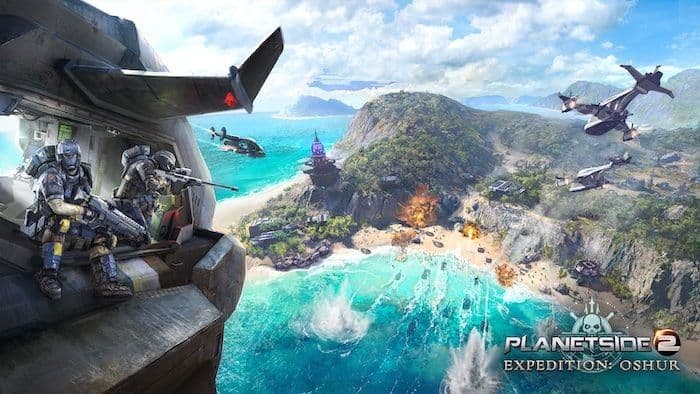
Three factions — the New Conglomerate, Vanu Sovereignty, and Terran Republic — have been locked in an endless war for the planet Auraxis since 2012, and PlanetSide 2 still lets thousands of players fi...
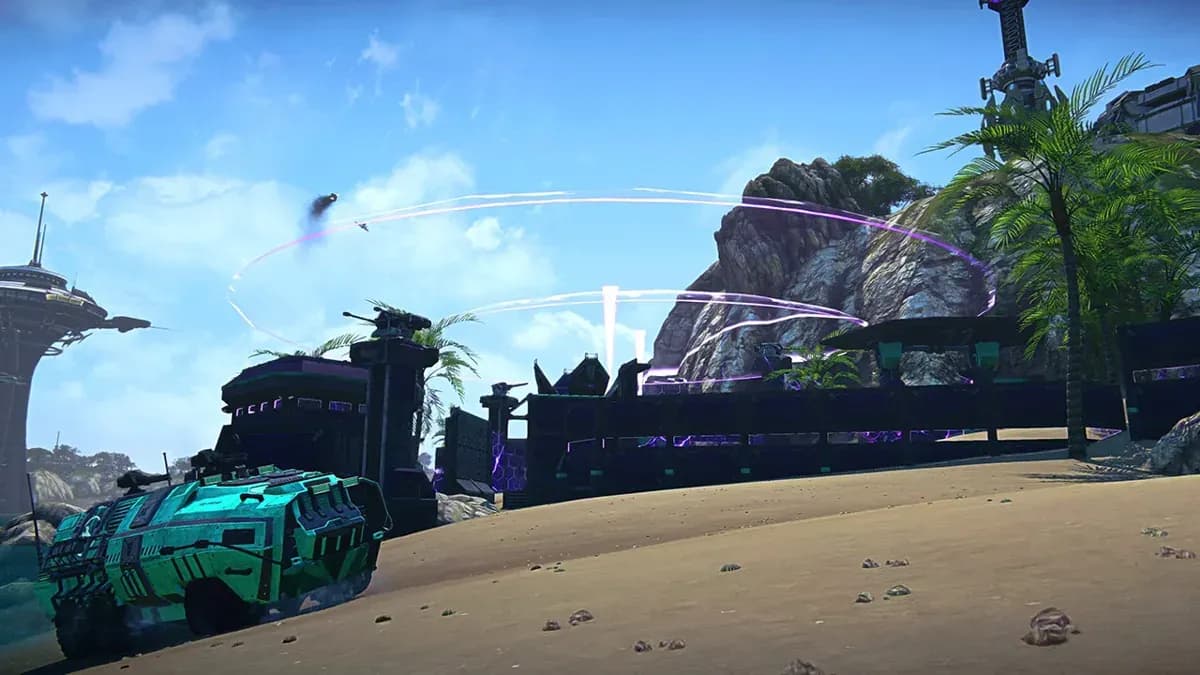
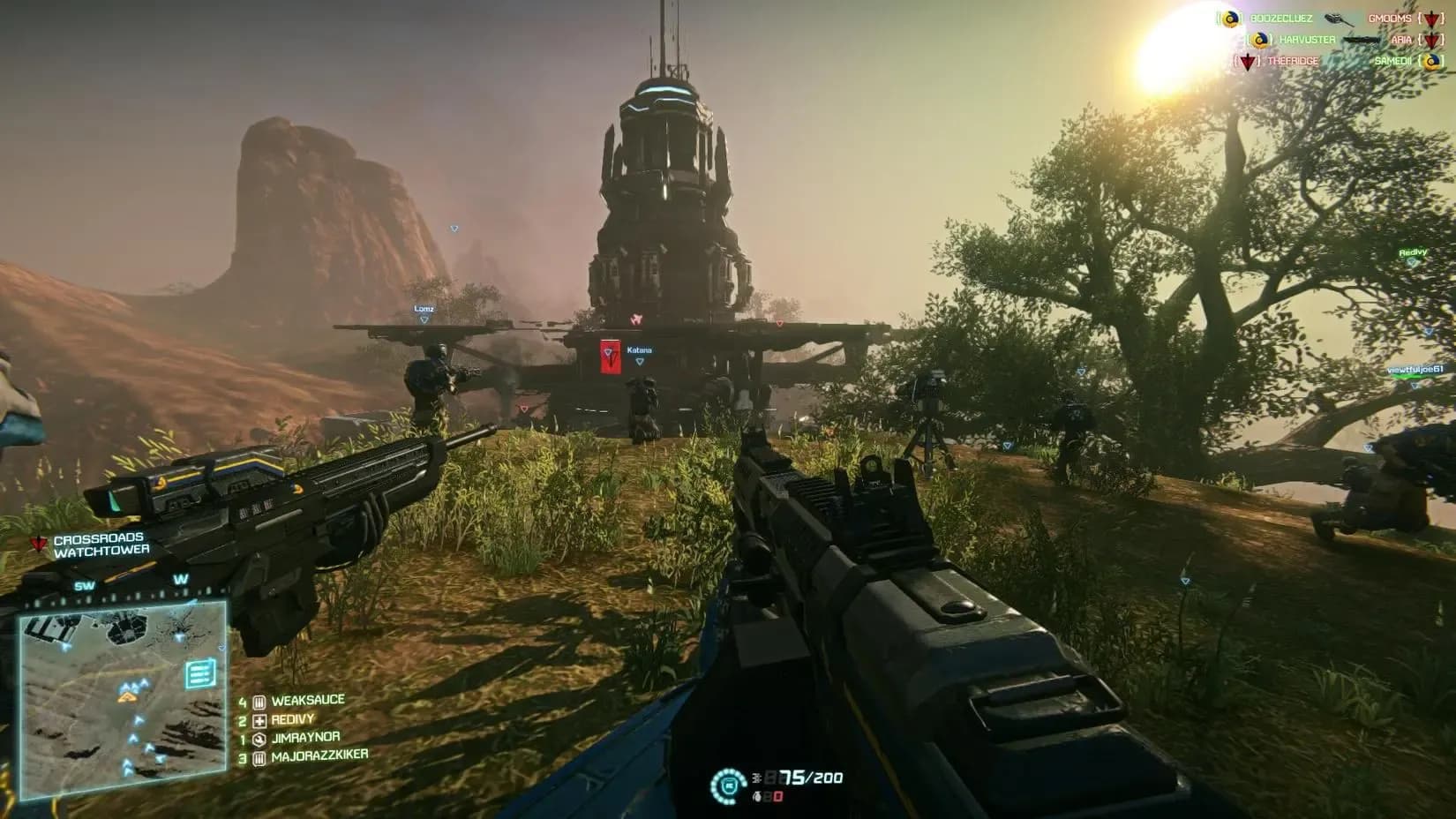
PlanetSide 2 is a free-to-play MMOFPS originally built by Sony Online Entertainment and released on PC in November 2012, now maintained by Daybreak Game Company after a string of ownership changes that most recently handed development duties to Toadman Interactive. It remains one of only a handful of games ever built around the idea of continent-scale combined-arms warfare — infantry, tanks, and aircraft sharing a single persistent battlefield with up to a thousand players fighting over the same stretch of ground. Thirteen years on, servers are smaller than they used to be and the studio behind it has been through real turbulence, but the core promise — a live, unscripted three-way war that never actually ends — is still the thing nothing else in the genre replicates.
The setting is thin by design: a moon called Auraxis, fought over by three human factions who no longer remember exactly why they're fighting. The Terran Republic wants order and control, built around reliable, high-rate-of-fire weaponry. The New Conglomerate is a corporate-militia rebellion running the loosest, hardest-hitting arsenal of the three. The Vanu Sovereignty worships alien technology it barely understands, and fields energy weapons with none of the recoil or bullet drop the other empires have to manage. None of this gets much narrative attention beyond faction flavor text and occasional lore drops — PlanetSide 2 has never been a story game, and it doesn't pretend otherwise. The setting exists to justify who's shooting at whom, and that's the whole job it's asked to do.
Where the factions matter more is in how they shape weapon feel rather than plot. Picking Vanu Sovereignty means learning to lead targets differently than a Terran Republic player does, because the weapon-handling philosophy is baked into the faction rather than into individual guns you can mix and match. It's a lighter-touch version of the class-fantasy work other MMOs put into races and factions, but it's consistent, and thirteen years of balance passes have kept the three empires close enough that no single faction dominates server populations for long.
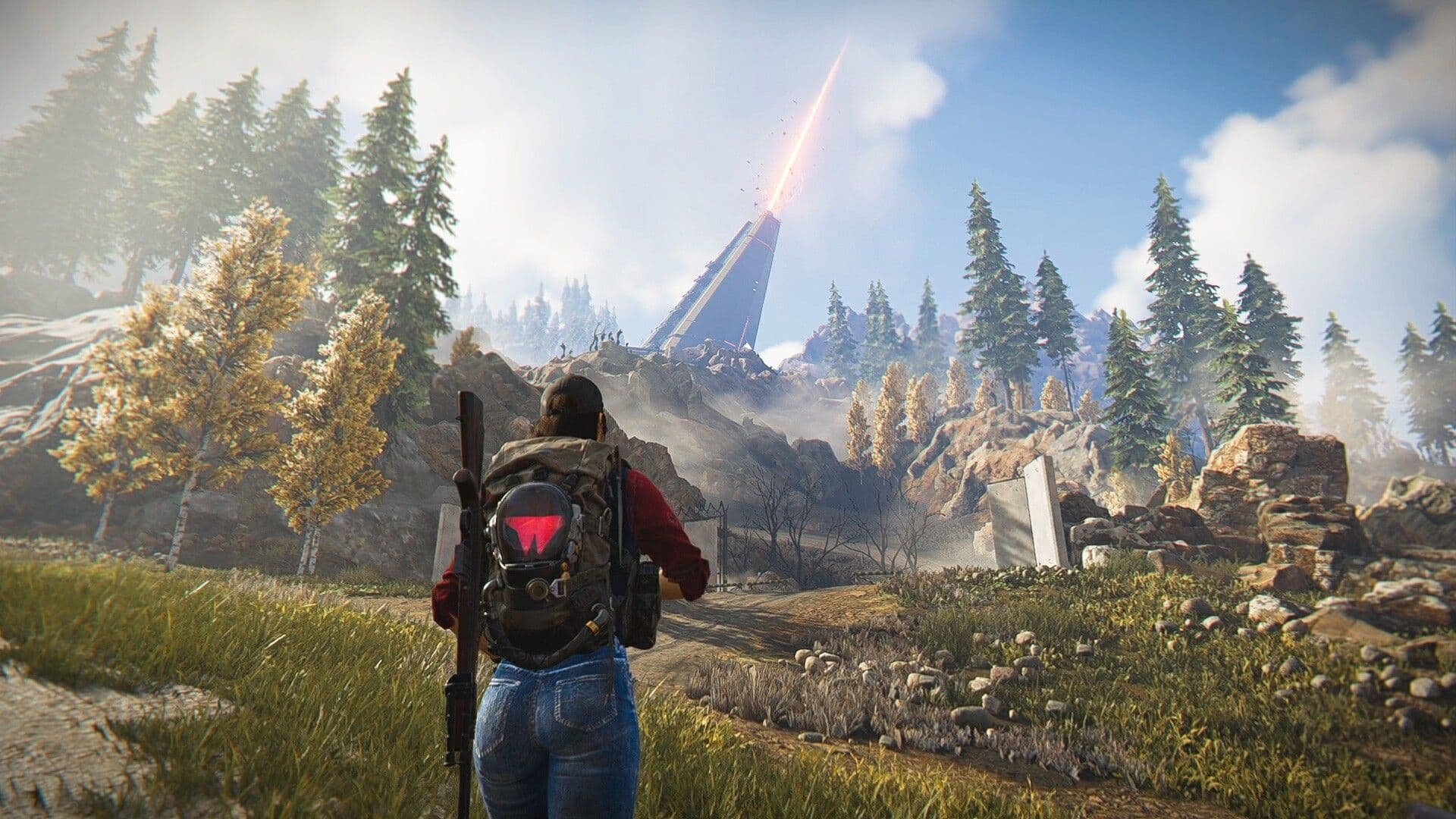
Character creation asks one real question: which empire? Everything else — class, loadout, vehicle — you unlock and swap freely once you're in, since PlanetSide 2 has no permanent class lock the way a themepark MMO has permanent race and class choices. You spawn at your empire's warpgate on whichever of the five main continents happens to be unlocked that hour — Indar's deserts, Amerish's cliffs, Esamir's snowfields, Hossin's swamp, or the partly underwater islands of Oshur — and the very first decision is which of six roles to drop in as: Infiltrator for stealth and sniping, Light Assault for jetpack flanking, Combat Medic for healing and revives, Engineer for repairs and ammo, Heavy Assault for raw frontline firepower, or the heavily armored MAX exo-suit for close-quarters demolition.
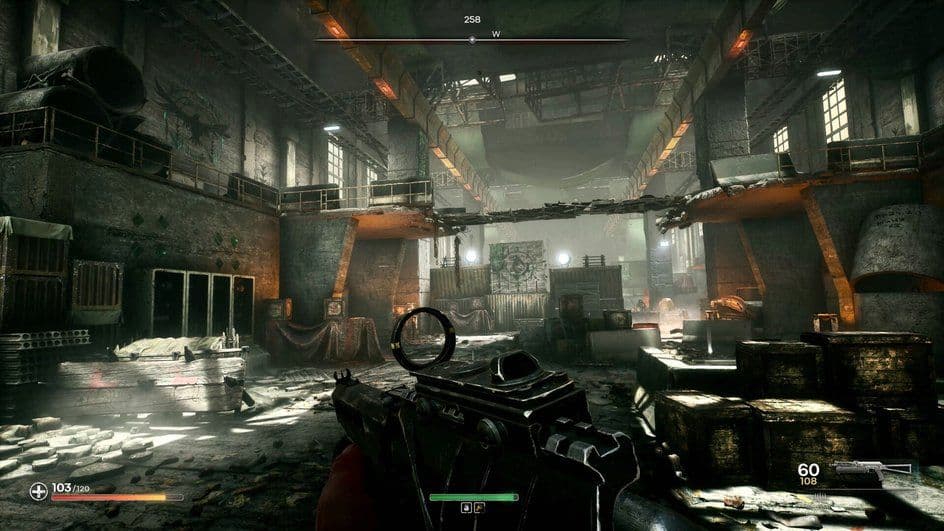
Say you drop in as an Engineer near a contested tech plant. The map shows a lattice line connecting your territory to the enemy's, and a squad of a dozen strangers is already pushing it, so you join. What follows is the actual PlanetSide loop: your platoon lead calls a spawn point, a Sunderer troop transport rolls in and drops a mobile spawn beacon under fire, and infantry pour out of it into a firefight that's already spilling across three courtyards. You drop ammo packs and repair a friendly tank that limped back from the front, then get flanked by an enemy Light Assault who jetpacks onto the roof above you — an engagement that has nothing to do with the tank fight forty meters away, because in PlanetSide 2 every square meter of the map is its own separate skirmish happening at the same time as a hundred others.
The base falls, or it doesn't, and either way the lattice line shifts and the platoon moves on to the next facility. There's no loading screen, no instance boundary, no matchmaking queue between fights — you walk, drive, or fly to the next objective across the same continuous terrain the last battle was fought on. By the time a continent-wide alert triggers — a scored, timed event where every faction's total territory gets tallied — you might have cycled through four or five completely different fights: a tank column ambush in open desert, a MAX-suit brawl in a bio lab's tight corridors, an air battle over a warpgate, a desperate last stand holding a single point against overwhelming numbers. That range, inside a single two-hour session, is the argument for the whole game.
What separates PlanetSide 2 from other large-scale shooters is that none of those fight types are separate game modes — they're all happening on the same map, at the same time, and they interact constantly. A tank column can get flanked from the air. An aircraft duel can get cut short by ground-based flak. Sunderers act as forward spawn points and can be built into fortified bunkers with their own defenses, turning a single vehicle into the anchor for an entire assault. MAX suits — walking exo-armor with dual-wielded weapon options ranging from anti-infantry shotguns to anti-vehicle rocket pods — trade mobility for the kind of raw damage output that can single-handedly hold a doorway. Learning which vehicle beats which, and when a fight calls for armor instead of infantry, is most of what separates a new player from a veteran.
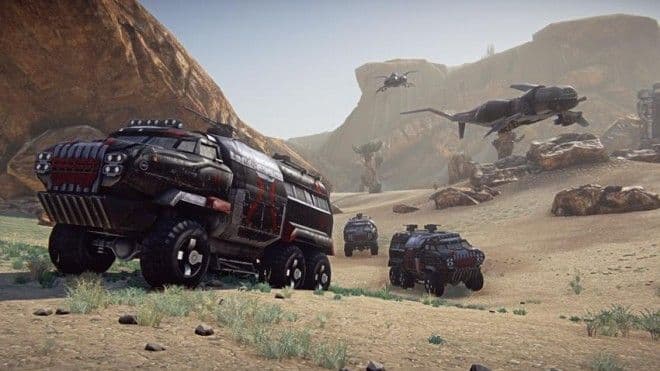
The vehicle roster runs deep on both sides of the fight. Each empire fields its own main battle tank, light and heavy fighters, and transport helicopters, all built around the faction's underlying weapon philosophy — Vanu armor trades raw damage for better tracking shots, New Conglomerate vehicles hit harder and die faster, Terran Republic hardware sits in the middle and rewards sustained fire. ANTs (Advanced Nanite Transports) haul the resources that fuel base construction, letting outfits drop their own turrets, spawn points, and shield generators directly onto the battlefield rather than relying only on the facilities the map already provides. None of it is optional flavor: a platoon that shows up to a siege with only infantry and no armor support is going to lose to one that brought both, and reading which combination the enemy is running is a skill in itself.
There's no traditional leveling in the RPG sense. Battle Rank climbs as you earn experience, but the currency that actually matters is Certification Points — certs — spent on unlocking weapons, vehicle upgrades, suit slots, and passive skills across sprawling per-class and per-vehicle trees. A new player's first few weeks are mostly about picking one or two roles and certing them deep enough to stop feeling like a liability, rather than spreading thin across all six classes at once: a fresh Engineer might spend their first hundred certs on a better repair tool and an ammo-resupply upgrade before touching anything else, since those two unlocks alone make a squad want to keep them around. Advanced Specialization (ASP), unlocked at max Battle Rank, lets veteran characters pick up a second, restricted skill tree for even more customization — a long-term goal that gives thirteen-year veterans something to still be chasing.
Because the core game is a persistent open-world conflict rather than an instanced raid ladder, "endgame" here means something different than in a themepark MMO. The closest equivalent is Outfit Wars, a bracketed tournament where organized guilds — outfits, in PlanetSide's terms — fight capped 48-versus-48 battles on the dedicated Desolation and Nexus maps for exclusive rewards, including a fully built Bastion Fleet Carrier for the winners. Beyond that, the honest answer is that the main continents are the endgame: alerts, continent locks, and the ongoing territorial tug-of-war are the entire activity loop, repeating indefinitely rather than escalating toward a final boss. If you need a credits-roll moment to feel progress, that structure will frustrate you. If what you want is a war that's still running the next time you log in, it's exactly the point.
Solo play is possible and even fun in short bursts, but PlanetSide 2 rewards organization more directly than almost any other MMO on the market. A coordinated twelve-person squad with a competent leader outperforms three times their number of disorganized players, and a well-run outfit running voice comms can turn the tide of an entire continent. Command chat lets platoon and squad leads issue waypoints and rally calls that show up directly on every member's HUD, which means the social layer isn't optional flavor — it's load-bearing infrastructure for actually winning fights.
Outfits themselves function closer to standing militias than to typical MMO guilds. The larger ones run scheduled operations with dedicated armor columns, air wings, and infantry squads that train together on specific base layouts, and rank-and-file members can move between those sub-groups depending on what the night's fight needs. That structure is also the game's steepest on-ramp: a solo player can absolutely contribute to a pub squad and have a good time doing it, but the deepest, most tactically interesting version of PlanetSide 2 — synchronized armor pushes, timed galaxy drops onto a besieged base's rooftop, coordinated Sunderer bunker defenses — only shows up once you're embedded in an outfit that's put in the hours to run it well.
It would be dishonest to write this PlanetSide 2 review without addressing where the game actually stands. Development passed from original studio Rogue Planet Games to Toadman Interactive in 2024, and Toadman's parent company announced a wind-down of the studio in January 2025 that left the game's future genuinely uncertain for weeks before Daybreak confirmed the development team would continue working on it. That instability shows up in the current patch cadence: 2026 updates have leaned heavily on hotfixes, crash diagnostics, and store items rather than major new content, and the team ran a dedicated Public Test Server session in July 2026 specifically to gather crash data from players still experiencing stability issues. Concurrent population estimates vary by tracker and aren't perfectly reliable, but multiple sources place recent daily peaks in the low thousands rather than the tens of thousands the game saw at launch — a real decline, though not remotely a dead game, and population concentrates hard during scheduled alerts and prime-time hours on the busier servers.
None of that erases what still works. Steam's lifetime rating sits at "Very Positive" across more than 47,000 reviews, with 81% positive overall, even as the more volatile last-30-days figure has dipped into "Mixed" territory around 56% positive — a gap that tracks with exactly the crash reports and technical frustration the studio has spent 2026 trying to run down. This is a game in a genuinely fragile administrative position, kept alive by a smaller team than it once had, and that's worth knowing before you install it.
PlanetSide 2 is free-to-play with an optional membership subscription and a cosmetic-and-convenience item shop. Membership runs $14.99 a month and grants a monthly stipend of premium currency, boosted experience and resource gains, marketplace discounts, and priority queue access when a continent is full. Nearly everything sold in the depot — weapon skins, camo, vehicle paint, cosmetic bundles — is visual rather than functional, and the weapons available for direct purchase are consistently side-grades with different handling characteristics rather than straight upgrades over what certs unlock for free. The honest answer to "is it pay to win": not meaningfully. Membership buys you convenience and faster progression, not power a skilled free player can't out-fight with better positioning and teamwork. The real cost of competing at a high level is time spent certing weapons and vehicles, not money spent in the depot.
PlanetSide 2 is a battlefield that's been shelled for thirteen years straight, patched by whichever crew Daybreak's owners happened to hand the keys to that month, and it's still standing — dented, understaffed, occasionally on fire, but standing. Nothing else currently shipping puts a thousand strangers into the same unscripted war and lets a tank column, a jetpacking flanker, and a squad of medics all decide the same fight at once. Whether that's worth the crash reports and the thinner servers depends on how much you value a war that simply refuses to stop, even when the people running it can't always promise what's coming next.