Aion 2 Class Guide: All 8 Classes Explained (Tank, DPS, Healer)
Picking a class in Aion 2 is a decision you'll live with for your first few hundred hours: it shapes how comfortable solo leveling feels, how fast groups invite you, how much pressure you bring in PvP, and — honestly — whether you enjoy the game at all. This guide breaks down all eight classes and their mechanics, and answers the question every newcomer asks: "so who should I actually play?".
Quick answer: who to pick
No time to read the whole guide? Here's the short version. For solo play and PvP — Assassin or Spiritmaster: the first brings explosive burst damage and stealth, the second carries solo content through its pets. Want to always get invited to groups — pick Cleric or Chanter: every dungeon needs healers and buffers. The safest all-rounder with a role that never goes out of fashion is Templar — forgiving of mistakes and barely dependent on the current meta. And if you still can't decide, just pick whichever combat style you enjoy — comfort matters more than a spot on any tier list. Below we break down every class in detail, explain the mechanics, and give a tier list by task rather than as absolute truth.
Let's separate two games first: Aion 2 is not Aion Classic
Before going further, an important disclaimer. Aion 2 is a new, standalone MMORPG from NCSOFT that launched in Korea and Taiwan in November 2025. The global PC release is now confirmed for October 5, 2026, with Early Access running from September 30 for anyone who buys a Founder's Pack, on Steam and NC's PURPLE launcher, free-to-play, with regional servers for North America, South America, Europe, and Asia, and client support for English, French, German, Spanish, Brazilian Portuguese, Japanese, Korean, Russian, Simplified and Traditional Chinese. A console version is reportedly in the works to follow the PC launch, though no platform or date has been announced yet. None of this is the original 2009 Aion, and it isn't Aion Classic either — both of those are still running today, separately. Class names largely overlap — Templar, Gladiator, Assassin and so on kept their names — but these are different games with different balance, different combat, and different leveling systems. Everything below refers strictly to Aion 2. If you were looking for a class guide for the original Aion, this isn't the page you want.
Aion 2's eight classes — the short table
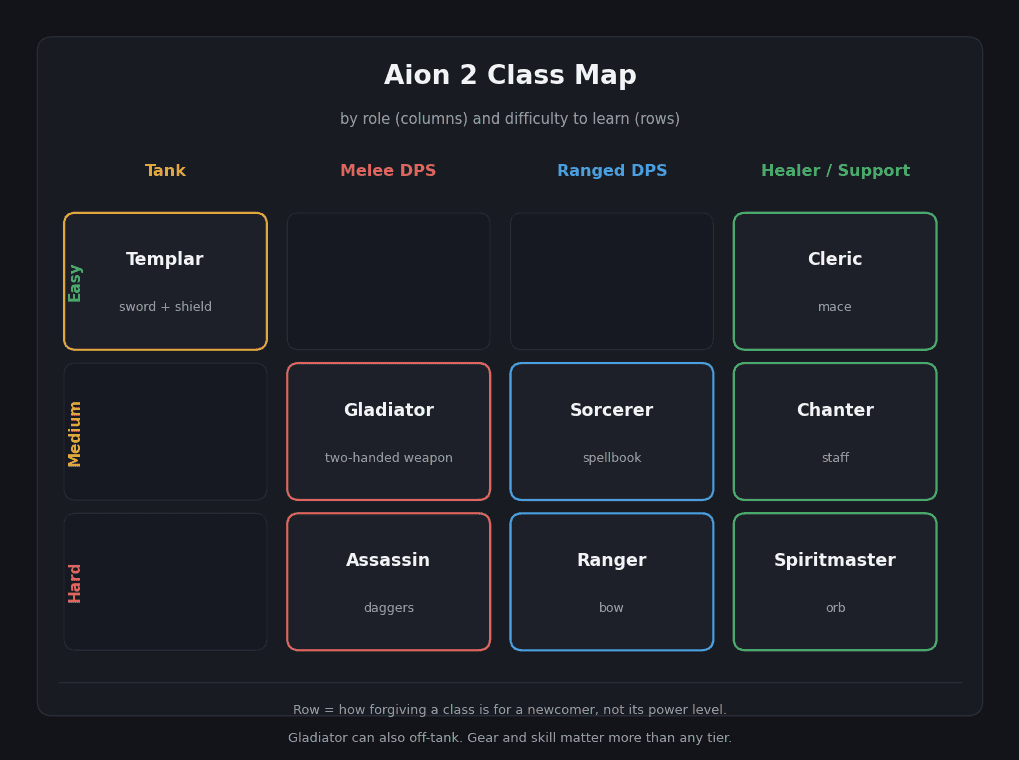
Aion 2 launches with eight classes, and the game keeps the classic "holy trinity" of tank, healer, and damage. One thing that sets the sequel apart from the original: a strict "one class, one weapon" rule. A Gladiator doesn't need to stockpile spears, bows, and shields — every class has a fixed weapon type, which noticeably simplifies gearing. The table below gives you the full picture in under a minute. One naming note worth flagging up front: the global showcase materials call this class Spiritmaster, while some Korean-service reference sites still use the name Elementalist for it — same class, same mechanics, just two names in circulation while localization settles.
| Class | Role | Weapon | Range | Best for |
|---|---|---|---|---|
| Templar | Tank | sword + shield | melee | Newcomers, players who like holding the line and protecting the group |
| Gladiator | DPS / off-tank | two-handed weapon | melee | Players who want to deal damage and survive at the same time; strong in solo and PvP |
| Assassin | DPS (burst) | daggers | melee | Fans of stealth, duels, and a high skill ceiling |
| Ranger | DPS (ranged) | bow | ranged | Players who like a safe distance and kiting; gear-dependent |
| Sorcerer | DPS (ranged) | spellbook | ranged | Fans of magic and explosive AoE damage; fragile |
| Spiritmaster | DPS / utility | orb | ranged | Solo players and anyone who enjoys pet play and control |
| Cleric | Healer | mace | — | Players who want to be needed in every group; weaker solo |
| Chanter | Healer-buffer / support | staff | melee | Fans of hybrids: buffs + healing + damage |
If one of these already caught your eye, that's a good sign — you'll find a full breakdown further down. If everything still sounds equally interesting, the next section will help narrow it down.
How to pick a class: three questions to ask yourself
Reading eight descriptions and flip-flopping is a bad strategy. It's much faster to answer three questions, and the field narrows on its own. This isn't about "which class is strongest" — it's about what fits you.
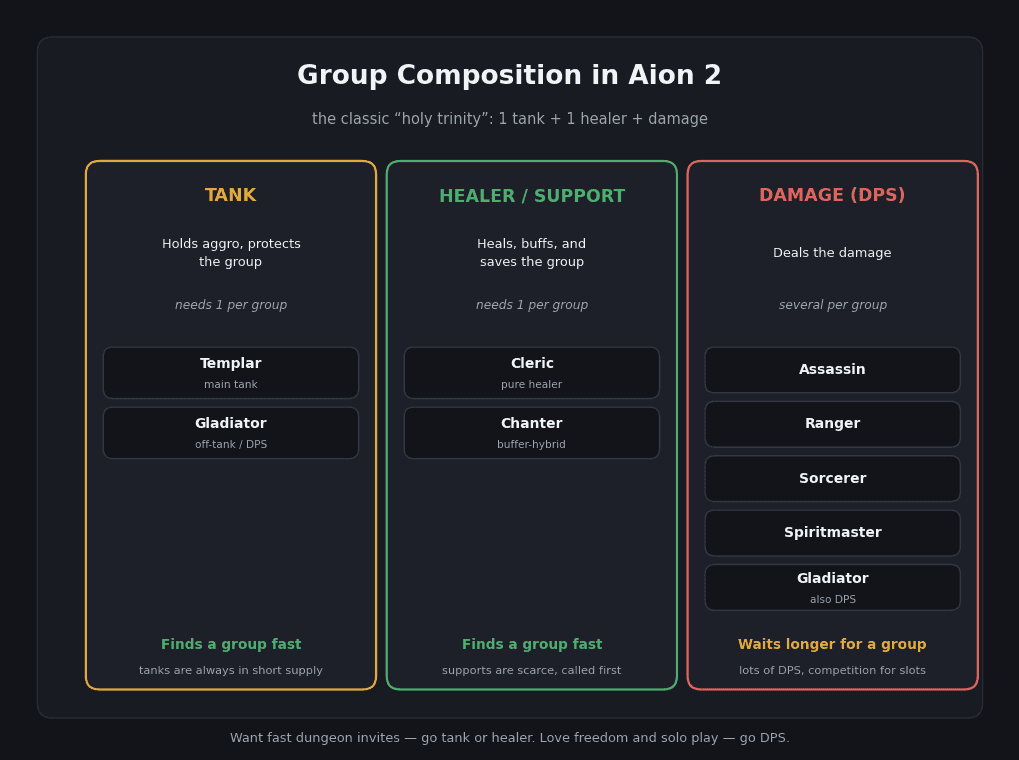
First: which role do you want to play. There's a purely practical point new players often overlook: tanks and healers (Templar, Cleric) get invited to groups almost instantly, because there's always a shortage of them, while DPS queues are perpetually oversupplied. If you plan to run a lot of dungeons and hate waiting on a party to form, going support or tank saves you real hours. DPS, on the other hand, is about freedom — solo farming, faster clears, the ability to kill a target before it reaches you. Neither is "better" — it's about how you want to spend your evenings in the game.
Second: melee or ranged. This one's a matter of taste, but it shapes a lot. In melee (Templar, Gladiator, Assassin, Chanter) you're in the thick of the fight, right up against the enemy, feeling every hit land — but you also eat the first hit yourself. Ranged (Ranger, Sorcerer, Spiritmaster) keeps you at a safe distance, gives you time to react and dodge, but demands constant attention to positioning and kiting. Worth flagging separately: on launch, latency will vary a lot by which regional server you land on (NA, SA, EU, or Asia), and ranged classes built around spells and pets tend to handle a rough connection better than an Assassin, who needs precise timing — we'll come back to this in the tier-list section.
Third: how much fiddly mechanical complexity are you willing to deal with. Classes have very different learning curves. Templar and Cleric forgive mistakes and are clear from the first few minutes — comfortable picks for anyone still learning the game. Assassin, by contrast, demands you learn positioning, combo timing, and stealth management; get it wrong and you die fast. Spiritmaster requires you to understand pets and which one suits which content. If you want to ease into the game's systems without micromanagement pulling your focus, go simple; if you like squeezing every bit out of a mechanic, the harder classes have a higher ceiling.
Role breakdown: damage classes (DPS)
Aion 2 has the most DPS classes, and they're the most varied — from a stealth assassin to a pet-focused caster. What unites them: your main job is dealing damage, survivability and utility come second. We'll go class by class: strengths and weaknesses → key mechanics → what to prioritize → best content.
Assassin
The Assassin is a melee specialist with dual daggers, built to break stealth, dump a burst of damage on one target, and vanish before anyone can retaliate. The strengths are obvious: massive single-target burst, mobility, gap closers, and invisibility for up to ten seconds, plus self-sustain through lifesteal and a mark mechanic. The weakness is just as obvious — it's fragile, and one positioning mistake often means a quick death. Core mechanics center on stealth damage from ambush and backstabs, stacking marks on a target, and combo chains you have to weave into your auto-attacks at the right moment. Prioritize crit and attack, as with any pure DPS. It's a top pick for solo farming and PvP, where it gets to choose its own prey, but in raids it demands clean mark management and a stable connection — above roughly 150ms latency, precise timing starts to break down and effectiveness drops. Assassin has a high ceiling: rough for beginners, but it pays off handsomely once you've mastered it.
Ranger
The Ranger deals steady ranged damage with a bow, keeping enemies at arm's length and controlling the field with traps, slows, and roots. Its strength is mobility and kiting — with good repositioning and steady fire, it can solo down monsters without taking damage back, and in groups it deals safe damage from behind the tanks. Its real defining trait, though, is a "class trap" for newcomers: a lot of players pick Ranger expecting easy top-tier damage, but without good gear it just doesn't deliver, and only opens up with serious investment. Key tools are control (slows, roots), traps, and stealth to break line of sight. Stat priority is standard for ranged DPS: crit and attack. It's a strong pick for open-world solo farming and kiting-based PvP, but if you're not ready to invest in gear, it can disappoint early on — worth keeping in mind.
Sorcerer
The Sorcerer is a classic glass cannon: spellbook in hand, huge water- and ice-elemental damage against both AoE and single targets, plus a kit of control effects. The strength is the nuke — it can delete a target in seconds and blanket a crowd of enemies with a single spell. The weakness is extreme fragility: anyone who closes the distance is a lethal threat, so positioning decides everything with this class. Core mechanics revolve around heavy-hitting spells with sustained damage and debuffs for control, which in a tight spot can save your life by freezing or stunning an opponent. A round of patches noticeably buffed the class, but it still demands careful play. Prioritize crit and magic attack. It's a great pick for anyone who loves ranged magic and flashy AoE damage, in both PvE and PvP, provided you're willing to constantly manage your distance from enemies.
Spiritmaster
The Spiritmaster is a pet-master and control specialist with an orb — and this is the class everyone in the original game hated facing in PvP, thanks to endless fears and buff-stripping. Its strength is that most of the work is done by four elemental summons — fire, water, earth, and air — which attack, heal, and shield while the Spiritmaster stays back and stacks debuffs. That's exactly why it's considered one of the best solo classes — the earth elemental is essentially your own personal tank, holding aggro off you. The weakness is the learning curve on pets: some are great in PvP and useless in PvE, and vice versa, so the class demands study. Core mechanics are summons, fear-and-silence control, and stripping buffs off enemies. Prioritize magic attack and crit. It's the ideal pick for solo players, anyone who enjoys pet play, and anyone who cares about stability under a rough connection — pets and long-duration effects depend far less on precise timing than melee burst does.
Gladiator as DPS
The Gladiator is a bruiser with a two-handed weapon, combining damage and survivability: it wades into the fight, hits in an area, and doesn't drop in a couple seconds the way pure DPS classes do. Its strength is the mix of AoE damage, lifesteal, and control, which makes it very self-sufficient solo and dangerous in large-scale PvP brawls, where it roots and finishes off opponents in the chaos. Its weakness as a DPS class is raid performance against bosses, where it falls behind specialized damage dealers — it's not the leader in a pure DPS race. Core mechanics are gap closers, chargeable skills, AoE lifesteal, and knockdowns. Build toward attack and crit for damage, or add survivability, depending on how you play it. More on its tank side in the next section — but as DPS, it's a versatile, dynamic, mistake-forgiving class, great for solo farming and PvP.
Role breakdown: tanks
Aion 2 effectively has two tanks: the primary, Templar, and a hybrid backup, Gladiator in an off-tank role. A tank holds monster and boss aggro, protects the group, and takes the first hit, which makes these classes always in demand in both PvE and large-scale PvP.
Templar
The Templar is the game's main tank, wielding sword and shield, with a crystal-clear role: pull aggro, hold the line under fire, and cover your allies. Its strengths are a massive health pool, high defense, self-sustain, and group-protection tools — the community sums it up in one word: "a wall." The weakness is low personal damage, so it's slow going in solo farming, but it's nearly unkillable. Core mechanics include pulling a target with a stun combo, AoE skills that group monsters together while restoring HP and boosting defense, "Iron Skin" for a sharp defensive spike, and a block that stops attacks outright. Its most valuable skill is "Guardian's Protection," which redirects damage from an ally onto the Templar, plus it has "Provoke," which Gladiator lacks. Prioritize defense and health. It's the best pick for a newcomer who wants to be the group's foundation: the role is clear, mistakes are forgiven, and a dungeon slot is basically guaranteed. If you want to ease into the game safely while always being needed, Templar rarely disappoints.
Gladiator as off-tank
The Gladiator is the Templar's "plate-armored cousin" — also able to dive into a crowd and take damage, just differently. Unlike the shield-wielding Templar, it carries a two-handed weapon and leans on a large HP pool and aggression rather than raw defense. The developers position it as a "deal tank": it can hold monster aggro through sheer health, but falls short of Templar's pure defense and, notably, lacks a full "Provoke." That means it handles off-tank duty fine in easy and mid-tier dungeons, but holding bosses gets harder in top-end content. On the plus side, its AoE skills group monsters together, and lifesteal skills help it survive long fights. If you like the idea of a tank that doesn't just stand and absorb but actively deals damage and controls the fight, Gladiator delivers exactly that — but for a main tank on serious content, go Templar.
Role breakdown: healers and support
Aion 2 also has two support classes, covering different niches. Cleric is a pure healer, and no serious group runs without one. Chanter is a hybrid that heals, buffs, and deals damage itself. Both are valuable because they're always in short supply, so a party slot is basically guaranteed.
Cleric
The Cleric is the game's primary healer, wielding a mace, and its role in a group is irreplaceable: it heals allies, revives the fallen, and cleanses harmful effects from the team. Its strengths are powerful AoE healing, protective shields for allies, and debuff removal — in tough boss fights and organized PvP, the Cleric is often what decides whether the group survives or falls apart. Its weakness is solo potential: alone, it's slow and relies on other players around it to really shine. Core mechanics are area healing, buffs that boost team stats, cleansing negative effects, and a shield that covers a single ally from damage. Prioritize healing power and cooldown reduction. One interesting meta note: after a round of buffs, a "damage-focused" Cleric build became surprisingly viable, so the class isn't quite as passive as it might look. It's the ideal pick for anyone who loves keeping a team alive and wants guaranteed demand in groups for the whole game.
Chanter
The Chanter is a hybrid support with a staff who fights closer to the enemy than a typical healer: buffing the group, topping off health, and dealing melee damage of its own. Its strength is versatility — it's not as strong a healer as Cleric, but it makes up for that with buffs that boost the whole team's combat power and personal damage, which makes it especially strong in PvP. In Aion 2 the class shifted toward a "control bruiser" with decent solo potential — unlike Cleric, it can hold its own alone. Its weakness is that solo, it's still weaker than pure DPS classes, and it delivers the most value in a team. Core mechanics are group buffs, healing, and melee combat skills. Balance your build between healing power, cooldown reduction, and attack, depending on whether you lean support or damage. It's a great pick for players who like being a useful hybrid and who value PvP, where Chanter's buffs make the whole group noticeably stronger.
Tier list by task: a compass, not gospel
Before the table — one honest caveat, without which any Aion 2 tier list is misleading. Sources disagree sharply: some put Assassin unconditionally at the top, others Gladiator, others rank Ranger higher. Three reasons why. First, almost every ranking so far is based on the early-2026 Korean and Taiwanese versions, not the global release. Second, balance is being actively patched — there was a major class rebalance in March 2026 and a rework of lifesteal and party synergy in April, so a "strong" class could become ordinary within a single patch. Third, the global meta will almost certainly settle differently once players on NA, SA, EU, and Asia servers get their hands on the game from October 5. So what follows isn't a strict S/A/B tier list — it's a guide to which class fits which scenario. And the rule everyone agrees on: gear and skill matter more than tier — a weaker class with top gear beats a stronger class with bad gear.
| Scenario | Recommended classes | Why |
|---|---|---|
| Solo play and farming | Spiritmaster, Assassin, Gladiator | Spiritmaster carries through tanky pets, Assassin kills fast, Gladiator is durable and self-sufficient |
| PvE groups and raids | Cleric, Chanter, Templar | Tanks and healers are always needed; they get invited first and rarely get "patched out" |
| PvP | Assassin, Gladiator, Spiritmaster | Assassin picks a target and deletes it, Gladiator pressures with control, Spiritmaster breaks enemies with fear and buff-stripping |
| For newcomers | Templar, Cleric, Gladiator | Clear roles, forgiving of mistakes, no complex micromanagement required from the start |
If we're talking "single strongest class overall" — on the Korean-Taiwanese meta as of early 2026, Assassin consistently sits closest to the top thanks to the highest single-target damage, while Spiritmaster is often named as the safest reliable pick. But again: this is a snapshot of the current Asian servers, not a verdict. The global release will settle the picture differently, and your gear and personal skill will affect the outcome more than any line in a ranking.
Builds and specialization: tuning a class to your playstyle
Aion 2 doesn't lock you into one "correct" build, which is a good thing — but there's little point giving exact skill rotations here: they shift with every balance patch and go stale within weeks. It's more useful to understand the underlying system and check specifics against current sources or the client itself when you need them. A few systems make up the core of customization. Skills don't auto-upgrade with level the way they did in the original game — you have to deliberately level them up through story content, dungeons, and mastery gains; forget that, and undertrained skills will make bosses much harder than they need to be. On top of that sits specialization — a flexible system that lets you swap and tune your skill set for specific content: one loadout for solo farming, another for raids, another for PvP. Rounding things out are stigmas (a talent-tree system for tuning and boosting skills) and Daevanion, a grid of passive bonuses that affects skills and stats.
The practical approach is simple: figure out what you'll be doing most, and build toward that. DPS in solo and PvE content leans into pure damage — crit and attack; tanks take defense and health; healers take healing power and cooldown reduction. Many skills get noticeably stronger at certain leveling milestones (unlocking, say, the ability to cast while moving), so leveling up key skills matters more than chasing a trendy rotation. And since specialization can be swapped per task, don't be afraid to experiment — that's where the system's depth lives.
Frequently asked questions
How many classes does Aion 2 have? Eight at launch: Templar, Gladiator, Assassin, Ranger, Sorcerer, Spiritmaster, Cleric, and Chanter. Together they cover all three classic roles — tank, damage, and support.
When does Aion 2 launch globally, and does it matter for class choice? The global PC release is confirmed for October 5, 2026, with Early Access from September 30 for Founder's Pack buyers, on regional NA, SA, EU, and Asia servers. It's free-to-play. Class balance so far comes from the Korean/Taiwanese version, so expect the meta to shift once the wider global population starts playing — don't lock in a "best class" choice based purely on pre-launch rankings.
What's the best class for a beginner? Templar and Cleric are the most comfortable starting points: clear roles, high survivability or group demand, forgiving of mistakes. Among damage classes, Gladiator is the softest entry thanks to its durability.
What's the strongest class? On the Korean-Taiwanese meta as of early 2026, Assassin is most often named top-tier for single-target damage. But balance is being actively patched, and the picture will shift at global launch — gear and personal skill matter more than tier-list placement.
What's the best class for solo play? Spiritmaster, thanks to pets that tank and heal for you — it's often called the "solo king." Assassin and Gladiator also solo well.
Which class finds a group fastest? Tanks and healers — Templar, Cleric, Chanter. They're always in short supply, so they get called first for dungeons and raids, while DPS wait longer for a party to fill.
Can you change class later? Class is a hard lock in Aion 2 and can't be swapped on the fly — the choice is made at character creation. Typically players roll a new character to try another class; whether the game offers a paid class-change service, as some other titles in the series do, is worth checking in the current client version, since this can vary by region and patch.
Bottom line: where to start
The main takeaway of this guide sounds a little paradoxical for an article with a tier list attached: don't pick your class off someone else's ranking. The meta shifts with every patch, and you'll spend hundreds of hours with this character — enjoying the process matters more than a line in a table. Use the tier list as a guide for your specific goal — solo, group, or PvP — but make the final call based on the combat style you actually enjoy. Want to be guaranteed useful and ease into the game calmly? Go Templar or Cleric. Love freedom and aggression? Look at Assassin, Spiritmaster, or Gladiator. Once you've decided, move on to gearing up your chosen class. You can find out more about the game on the Aion 2 page in our catalog.