Aion 2 Gear & Crafting Guide
If you've just hit level 45 in Aion 2 and you're staring at your gear wondering how other players are pushing their Gear Score to 2400 and beyond, this guide is for you. We'll walk through the full gear loop: where to get it, how to craft the best PvE gear, how to enhance it safely, and finally how to optimize your stats at endgame. No filler, no restating the obvious — just what actually moves your character forward.
Short answer up front for anyone who came from search. Gear in Aion 2 progresses through a simple loop: the main story gives you your baseline, the best PvE gear comes from crafting up a tier chain, and everything after that comes down to enhancement (safe up to +10) and fine-tuning your stats. The real measure of power isn't your character level — it's your gear level, or Gear Score; the endgame bar starts around 2400. Below is a detailed breakdown of every step.
Before diving in, it's worth separating two games people often mix up. Aion 2 is a new MMORPG from NCSOFT that launched in Korea on November 19, 2025. The global PC release is officially confirmed for October 5, 2026, with Early Access from September 30 for Founder's Pack owners. This is not the original 2009 Aion, and it isn't Aion Classic either — both have completely different gear systems, and everything below refers strictly to Aion 2. For a full rundown of every system in the game from scratch, see our complete Aion 2 beginner's guide — this page is entirely dedicated to gear.
A note on version and terminology. Most of the underlying facts here come from the Korean and Taiwanese versions, but the text has been updated with global-release patches through mid-September 2026 — including the Abyss set-bonus rework and the new Seal slot. Where a known gap exists between the Asian servers and the global release, we flag it explicitly — for some systems (like whether Inheritance is guaranteed, or the status of the Pendant slot) the exact picture on global hadn't been officially confirmed as of this writing, so double-check in your own client. Specific numbers (enhancement odds, Gear Score thresholds) get patched every season, so treat key figures as something to verify against your current client.
How gear progression works: two axes of power
To avoid confusion from the start, keep one simple model in mind: your character's power in Aion 2 is measured along two axes. The first is your character level, capped at 45. Level grows through the story, unlocks the ability to wear certain items, and determines how tough regular open-world monsters are. This axis caps out fast: playing through the story at a normal pace, you'll hit level 45 with a Gear Score around 900–1000 by the end of the main campaign.
The second axis is your gear level, or Gear Score (GS). Every item has its own base gear level, and the sum across everything you're wearing gives your total Gear Score. This — not your character level — is what decides almost everything at endgame: specific GS thresholds gate access to dungeons, expeditions, and raids. Put simply, the game really starts after level 45, and all further progress is just Gear Score growth.
On the global release, the developers deliberately smoothed out the early progression curve: compared to the Korean/Taiwanese version, early Heroic gear drops were removed at launch, and Hard Mode for Transcendence (Conquest) dungeons was pushed back until after release — specifically to avoid an early power gap between players. So if you see Heroic-tier gear mentioned in Asian-server guides from the first few weeks, expect that path to arrive later on global.
The whole gear process boils down to a repeating three-step loop: get it → enhance it → tune it. First you obtain an item (from the story, a dungeon, crafting, or the market), then you raise its base level through enhancement and tier breakthroughs, and finally you dial in its stats through soul binding and Arcana Cards. Early on you'll mostly be cycling through the first two steps; the third really opens up at endgame, once your gear stops changing every day. Let's go through each source and system in turn.
Where to get gear: from story basics to endgame gold items
There are several sources of gear in Aion 2, and each one covers a different stage of progression. Understanding what each source gives you and when saves you from the classic newbie mistake of investing resources in the wrong place. Let's go through them in order, from starter gear to endgame.
The main story is your primary supplier of baseline armor and weapons all the way to level 45. Yellow quests (the main story line) give the most experience and also regularly hand out gear sets matched to your current level. At this stage, you genuinely don't need to think about hunting for gear — just follow the story, and baseline equipment shows up on its own. By the end of the campaign you'll land around that 900–1000 Gear Score mark — enough to start engaging with endgame.
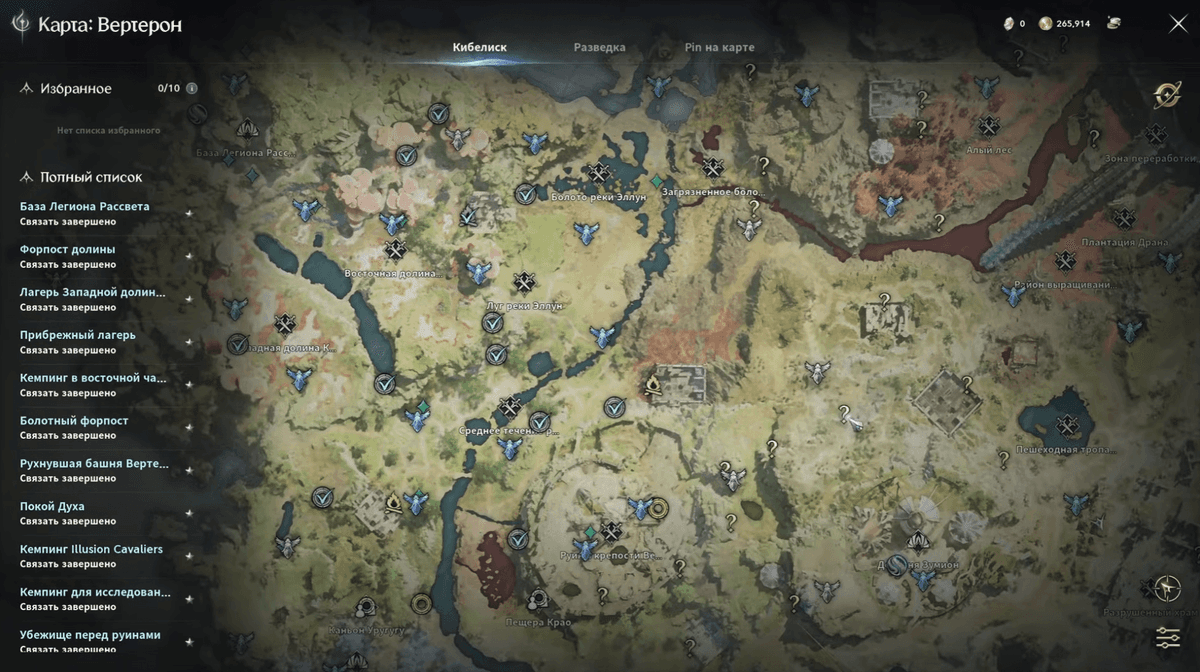
When a story boss digs in and refuses to die, that's when Sealed Dungeons and Strongholds — marked with question marks on the map — come into play. These are small instances and combat challenges, valuable less for the gear itself and more for enhancement materials: Enhancement Stones and Devenian Crystals, which feed the passive-bonus system. There are more than sixty Sealed Dungeons per faction, so you won't run out. Check them out whenever you need to power up before the next story push.
Beyond that is where things get interesting — the endgame sources. Crafting produces the best PvE gear in the game: crafted weapons and armor carry a percentage bonus to PvE damage (roughly 5% on current versions) that no dropped item has. That's exactly why serious players eventually sit down and learn a profession — more on that in the next section. Abyss Gear is the PvP branch: it's bought with Abyss Points, earned in large-scale fights like the War of the Abyss and open-world PvP. PvP gear has four main tiers — Decanus, Tribunus, High Commander, and Praetorian Captain — and while the first tier is bought with points alone, the top one demands rare associated traits and special medals. A recent patch also made the top tier noticeably more valuable, which we cover in its own section on Abyss set bonuses below.
At the very top of the pyramid sits gold (unique) gear from high-level expeditions and Transcendence dungeons (Conquest/Expedition content). It unlocks once your Gear Score crosses 2400, and these are some of the strongest items in the game, later further enhanced and tuned on top of that. The road to that threshold runs through intermediate systems — Transcendence, the Skyward Isle of Vakhron, and other activities that step your GS up from roughly 1500 toward 2200 and beyond. Finally, there's the market (auction house): for Kina (the main currency) you can buy missing items, mana stones, and consumables. Keep the local "pay-to-trade" quirk in mind — trading is structured so that currency speeds up progress rather than fully replacing playing the game.
Worth knowing about the currency itself: recent September patches split Kina into Bound and Unbound. Bound Kina drops from exploration dungeons and can't be traded between characters. Unbound Kina — the reward from Transcendence (Conquest) dungeons — trades freely. This changes the economics of running alts: if you're farming tradeable currency for the market, Conquest content is the priority, not routine exploration runs.
To bring it all together, here's a quick map of sources — what each gives and when it's relevant:
- Main story (yellow quests) — baseline armor and weapons, the whole 1–45 journey.
- Sealed Dungeons and Strongholds — enhancement stones, Devenian Crystals, early upgrades; use when stuck on a boss.
- Crafting — the best PvE gear with a damage bonus; relevant early and at endgame.
- Abyss Gear — PvP gear bought with Abyss Points, four tiers; PvP endgame.
- Expeditions and Transcendence dungeons — high-end gold gear; at GS 2400+ (Hard Mode arrives after global launch).
- Market (auction house) — fill gaps and buy mana stones with Kina (Unbound only); relevant at any stage.
Now that you've seen the full map of sources, let's dig into the section most new players underestimate — crafting. It's what separates players still wearing random drops from players wielding the best gear in the game, made with their own hands.
Crafting and professions: making the best gear yourself
Crafting in Aion 2 isn't a side activity for roleplayers — it's a full progression path that gives you the best PvE gear in the game at endgame. Weapons, armor, accessories, consumables, and even enhancement materials all run through crafting. Yes, it's a real time investment in gathering resources and leveling professions, but the payoff is worth it: crafted items carry a percentage PvE damage bonus that dropped gear doesn't have. Let's break the system down piece by piece — professions first, then the key tiered-crafting mechanic, then gathering and practical tips.
The five professions and what they make
There are five core professions in the game, each with its own workbench in the major city districts. Here's what each one does:
- Blacksmithing — melee weapons: swords, two-handers, daggers, maces, plus defensive guards. Turns ore into ingots, which then get forged into weapons.
- Armor Smithing — all wearable armor: helmets, shoulder guards, chest pieces, leg armor, gloves, boots, cloaks. Needs leather (dropped by monsters) and metal.
- Handicrafting — ranged weapons (bows, staves) and jewelry (necklaces, earrings, rings, bracelets). Accessories are hard to get any other way, which makes this profession especially valuable.
- Alchemy — the most versatile craft: potions, scrolls, magic weapons (spellbooks, orbs), plus Mana Stones for gear sockets and enhancement items.
- Cooking — buff food that boosts stats temporarily. Useful for literally everyone and pays for itself easily.
One important Aion 2 rule applies here: "one class, one weapon." Every class is locked to a specific weapon type, so pick your crafting profession accordingly. Gladiator wields a two-handed sword, Templar (tank) a sword and shield, Assassin daggers, Cleric a mace, and magic classes like Sorcerer and Spiritmaster use spellbooks and orbs. That means Blacksmithing and Armor Smithing make sense if you want to forge gear for your own class, while Alchemy and Cooking are useful to literally everyone — every character constantly needs consumables — so for your first profession, Alchemy or Cooking is almost always a safe pick.
Tiered crafting — the core mechanic you need to understand
Now for the single most important thing to understand about crafting in Aion 2. You can't make top-tier items directly — they're crafted through every intermediate tier via a "proc" system (from the random-chance sense of the word). Here's how it works: you craft a low-tier item, and there's a chance (usually around 25%) that crafting it also produces an upgraded version alongside it. That upgraded version becomes a material for the next tier up — and so on, all the way to the top.
Here's an example with a bow. First you craft a Grey bow, which has a chance to proc into a Green one. The Green bow becomes a material for a Crafted Green, which can proc into a Blue, the Blue feeds into a Crafted Blue, and so on, tier by tier, until you reach the top version. Armor and accessories follow the same logic. The one key takeaway to burn into memory: never sell or discard intermediate procs — they're your materials for the next step. New players regularly dump green and blue components onto the market without realizing they just threw away half the road to a top-tier item. Always craft from the bottom up, and hang onto every successful proc.
The very top rung of tiered crafting is what's called inheritance crafting, where a finished high-tier item itself becomes an ingredient for an even stronger version. A fresh example from the September patches: the "[True] Genesis / Nemesis Dragon Lord" weapons and guards are crafted by upgrading their "Splendent" versions, or by converting Unbound "Midnight Sun" gear; "[True] Guardian / Archon Praetorian Captain" gear is crafted from existing tiers of that same line through the Abyss exchange. In other words, at the very top of the chain, crafting merges with endgame Abyss gear — you don't necessarily have to build everything from scratch; it's often more efficient to carry an existing high-tier item the rest of the way.
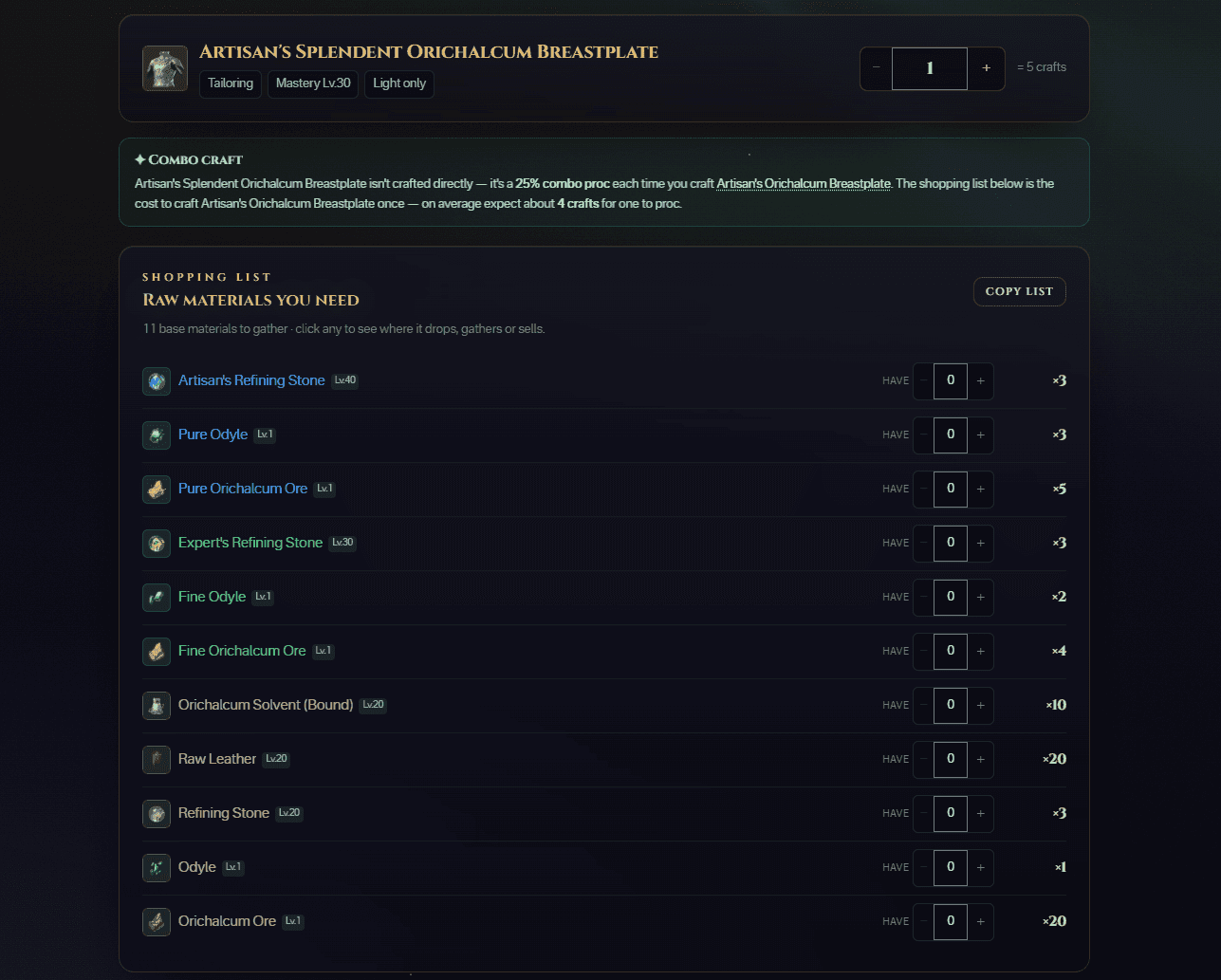
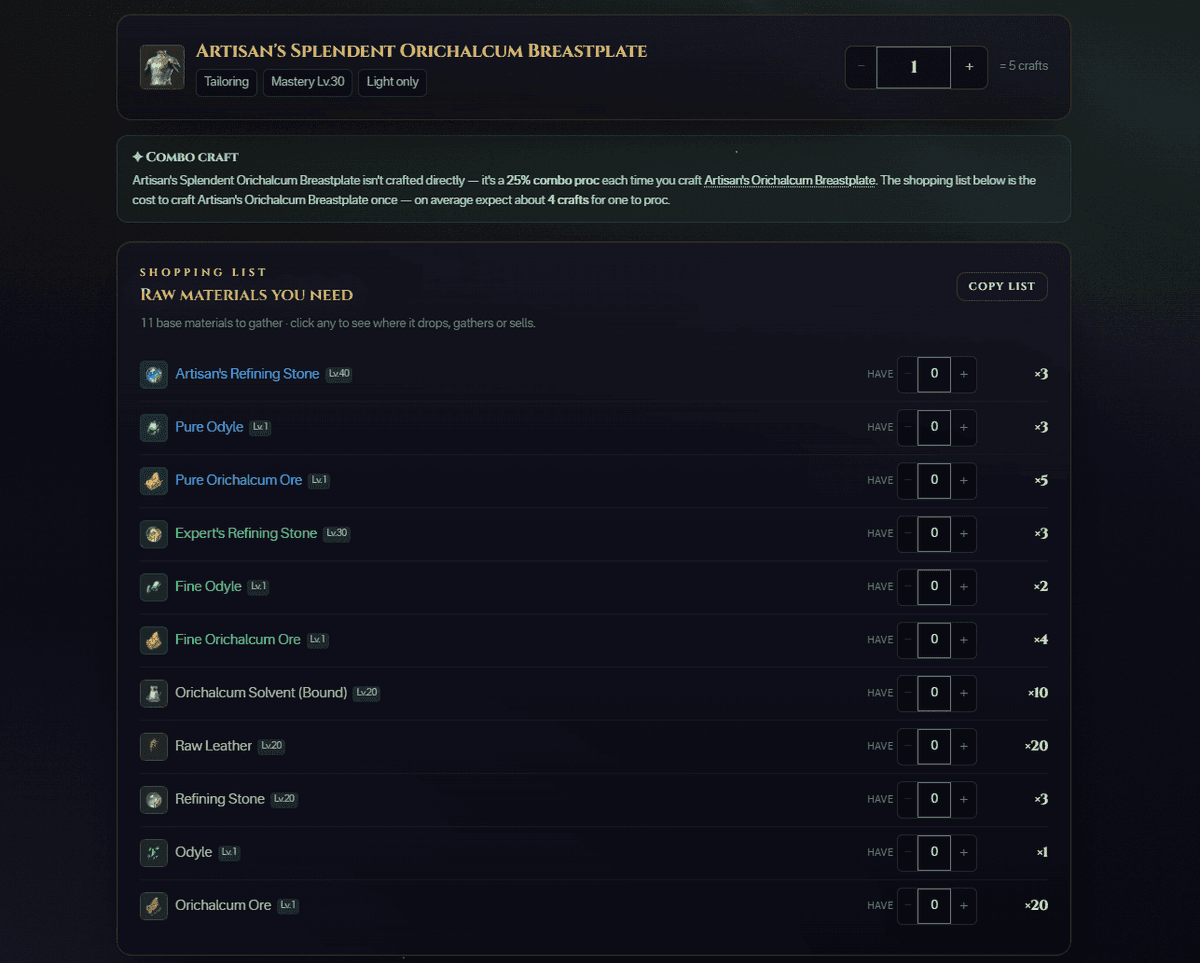
If counting materials by hand sounds tedious, third-party crafting calculators (aion2hub.com, for one) will take a chosen item and unfold the entire chain down to base resources, giving you a shopping list. Handy when you're planning a big crafting run and want to know upfront how much ore, wood, and herbs you'll need to gather.
Gathering resources and skill ranks
All crafting starts with gathering, and every resource type — wood, herbs, ore, and so on — has its own separate skill branch. Leveling it unlocks useful perks: rank 1 highlights resource nodes on the minimap, rank 2 gives a chance at a double harvest, rank 3 gives a chance at higher-quality material (say, green or blue wood instead of grey). The quality of what you gather directly affects crafting quality, so leveling gathering pays off.
Gathering itself plays out as a mini-game: interacting with a node brings up a three-attempt interface, where green results yield materials and red ones block a slot — you can harvest a single node up to three times, with quality ranging from common (grey) to unique (gold). If you've put gathering points into one resource and then decide to switch to another, resetting your gathering points costs roughly 50,000 Kina — so you can change your specialization, but it isn't free, which makes it worth planning ahead.
Practical tips: batch crafting and crafting without a workbench
A couple of practical conveniences that save real hours. First, Aion 2 supports batch crafting: you can queue up a large number of items — even two hundred potions — and the process runs on its own, a few seconds per item, while you go do something else. Important caveat: moving or taking any other action cancels the whole queue, so to stop safely, hit Escape — the game finishes the item currently in progress and stops there, without losing the rest of the queued materials.
Second, you can craft from almost anywhere through the crafting management menu — workbenches in cities are more of a landmark and a place to access recipes than a hard requirement. One caveat on controls: in some UI builds the crafting menu is bound to the N key, while in others N opens the enhancement window instead — check the exact bindings in your own client, since they can differ between versions and patches. Once you've got gathering and tiered crafting down, you become self-sufficient: you make your own consumables, best-in-class PvE weapons, and accessories, and sell the surplus on the market. But making an item is only half the job. Next, it needs enhancing — which is where the next section picks up.
Enhancement, Breakthrough, and Inheritance: raising your Gear Score
Once you've got a piece of gear, the enhancement stage begins — it's what gives you the most predictable, fastest Gear Score gains and helps you clear content-access thresholds. Good news: Aion 2's enhancement system is noticeably friendlier than most Korean MMOs, and it almost never lets you lose an item for nothing. Let's cover enhancement itself, breaking items into a higher tier, and the relatively new system for safely carrying investments forward.
Enhancement: safe up to +10
Basic Enhancement raises an item's base level, and with it your Gear Score. Enhancing always needs two resources — Kina and Enhancement Stones, which drop from quests, dungeons, and strongholds. The enhancement menu opens through the "Enhance All" option: it shows every item you own, both worn and sitting in your cube (inventory), along with your available materials. Pick an item, hit enhance, and if you've got the resources, the enhancement goes through.
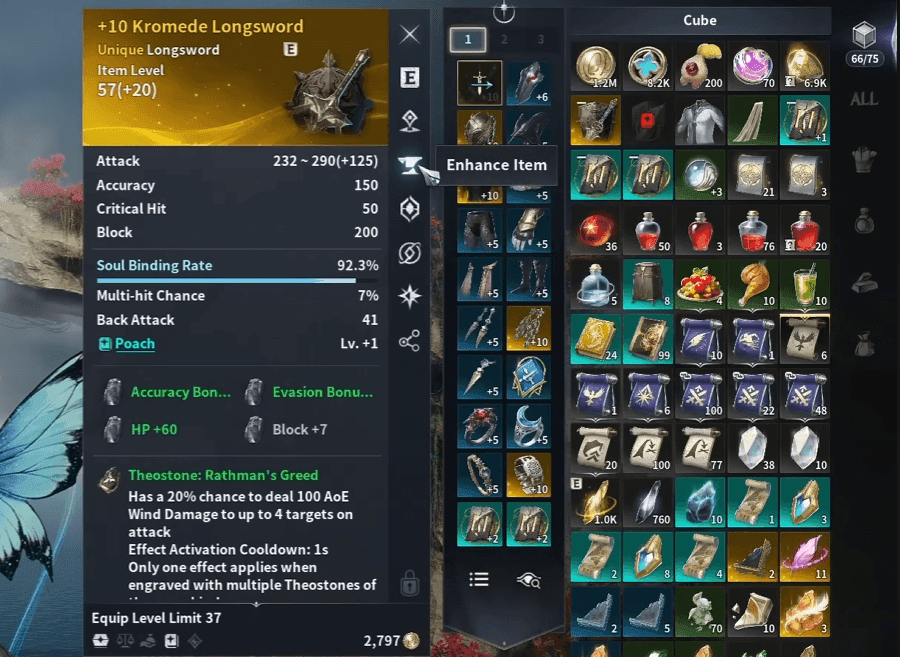
The key numbers that make the system friendly: success is guaranteed (100%) up to +10, after which the odds drop to roughly 60%. But even on a failure past +10, the item doesn't break or lose its level — it just stays where it is, and the game runs a pity system: your odds go up after every failed attempt. So there's no such thing as permanently unlucky here — the enhancement will eventually land. That's meaningfully softer than games where a failure sets an item back or destroys it outright.
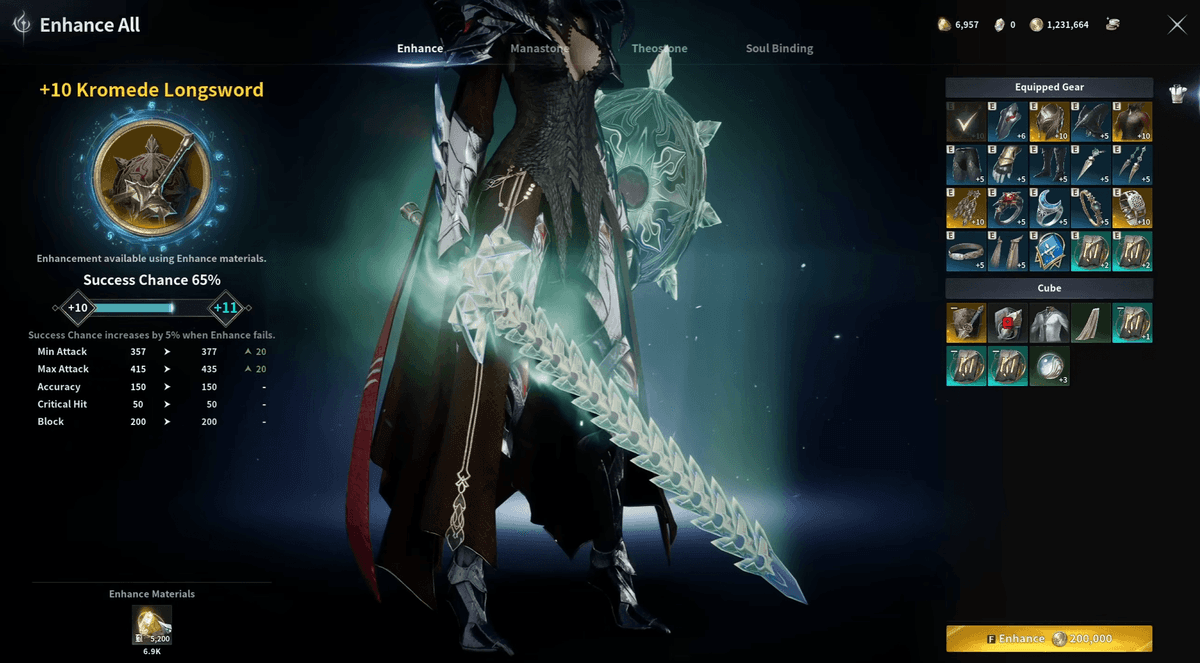
A note on recovering your investment. If you find a better item and want to free up resources tied up in the old one, use Extraction: breaking down an enhanced item returns 100% of the Enhancement Stones you put into it. One important catch — Kina, mana stones, and theostones are not refunded. So the rule is simple: don't be afraid to enhance, but put your big investments into long-term items you won't be replacing soon. The stones always come back; the Kina you spent across a dozen enhancement attempts doesn't.
What to enhance first
Enhancement priority is probably the single most common newbie question, and the answer here is pretty clear-cut. Early on and while leveling, always enhance your weapon first — it gives the most noticeable damage increase, speeds up farming, and makes story bosses noticeably easier. Pull armor and accessories along as needed — if your survivability is lagging, add defense; if your damage is lagging, go back to the weapon.
At endgame, though, priorities shift. Two permanent items rise to the top — ones you'll never replace for the rest of the game: the Revelation Amulet and the Noble Belt. They affect key stats (the amulet boosts weapon damage bonus and penetration, the belt boosts HP, regen, and defense) and, unlike the rest of your gear, never get swapped out for a newer version. That's exactly why enhancing them is the safest bet — the investment never "burns" on a replacement. Note that both items also each require a special enhancement scroll to upgrade. After the amulet and belt comes your weapon, and only then everything else, in moderation. The final priority order looks like this: Revelation Amulet and Noble Belt first, then your weapon, then everything else as needed.
Breakthrough: moving an item into a higher tier
Enhancing to +10 is only half the road for any given item. Next comes Breakthrough (called "morphing" or "substance morph" on Western wikis). Here's how it works: once you've pushed an item to +10, you convert it into the next rarity tier at enhancement level 0 and start enhancing again from scratch. For example, a Green item at +10 morphs into Blue, Blue morphs into an even higher tier, and each such jump sharply boosts your Gear Score. It's exactly this chain — "enhance to +10 → Breakthrough → enhance again" — that carries characters up toward the 2400+ threshold.
The permanent items make this easy to visualize. Taking a Rare (blue) amulet and belt to +10, you morph them into an Epic version at level 0 and enhance again to +10, then Breakthrough once more into a Unique (gold) version, with a final enhancement to +10. What you end up with is a Unique Revelation Amulet +10 and a Unique Noble Belt +10 — the foundation of an endgame build that stays with you for the long haul.
The new Seal slot
The September patches added another gear slot: the Seal. You can get a Seal item two ways — craft it directly through professions, or convert special vouchers dropped by the new Snowfield of Sorrow sanctuary, paying extra in Kina. In terms of enhancement, a Seal behaves like a normal piece of gear — it goes through the same enhancement and Breakthrough system — but since the slot is so new, a fully settled guide to the optimal path for upgrading it doesn't really exist yet at the time of writing. Some Korean/Taiwanese-version sources mention a similarly-purposed Pendant slot, added back in July 2026 — this is likely the same system under a different localized name, but there's no way to confirm that for certain before the global release ships. Check your own client for the current name and mechanics of this slot.
Abyss gear: set bonuses are no longer equal across tiers
One rework deserves its own callout: the PvE set bonuses on Abyss gear got reworked in September. Previously, the damage-boost percentage for wearing a full set was roughly the same across all PvP gear tiers. Now the bonus scales with tier: lower tiers lost access to bonuses that used to come from larger sets, while the top tier got a meaningful boost. As of mid-September 2026, the thresholds look like this:
- Decanus — caps at 20% (maximum for a 5-piece set; the 8- and 12-piece bonuses are no longer available at this tier).
- Tribunus — 12-piece bonus raised from 35% to 45%.
- High Commander — 12-piece bonus raised from 40% to 50%.
- Praetorian Captain — 12-piece bonus raised from 45% to 55%.
The 2-, 5-, and 8-piece bonuses on the higher tiers are unchanged. The practical takeaway: where you used to be able to coast on a lower Abyss tier for a while without losing much PvE damage, the gap between tiers now hits harder, and upgrading from Decanus to Tribunus and above is a noticeably higher priority than it used to be.
Mana Stones and Inheritance
Beyond enhancement, gear sockets take Mana Stones, which add extra stats — attack, defense, crit, and other combat parameters. Effects are randomized, but the higher a stone's rank, the better the bonus quality; they drop from monsters, appear in exchange shops, and come from Alchemy. Accessories use mana stones less often than weapons and armor.
Finally, a relatively new and genuinely convenient system: Inheritance (also called Transfer or Succession in some regions). Replacing an upgraded item used to mean partially losing your investment, and players got wary of enhancing anything they'd outgrow soon. Inheritance lets you carry an item's enhancement level and soul-binding status over to a new item of the same rarity. On the Korean/Taiwanese service, the Chapter 1 update (July 2026) made Inheritance transfers fully guaranteed — previously it succeeded with a chance, now success no longer depends on luck. That same update also removed the cap on the attack stat. Whether the global release inherits these same rules from launch hadn't been confirmed as of this writing — check how the system actually behaves in your own client after release.
In practice, this system removes a lot of the fear around upgrading — you can commit a bit more boldly. That said, it doesn't remove the need for discipline: don't try to max out every slot at once, or you'll stall out with no resources right before the next threshold. Enhancement raises the base numbers — turning a good item into a great one is what fine-tuning stats does, which we cover next.
Fine-tuning stats: endgame optimization
Once your gear stops changing daily and enhancement and Breakthrough have squeezed out all the base numbers they can, the deepest layer of progression kicks in — stat tuning. This is the part that keeps optimization fans in Aion 2 for months. In the Korean original, this whole group of mechanics is grouped under Soul Binding, and it has three main functions: binding, syncing, and reset. Let's go through them one at a time, with notes on when to use each.
Soul Binding: squeezing 100% out of a stat
Every stat on an item has not just a numeric value, but a realization percentage. Sounds tricky, but a quick example makes it simple: an item with a +27 bonus to some stat might only be working at, say, 82% efficiency — meaning you're actually getting around 22 of those 27 points. The binding function, through special Soul Binding Books (earned from achievements, login rewards, and battle passes), pushes that percentage up to 100%, giving you the stat's full power.
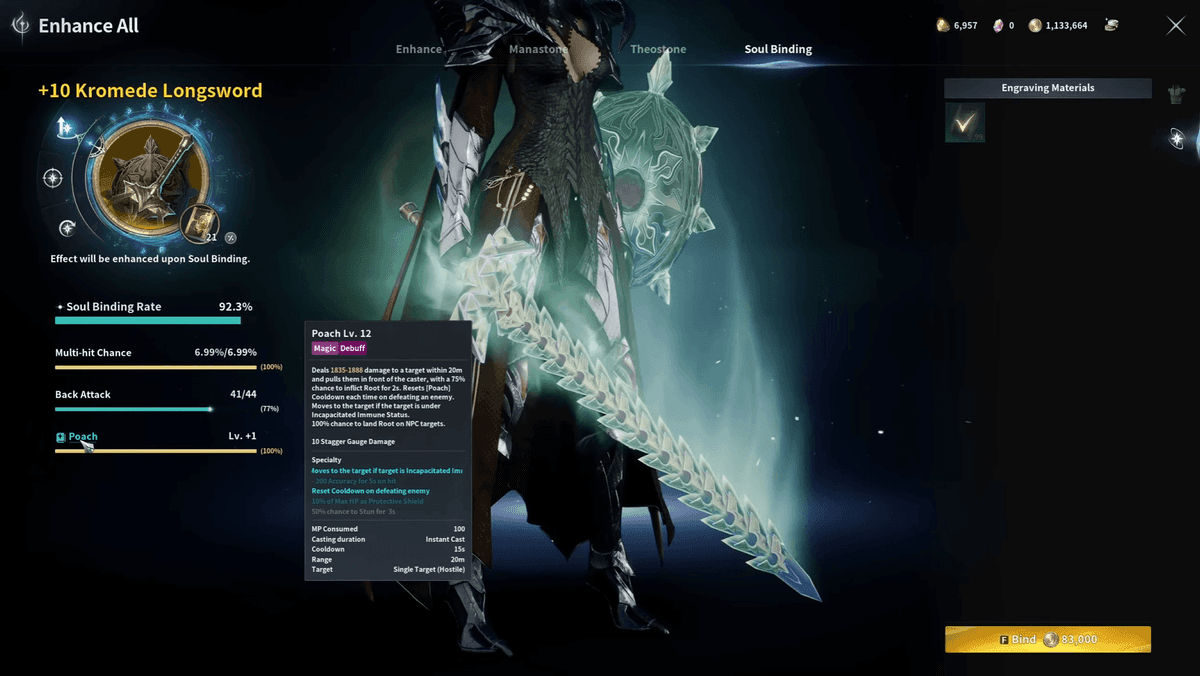
The application logic is obvious: binding books get spent on your best endgame items that already have ideal stats. Pushing a soon-to-be-replaced item to 100% is a waste of a scarce resource. Save binding for your "keepers" — gear you plan to run for the long haul.
Syncing: swapping out an unwanted stat
The single most powerful tuning tool is Syncing. It lets you replace one bad stat on your item by sacrificing another gold (unique) item as "fodder." It's effectively a controlled stat reroll: you sync the same item over and over, feeding it unique items, until you land the ideal combination of four target stats or passives. This is the classic endgame loop of hunting for BiS (best-in-slot) gear.
Two important restrictions to remember. First, you can only sync unique (gold) items — blue (rare) items don't qualify, either as the target or as fodder. Second, that leads directly to the golden rule of endgame: never sell or dismantle gold items, even ones that don't directly suit your build. Every one of them is fuel for syncing your main gear. That's exactly why unique items hold their value on the auction house — the whole tuning process runs on them.
Reset and Soul Fuse
If an item is valuable but its stats are genuinely bad, there's a last resort — Reset. Using a special reset item plus Kina, it wipes an item's current stats and rolls four new random ones, while keeping its tier and item type intact. It's a lottery, and it's worth using when the slot matters and the current stats are bad enough that there's nothing left to lose. Notably, one patch significantly cut the cost of resets and rerolls — the developers noticed players getting stuck on bad rolls and quitting out of sunk-cost frustration. Experimenting with stats is meaningfully less painful now than it was at launch.
On top of all this, endgame unlocks one more rung: Soul Fuse. Once an item is fully enhanced and sitting at 100% soul binding, special items (the Philosopher's Stone: Revelation) let you layer additional binding effects onto it. A September patch added a useful new recipe to this chain — a bound version of the Philosopher's Stone that converts ten Power stones into a single Truth stone, partially cutting your dependence on random drops of rare stones at the very top of progression. This is optimization for the last few percentage points of power, and most players won't get here quickly — but it's worth knowing it exists so you understand where the ladder ultimately leads.
Arcana Cards — a parallel layer of power
Beyond gear itself, endgame also brings in the Arcana Cards system — collectible cards with stats and set bonuses that drop from timed challenge content. Cards level up and can be transmuted using Kina, and on the global release the developers specifically improved rare Arcana card rewards from lower-level Transcendence dungeons — apparently to make the card system more approachable for new players from day one, rather than feeling like veteran-only content.
Essentially, Arcana Cards are another parallel power multiplier on top of Gear Score, alongside the Daevanion system. The developers are clearly shifting part of the endgame balance in this direction: the higher item-level gates on newer content require not just raw gear power, but card optimization and smart party composition too — meaning raw Gear Score alone no longer decides everything at the top end of content.
One last link in the chain. Gear power in Aion 2 doesn't stop at the items themselves: running in parallel is the Daevanion system — a grid of passive bonuses leveled up with Devenian Crystals from dungeons and strongholds, giving a huge cumulative boost to stats and skill levels. On the global release, by the way, max skill and stigma levels are capped at 20 — keep that in mind if you run into higher numbers in older Asian-server guides. Daevanion is a big topic of its own, covered in detail in our general Aion 2 guide; the key thing to remember here is that Daevanion is yet another permanent multiplier on your power stacked on top of gear and Arcana Cards, and it's not something to neglect.
Where to start as a beginner: a practical checklist
Let's pull everything together into a short roadmap you can act on from day one. These priorities will save you from the most expensive mistakes and weeks of grinding.
- Follow the story for your baseline. Yellow quests give both experience and starting gear — you don't need to worry about hunting for gear on the way to level 45.
- Enhance your weapon first. While leveling, your weapon gives the biggest power increase; bring armor and accessories along as needed.
- Don't over-invest in early gear. You'll eventually replace everything except your amulet and belt — enhance early gear just enough to hit the next content-access threshold, no more.
- Prioritize the amulet and belt. The Revelation Amulet and Noble Belt are permanent and never get replaced, so investing in them is the safest bet — run them through the full enhancement and Breakthrough chain up to Unique +10.
- Hoard your materials. Enhancement stones, Devenian Crystals, monolith feathers — don't throw any of it out, all of it gets used eventually.
- Never sell gold items or procs. Unique (gold) items are syncing fuel, and intermediate crafting procs are materials for the next tier. These are the two things new players lose most often.
- Track your Unbound Kina. If you're farming currency to sell or running alts for it, prioritize Transcendence (Conquest) dungeons over routine exploration runs — that's the only place Kina trades freely.
- Don't ignore Arcana Cards. At top-tier content, they're a separate power multiplier alongside Gear Score — level them up alongside your gear, not as an afterthought.
Frequently asked questions about Aion 2 gear
How do you upgrade gear in Aion 2? The story gives you your baseline, then you raise item levels through enhancement (safe up to +10), push items into higher tiers with Breakthrough, and fine-tune stats through soul binding, syncing, and Arcana Cards. The main measure of power is Gear Score — it's what all progression past level 45 revolves around.
Is there crafting in Aion 2, and do you need it? Yes, and for serious PvE it's close to mandatory: crafted weapons and armor carry a percentage PvE damage bonus that dropped gear doesn't have. Crafting also makes you self-sufficient for consumables and accessories, and at the very top of the chain it merges with endgame Abyss gear through inheritance crafting.
Up to what level is it safe to enhance gear? Success is guaranteed 100% up to +10. Above +10 the odds drop to around 60%, but the item doesn't break on failure, and the pity system raises your odds after every failed attempt — so you can't get permanently stuck.
What's Gear Score, and how much do you need for endgame? Gear Score is the sum of the levels of everything you're wearing, and it matters more than character level at endgame. You'll land around 900–1000 by the end of the story; the endgame bar for top-tier gold gear starts around 2400. On the global release, some early-endgame content (Heroic gear, Hard Mode Transcendence dungeons) is deliberately delayed past launch, so the road to 2400 may take a bit longer than on the Asian servers.
What's the new Seal slot? It's an additional gear slot added in the September 2026 patches. You get an item for it through crafting or by converting vouchers from the new Snowfield of Sorrow sanctuary using Kina. It enhances under the same rules as regular enhancement and Breakthrough.
What should you never sell or dismantle? Unique (gold) items — you need them as fuel for stat syncing. And intermediate crafting procs (green, blue components) — those are materials for the next crafting tier. Everything else can safely be extracted for enhancement stones when you replace it.
What's the difference between enhancement and syncing? Enhancement raises an item's base level and your Gear Score, spending enhancement stones and Kina. Syncing doesn't change the level — it replaces bad stats on an item, sacrificing another gold item to do it. One is about "bigger numbers," the other is about "the right numbers."
What's next
Gear is the heart of progression in Aion 2, but it's far from the only part. If you want to get up to speed on classes, skills, the Daevanion system, and how the game fits together as a whole, check out our complete Aion 2 beginner's guide — it sets the broader picture that this page slots into as a deep dive on gear. You can find the game in our catalog and follow release news on the Aion 2 page. As the global version and its updates roll out, treat specific enhancement numbers and Gear Score thresholds as things to double-check against your current client — the Korean, Taiwanese, and global versions can diverge in balance, and that's especially true for brand-new systems like the Seal slot and the reworked Abyss sets.