 F2P · Live
Lineage 2 Essence
Lineage 2 Essence is NCSoft's free-to-play take on the classic Korean MMORPG Lineage II, built around faster…
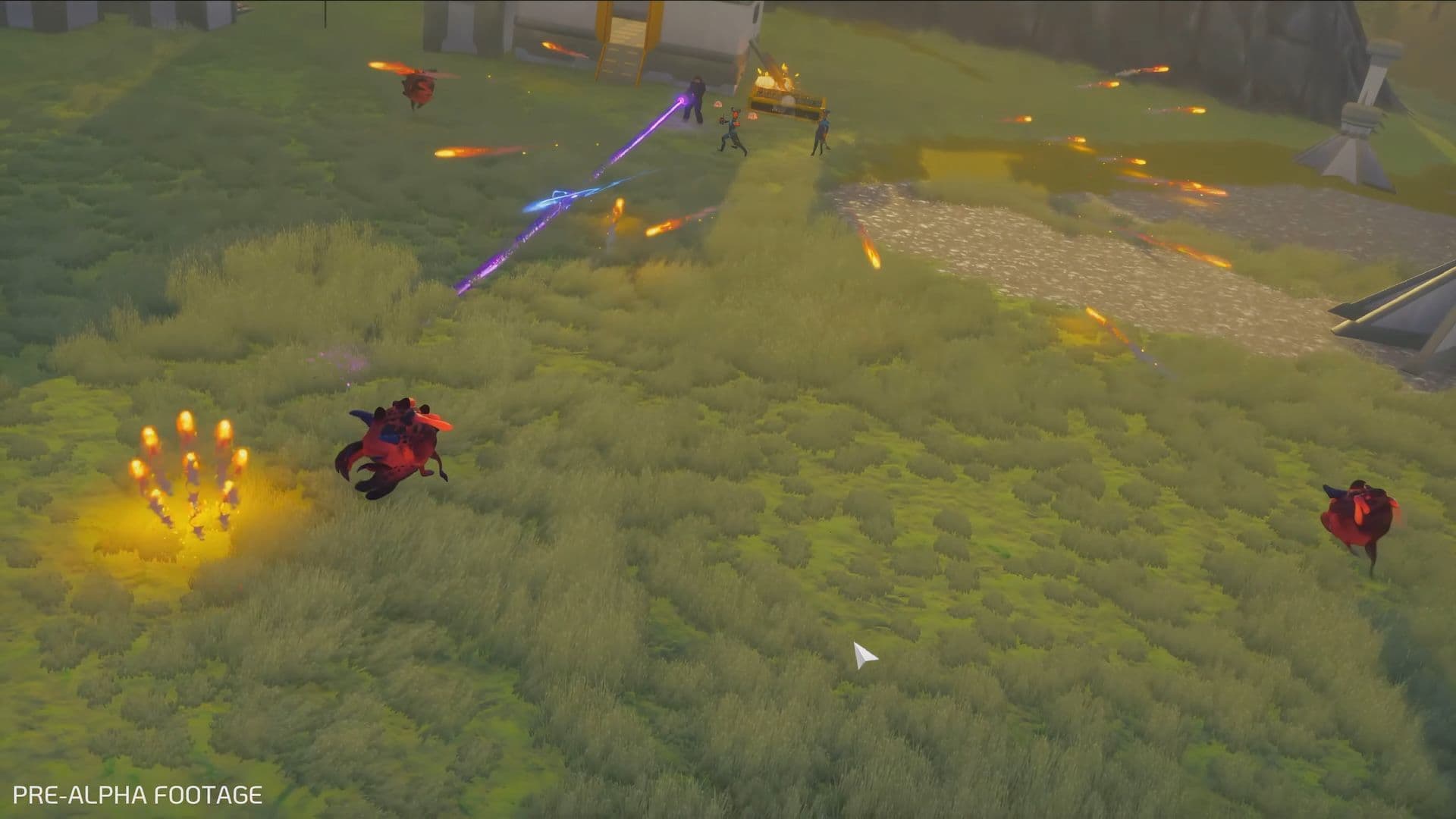
Stars Reach is Playable Worlds' upcoming sandbox MMORPG — a single, shardless galaxy of simulated planets where over forty player professions weave into one crafting-driven economy, terrain reshapes p...
Stars Reach is a sandbox MMORPG in development at Playable Worlds, a San Marcos, California studio founded in 2018 by Raph Koster — designer of Ultima Online and Star Wars Galaxies — alongside industry veteran Eric Goldberg. The project has been running closed pre-alpha tests since late 2025, cleared a $816,922 Kickstarter campaign in early 2025 on the strength of Koster's name alone, and was publicly slated for Steam Early Access "this summer." That date has quietly slipped: as of late July, the studio's own development streams place the build a stage short of alpha, with a full test-server wipe still ahead of it. This preview covers what the pre-alpha build actually does right now, not the finished pitch on the Steam page.
The framing fiction is thin by design — a vanished precursor race called the Old Ones once terraformed the galaxy, carved wormhole routes between star systems, and disappeared, leaving ruins that behave like magic to the civilizations that came after. Players start from a shared jumping-off world called Haven and fan out from there into a field of procedurally generated planets, each one simulated down to the temperature of individual patches of ground. It's less a story than a premise for a universe that's supposed to hold still and let players write the rest of it.
What makes that premise interesting is the engineering underneath it. Stars Reach runs on a heavily customized build of Unity, but the parts that matter — the planetary simulation, the persistence layer, the hosting — are proprietary, cloud-distributed systems Playable Worlds built specifically to keep a single, shardless galaxy running without periodic resets. A crater you blow into a hillside is supposed to still be there next year. A planet nobody settles is supposed to see its wormhole connections quietly decay from neglect. None of that is unusual to promise in an MMO pitch deck; what's unusual is that Koster has spent thirty years publicly wanting to build exactly this, going back to his work on the never-shipped EverQuest Next.
There's no character class in Stars Reach, and there's also no single skill tree — there are reportedly more than forty of them, covering everything from combat specializations and weaponsmithing to xenobiology, cartography, and journalism, with over a thousand individual skills spread across the set. Progress in each one comes from doing the thing: fight, and you earn combat experience to spend on combat skills; mine ore, and you earn mining experience to spend on mining skills. It's the Star Wars Galaxies model Koster helped build a generation ago, reassembled for a new engine.
The catch, and it's a deliberate one, is the toolbelt. Out in the field you can only carry a limited loadout of profession tools at once, so a session spent scouting ruins with a scanner and a rifle is not the same session as one spent hauling ore with a mining laser and a cargo drone — you have to choose, travel back, and re-equip to switch hats. Having the skill without the matching tool does nothing, and having the tool without the skill does nothing either, which is the game's way of avoiding soulbound loot: anyone can pick up anyone else's gear, but only the right training makes it useful. It's a small piece of friction that's doing a lot of design work, forcing the kind of specialization-and-trade dependency that made SWG's economy feel alive instead of solitary.
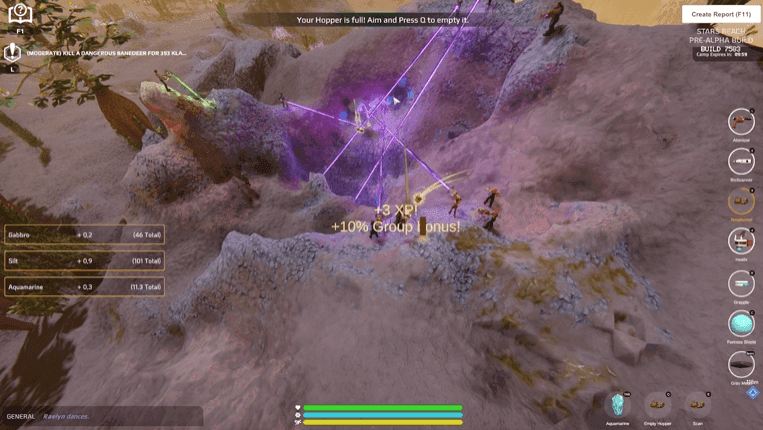
Combat is real-time and aim-based, with an accessibility layer underneath it — players can choose full manual aiming, softer homing shots, or straight lock-on targeting, which is a wider spread of options than most action-combat MMOs bother offering. Weapon variety spans sniper rifles, close-range sci-fi sidearms, swords and spears for melee builds, and the odd throwing weapon the team has floated adding later. What separates it from a generic third-person shooter, on paper, is that the world is meant to react rather than sit still: enemies that are losing a fight are supposed to flee or call in reinforcements, and damage to terrain is supposed to persist rather than reset on a timer. Melt a hillside into lava during a fight and, per the developers, that lava is still there the next time you walk past.
That physics-driven promise is the single most interesting thing about the pitch, and it's also the part that's hardest to evaluate honestly right now. What's visible in demos and hands-on previews so far — flowing lava, terrain you can tunnel through, a planet with an on-screen health bar reflecting how heavily it's been stripped of resources — reads as a tech demo more than a finished combat loop. Impressive tech demos and durable moment-to-moment combat are not the same achievement, and Stars Reach hasn't yet had the volume of player-hours needed to prove the second one out.
Housing isn't a separate menu system bolted onto the world — it's tied directly into the terraforming tools that let players reshape terrain, tunnel through mountains, and burn or green a landscape depending on how it gets used. Settle a planet with your guild and you're meant to be able to build outward from a homestead into an actual town, with the environment itself tracking the consequences: strip-mine a world for resources and its ecosystem is supposed to visibly decline; manage it carefully and it's supposed to recover. Whether a planet stays populated even affects the wormhole lanes connecting it to the rest of the galaxy, which is a genuinely novel way to make abandonment feel like a real cost instead of just an empty server.
The economy is meant to run entirely on what players make. There's no gear dropping from loot tables — weapons, tools, and structures all come from crafting, and the studio has been explicit that this is a design pillar rather than an early-access placeholder. Combined with the profession web above, the intended loop looks like a real supply chain: someone farms and cooks food, someone else mines ore and refines it, a weaponsmith turns that ore into gear, and an adventurer carries that gear into a fight that generates the resources the next link in the chain needs. It's an ambitious thing to promise for a launch, and an even more ambitious thing to balance once thousands of players are pulling on it at once.
Longer-term, groups of players are meant to be able to claim and govern entire planets — setting taxes, writing rules, and choosing whether their world runs as a peaceful trade hub or an open PvP free-for-all. That's the feature that gets Stars Reach compared most often to EVE Online, and it's also the feature furthest from being tested at any real scale. Koster has said the team is prioritizing the peaceful, professions-first side of the game first and layering PvP and full governance systems on afterward, which is a defensible sequencing choice for a studio this size, but it does mean the galactic-politics pitch on the box is currently mostly a promise rather than a system you can log in and try.
Is Stars Reach going to be pay-to-win? The studio's public answer is a clear no, and the model they've committed to is at least unusually specific for a game this far from launch. Stars Reach is planned as free-to-play at release, funded by an optional monthly Property Pass — required to own and hold long-term land, but not required to use the gameplay systems tied to that land, since the same facilities will be available through public infrastructure for everyone. Alongside it sits a cosmetics store and a tradeable, PLEX-style token that lets players earn Property Pass time through play rather than a card. Kickstarter backers at the $30 tier and up get that access for free through the remainder of testing.
The intent reads as genuinely player-friendly, and it's worth saying so plainly rather than reflexively distrusting it — this is a small studio being unusually transparent about a model most companies keep vague until the week of launch. The honest caveat is that "optional subscription funds free-to-play" is a model several MMOs have promised and then quietly leaned on harder than advertised once server costs came due, and Stars Reach hasn't launched long enough to have tested that promise against real revenue pressure yet.
Playable Worlds has been building toward this since 2019, backed by $37.7 million across three funding rounds from investors including Kakao Games and BITKRAFT Ventures before it ever ran a Kickstarter. That's a long runway, and it shows in how much of the vision is already implemented in some form: multiple planets, functioning combat, crafting, terrain modification, and space travel between systems have reportedly all been playable in testing for months, with backer accounts logging real hours.
That gap between the pitch and the current build status is the whole story of Stars Reach right now. The professions web, the toolbelt, the crafting-only economy — all of that is real and reportedly playable. The planet-eating hive mind threat, full faction PvP, and planetary governance are still listed as things coming after Early Access starts, not before it. A studio this size, self-funded through a genuine passion project rather than a publisher mandate, moving carefully instead of shipping to a marketing date, is not automatically a red flag — slow and transparent has a better track record in this genre than fast and quiet. But it does mean nobody outside the closed test can honestly review Stars Reach yet. They can only preview the shape of it.
If you backed Star Wars Galaxies or Ultima Online in their prime and have spent two decades waiting for someone to try that formula again with modern tools, Stars Reach is worth wishlisting and watching the dev streams for — the professions system and the crafting-only economy are shaping up to be the real deal, not marketing language. If what you want is a game you can install and sink a weekend into this month, there's nothing here for you yet: no confirmed Early Access date, half the pitched systems still unbuilt, and a studio that has already missed one public timeline. This is a preview of a promise, not a review of a product, and the honest move is to wait for Playable Worlds to actually open the doors before deciding whether the galaxy they've built is worth living in.