Vehicles in Once Human: Motorcycle, Garage, Tuning Modules, Mobile Base Truck, and Ships
Foot travel across Once Human burns stamina fast. Heavy hauls of copper, iron, and sulfur drag your speed to a crawl. Personal transport flips the survival tempo on its head, turning hour-long treks into five-minute sprints. While the basic two-wheeled Bicycle unlocks free of charge during the early Tutorials Journey questline, crafting motorbikes, four-wheel-drive haulers, and ocean craft requires building an operational Garage at your base.
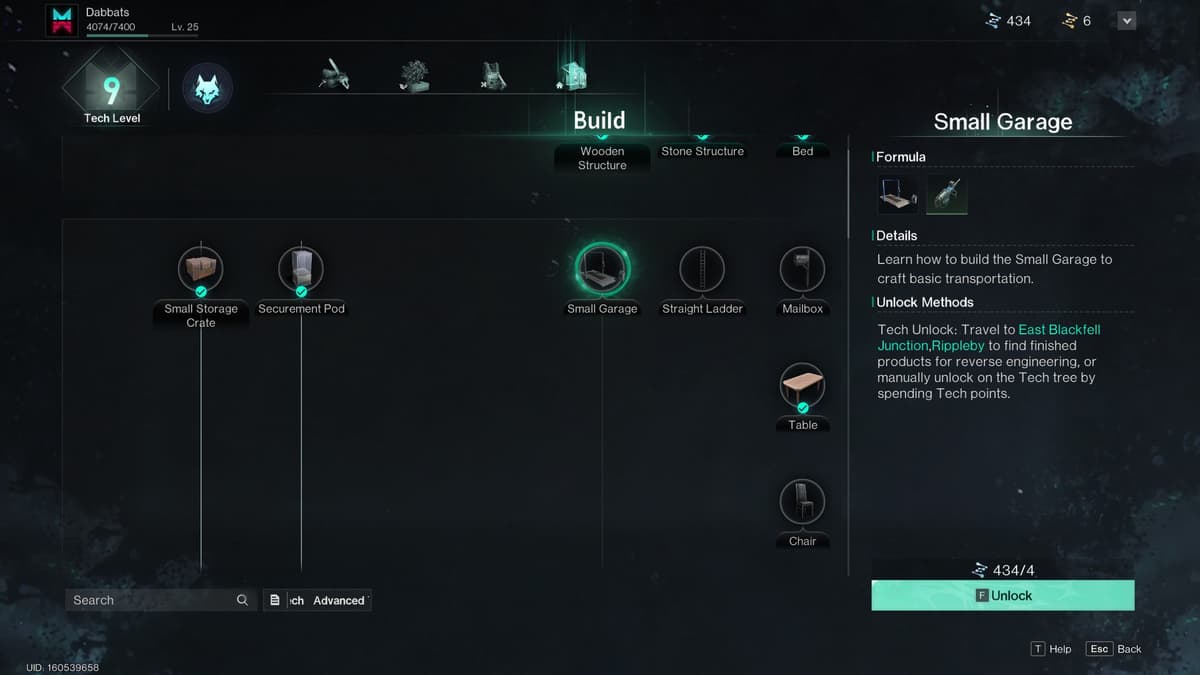
Quick Take: The Tech Tree opens with key O (or via inventory "I" -> "Tech - Cradle"). The baseline Garage is built inside your territory under the "Facilities" tab for 13 Iron Ingots and 10 Parts. In the Garage Terminal, vehicles craft as complete units from raw basic materials. Once crafted, your ride is immediately accessible in the field summon menu by pressing G with a 100% full fuel tank.
In the Tech Tree, vehicle infrastructure formulas are situated across the Building and Production branches:
| Tech Node | Tree Branch | Unlock Cost | What It Provides |
|---|---|---|---|
| Tutorial Vehicle (Bicycle) | Tutorials Journey Questline | Free | Starter two-wheeled bicycle. Available immediately, requires no fuel and no garage to operate. |
| Garage | Building / Facilities | 5 Tech Points | Service ramp to craft, repair, customize, and upgrade lightweight wheeled transport. |
| Large Garage | Building / Advanced Facilities | 12 Tech Points | Expanded industrial bay for heavy all-terrain vehicles and mobile outpost trucks. |
Access the Tech Tree by pressing O on your keyboard or opening your inventory (press I and select "Tech - Cradle" along the top bar). Unlocked formulas remain active with your character throughout the scenario season. If you are running short on tech points, researching salvaged electronic components at the Tech Synthesis Bench yields supplementary Tech Experience.
Construction and Site Requirements: Standard and Large Garage
The Garage functions as an open mounting ramp equipped with an interactive terminal screen. Inside your home territory, press B to enter Build Mode, switch to the "Facilities" tab, and select the vehicle category marked with a motorcycle icon:
- Standard Garage: The baseline hoist ramp. Construction requires 13 Iron Ingots and 10 Parts. Occupies a 3x3 foundation footprint. Crafts and services the Street Motorcycle, Retro Coupe, and lightweight two-seater flyers.
- Large Garage: An expanded industrial bay spanning 5x6 foundations. Required for the four-seater All-Terrain Vehicle and heavy Trailer Head - Truck. Built using steel beams and mechanical actuators.
Crafting Your First Street Motorcycle
After unlocking the vehicle blueprint through Mary's storyline in Dayton Wetlands, interact with the Terminal of your built Garage by pressing F. In the top navigation bar, select the "Craft" tab — cycle between terminal screens using Q and E.
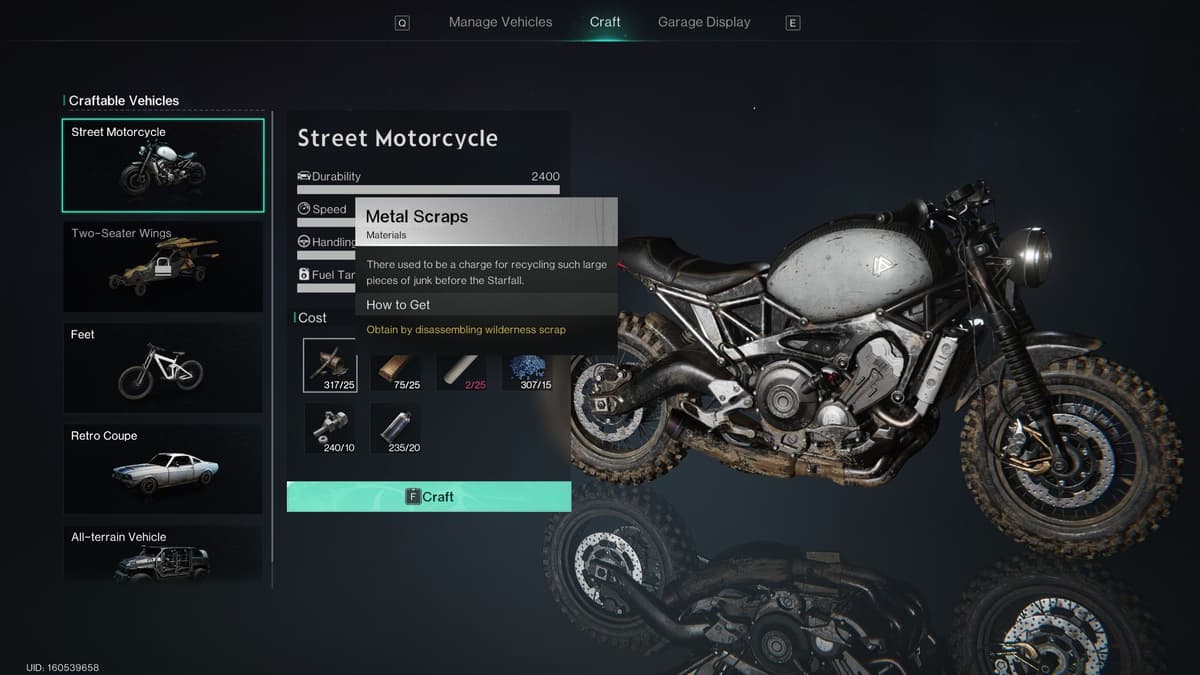
Vehicles craft from raw materials gathered across the open world and smelted inside your base furnaces:
| Vehicle Model | Required Crafting Materials | Baseline Vehicle Stats |
|---|---|---|
| Street Motorcycle | 50 Rusted Parts, 15 Parts, 30 Copper Ingots, 20 Fabric, 15 Rubber | Durability: 2800 HP, Speed: 4.0, Handling: 3.2, Fuel Capacity: 2000 |
| All-Terrain Vehicle (ATV) | 70 Rusted Parts, 20 Parts, 48 Plastic, 45 Steel Ingots, 50 Rubber, 12 Electronic Parts | Durability: 4200 HP, Speed: 3.5, Handling: 2.6, Fuel Capacity: 4000 |
Pressing F ("Craft") registers the vehicle directly to your personal motor pool. It is road-ready immediately: every freshly crafted bike starts with a 100% full fuel tank and is instantly accessible in the field summon menu.
Summoning Vehicles in the Field: Key G and the Q/E Selector
Summoning your ride anywhere out in the wild takes a single keystroke. Field summons are instantaneous:
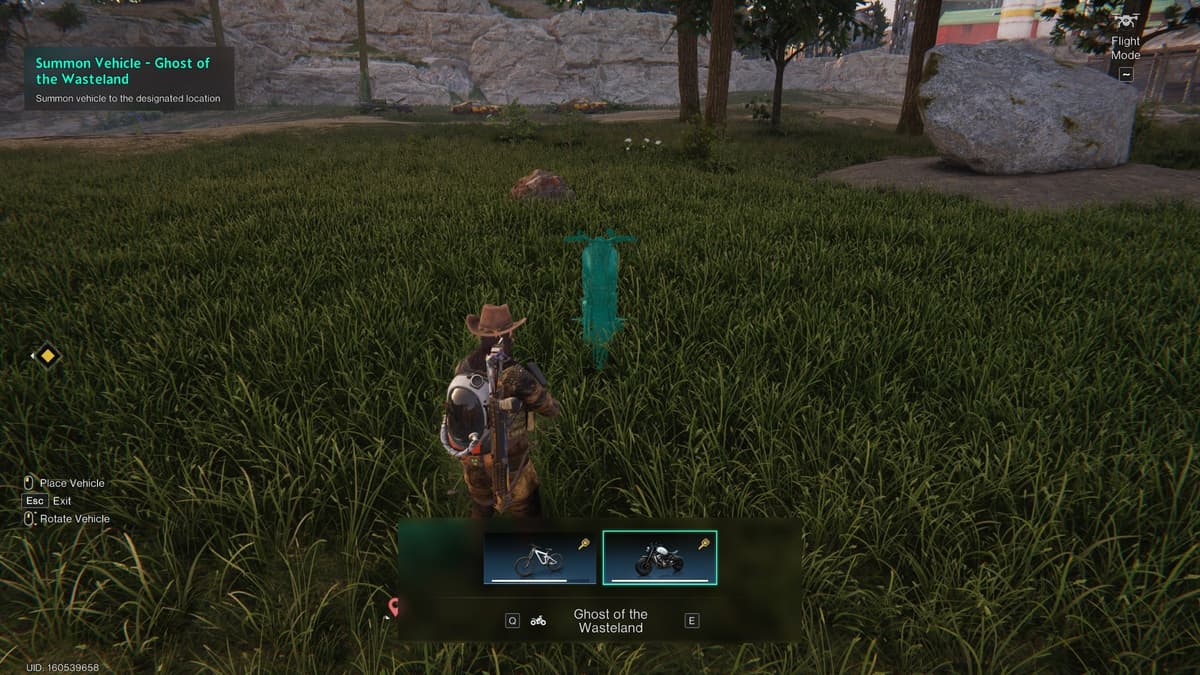
- Press
Gon your keyboard. A vehicle selection HUD appears along with a green holographic projection on the ground. - The bottom bar displays your owned vehicle pool. Cycle through them (such as switching between the starter Bicycle and the faster Street Motorcycle) using keys
QandE. - Rotate your mouse wheel to aim the headlights down the road, then press
Left Mouse Button (LMB)to materialize the ride. PressEscif you wish to cancel the summon.
Approaching a parked vehicle and holding down G opens the circular radial interaction menu:
- Top Sector (Shirt Icon): Vehicle paint jobs and exterior cosmetics (Skin).
- Right Sector (Gas Can Icon): Refueling the gas tank (Refuel).
- Bottom Sector (Car with Arrow Icon): "Retrieve" command — recalls the vehicle back into your home territory garage right from the open world while keeping all trunk cargo completely safe.
- Left Sector (Wrench Icon): Field damage repairs (Repair).
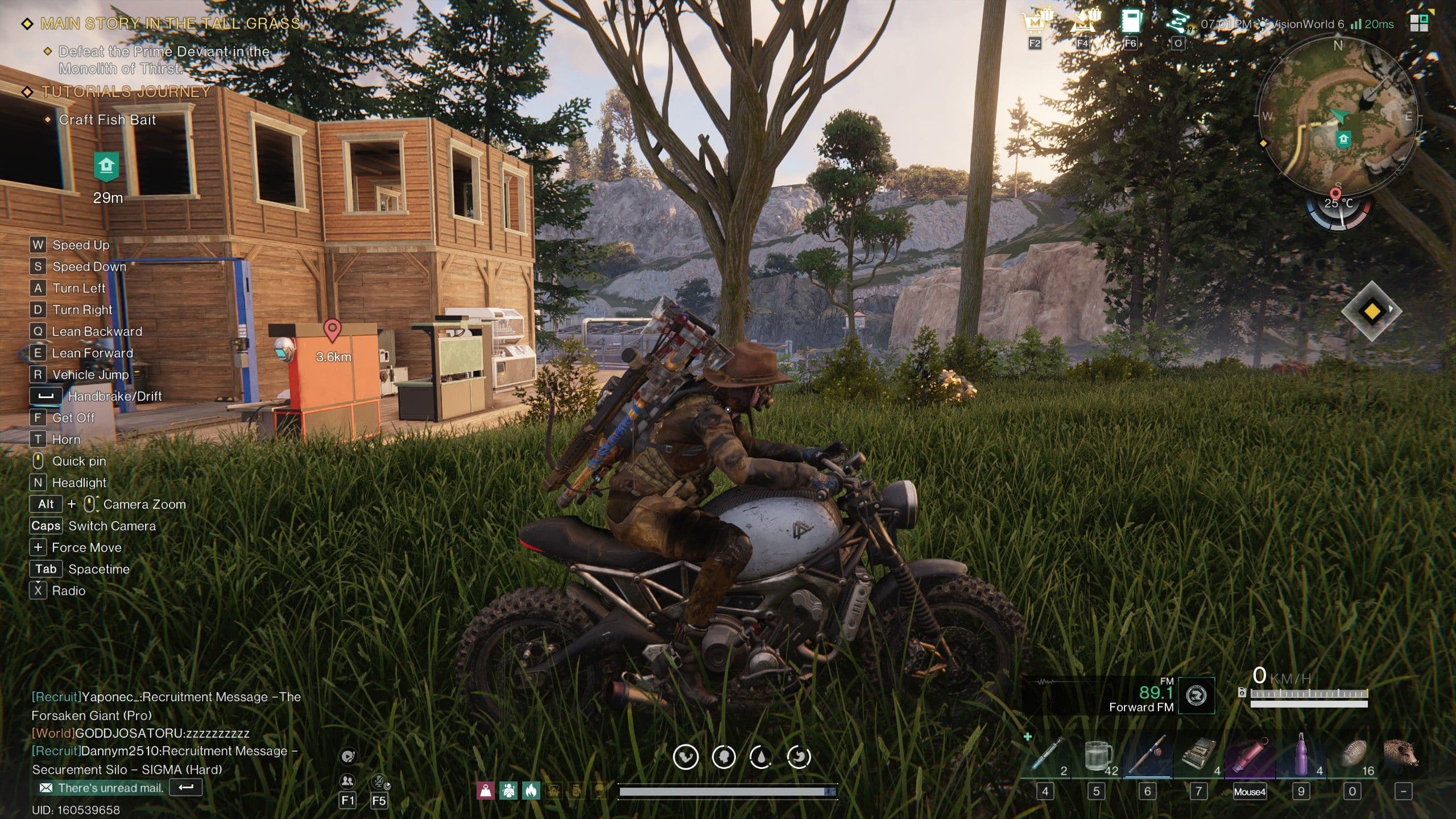
Riding controls on the road: keys W/S handle throttle acceleration and braking, A/D steer, Q/E lean the rider forward or backward when airborne off ramps, R performs a suspension jump over low obstacles, Space activates the handbrake for controlled drifts, N toggles headlights during night travel, and X flips through in-game radio stations.
Vehicle Anatomy: Basic Parts Slots and the Role of Components
A freshly manufactured motorcycle or off-roader straight off the hoist rolls out with balanced baseline specs: a moderate top speed, factory tires geared toward generic pavement, and a standard fuel capacity. The vehicle modification system in Once Human allows players to fine-tune each mechanical assembly to fit specific exploration goals, turning a lightweight commuter bike into a rugged mountain crawler or a high-velocity sprint racer.
Quick Take: Inside the "Manage Vehicles" tab, every ride features 4 modification slots (Basic Parts): Chassis / Suspension, Tires, Engine, and Fuel Tank. High-level Industrial Strongholds yield specialized semi-finished crafting items such as factory Tire items, Connector Firmware boards, and heavy shock absorbers. Integrating these components at your Garage Terminal significantly boosts durability HP, handling stability, top speed, and total tank range.
Accessing the Garage Terminal under the "Manage Vehicles" screen displays four vital equipment slots:
| Modification Slot (Basic Parts) | Performance Impact | Component Acquisition Source |
|---|---|---|
| Chassis / Suspension | Maximum Durability (HP) and terrain impact absorption | Forged from structural alloy plates and heavy-duty shock absorbers scavenged from stronghold containers. |
| Tires | Handling coefficient, grip, and steering response across rough dirt | Requires factory-salvaged Tire items combined with vulcanized rubber and reinforced cord. |
| Engine | Top road Speed and uphill hill-climbing torque | Upgraded using machined piston assemblies, turbochargers, and high-tier microchips. |
| Fuel Tank | Total fuel capacity and long-distance operational range | Fabricated using salvaged Connector Firmware circuit boards and sealed fuel-grade alloy plating. |
Modification Progression: Scavenged Stronghold Components
Upgrading vehicle performance requires materials collected across contaminated manufacturing zones. For detailed mineral deposits, consult the mining guide for ores, ingots, and crystals. The modification cycle proceeds through a straightforward sequence:
- Infiltrate Industrial Strongholds and abandoned manufacturing facilities in level 30–50 zones.
- Search metal crates, weapon caches, and tool storage lockers: they contain specialized Semi-finished Items, including pre-fabricated Tire parts, Connector Firmware circuit boards, and industrial power relays.
- Return to your territory, open the Garage Terminal (press
F), and switch to the "Manage Vehicles" screen. - Select the target slot in the "Basic Parts" row to install the upgrade: combining the semi-finished item with Acid and refined ingots (Aluminum, Tungsten) replaces the baseline unit with an enhanced tier module.
Balance speed with durability. Upgrading your chassis alongside your engine ensures optimal performance: high-output powertrains propel vehicles at extreme speeds, where a reinforced suspension absorbs high-impact jumps without blowing out your durability bar.
Garage Terminal Customization: Paint, Skins, and Visual Tuning
The Garage Terminal also handles exterior styling and fleet roster management (press V to open "Cosmetics"):
- Color Finishes: Customize the color scheme of your gas tank, fairings, fenders, and frame tubes. Color presets range from tactical matte camo to gleaming metallic pearls and vibrant motorsport wraps.
- Manage Skin: Visual conversion kits that overhaul exterior vehicle geometry. Rugged overland packages equip protective bullbars and roof luggage racks, while aerodynamic sport trims lend your motorcycle a sleek carbon-fiber contour.
- Vehicle List: Pressing
Xinside the garage menu pulls up your complete motor pool, allowing you to monitor current condition values and dismantle obsolete duplicate chassis with keyU("Destroy").
Vehicle Access Permissions
Never leave cargo unprotected. In shared open-world servers, an unattended off-roader packed with refined ore can attract roving opportunists. Security parameters are configured directly at the Garage Terminal under the permissions interface:
| Access Permission Tier | Driver Seat Access | Passenger Seat Access | Trunk Cargo Access |
|---|---|---|---|
| Private | Vehicle owner only | Locked for all other players | Vehicle owner only |
| Hive Only | Owner and active Hive members | Owner and active Hive members | Owner and designated Hive comrades |
| Squad / Team | Owner and current party members | All active squad members | Configurable: owner only or entire party |
| Public | Any passing survivor | Any passing survivor | Completely open (extreme cargo theft hazard) |
For organized group expeditions, the "Hive Only" setting offers the best balance: allies can drive the vehicle and ride shotgun across dangerous territory while your haul of mined resources in the trunk remains safely locked down.
All-Terrain Vehicle: 4-Seater Armored Transport for Squads
While the starter motorbike excels at solo scouting runs, navigating the wilderness with a four-player squad quickly exposes the limitations of two-wheeled travel. Squad coordination demands armor. Convoy runs on separate bikes often get separated across uneven terrain, and exposed riders remain vulnerable to ambushes along mountain ridges. For tight team coordination and secure fire support, squads rely on heavy-duty four-wheel-drive platforms with enclosed cabs.
Quick Take: The ground fleet in Once Human spans four dedicated vehicle classes: the rugged 4-seater All-Terrain Vehicle (ATV) built for punishing off-road trails, the aerodynamic Retro Coupe tailored for paved highways, the silent and fuel-free Bicycle granted for free during the tutorial journey without a garage requirement, and the advanced Hoverbike (Hover Motorcycle) capable of skimming across open water. Manufacturing four-wheeled vehicles requires constructing a Large Garage and advancing your metallurgy tech nodes.
The All-Terrain Vehicle (ATV) serves as the backbone for coordinated squad incursions. Armed with full-time four-wheel drive and heavy-duty torsion bar suspension, the off-roader plows through deep river fords, loose scree slopes, and steep hillside ascents where lightweight bikes struggle for traction.
Key operational advantages of the ATV during squad expeditions:
- 4-Player Crew Capacity: While the driver steers, up to three passengers can aim and fire personal weapons out of the open side windows while in motion (hold
RMBto aim down sights). - Heavy Armor Durability: The reinforced ladder chassis straight from the garage platform boasts a massive health pool, withstanding direct hits from disciple rocket launchers and explosive landmines.
- Expedition Trunk Space: Houses an expanded trunk bay holding up to 12 cargo slots. Heavy hauls of mined ore and scrap parts can be loaded directly into the bed without overburdening your fighters.
Retro Coupe: High-Velocity Highway Sports Car
For high-speed transit between distant trade settlements along paved thoroughfares, nothing matches the Retro Coupe — a low-slung, twin-seater vintage sports coupe tuned for high-revving asphalt cruising.
Performance dynamics of the Retro Coupe on paved roads:
- Top-End Acceleration: The coupe reaches blistering road speeds exceeding 140–160 km/h, allowing drivers to cross entire territorial sectors in minutes.
- Sharp Steering Response: The tight steering rack responds instantly to
AandDinputs, making it effortless to whip through tight mountain hairpins using controlled power-drifts (pressSpacefor the handbrake). - Low Ground Clearance Hazard: The low chassis demands extreme caution when veering off asphalt onto rocky terrain. Bashing into boulders along dirt shoulders strips away 300 to 600 HP of chassis integrity, and plunging into deep wetlands floods the intake, stalling the motor immediately.
Bicycle: Eco-Friendly Pedal Transport from Game Start
Zero fuel. Pure pedal power. When gasoline runs scarce and roaring exhaust pipes attract roaming mobs, pedal travel saves lives. The Bicycle provides clean, two-wheeled transportation driven entirely by your survivor's muscle power.
The bicycle is unlocked completely free of charge early in the game: it requires no garage facility, consumes zero metal ingots, and burns no petroleum. Completing the introductory milestones of the Tutorials Journey questline registers the bike automatically to your personal motor pool. Press G anywhere in the wild, cycle to the bicycle using Q/E, and deploy it onto the road.
Tactical considerations for bicycle travel:
- Zero Fuel Consumption: The bicycle burns no fuel whatsoever. You can conduct agricultural harvesting circuits and forage neighborhood homesteads without wasting your territory's refined fuel reserves.
- Stealth Infiltration: Silent pedal propulsion generates virtually no acoustic footprint. You can glide right up to enemy perimeter watchtowers without alerting roaming patrols.
- Utility Cargo Basket: The handlebar basket and rear luggage rack provide 4 slots of lightweight storage (ideal for rations, medical injectors, crop seeds, and ammunition crates).
- Speed and Elevation Limits: Cruising speed hovers around 35–45 km/h. Grinding up steep mountain inclines slows pedaling cadences significantly and drains your personal stamina gauge.
Hoverbike: Anti-Gravity Floatation and Water Gliding
The crowning engineering achievement for ground scouts is the Hoverbike (Hover Motorcycle) — an advanced anti-gravity skimmer incorporating Stardust levitation technology. Terrain friction vanishes. Replacing conventional rubber tires with high-output repulsion thrusters, the hoverbike glides roughly half a meter above ground level.
Unique mechanics of the Hoverbike:
- Obstacle Clearance: The hovercraft floats cleanly over jagged boulders, exposed tree roots, collapsed road barricades, and railway tracks without losing forward momentum or flipping the rider.
- Surface Water Gliding: The repulsion thrusters maintain complete flotation over rivers, marshlands, and coastal ocean bays, sustaining identical cruising velocities over water as on dry land (100–115 km/h). It functions as the premier scout vehicle for island hopping and river crossings.
- Inertial Drift Physics: Because the skimmer lacks tire friction against the ground, it carries noticeable lateral drift momentum. When approaching tight canyon turns, feather the throttle and tap
Searly to bleed excess speed.
Fleet Comparison Table: Ground Transport Specifications
Comprehensive side-by-side performance breakdown for all ground transport options in the current game version:
| Vehicle Model | Seating Capacity | Factory Top Speed | Base Durability (HP) | Fuel Burn per 10 km | Primary Tactical Role |
|---|---|---|---|---|---|
| Bicycle | 2 seats | 35–45 km/h | 1200 HP | 0 Units (Free) | Tutorial reward vehicle requiring no garage; silent reconnaissance and zero fuel cost. |
| Street Motorcycle | 2 seats | 75–120 km/h | 2400 HP | 15 Units | Rapid solo exploration; field-summonable via G key; crafts with 100% full fuel tank. |
| All-Terrain Vehicle (ATV) | 4 seats | 65–100 km/h | 6500+ HP | 35 Units | Full-squad combat raids; drive-by weapon firing from passenger windows; high cargo hauling. |
| Retro Coupe | 2 seats | 90–160+ km/h | 4200 HP | 25 Units | High-velocity long-distance travel between trade hubs along paved asphalt routes. |
| Hoverbike | 2 seats | 80–115 km/h | 4800 HP | 20 Units | Rough cross-country exploration; effortless amphibious gliding across rivers and swamps. |
Unlocking the Large Garage and Trailer Head (Turbo Pickup)
Deep expeditions into high-level contaminated zones require extensive logistical planning: squad backpacks quickly fill to capacity with raw ore, characters require rest to recover lost Sanity, and accidental casualties in the depths of ruins force long treks back from stationary bases. The premier solution for sustained autonomy in Once Human is the heavy mobile rig — a mobile outpost combining an enclosed driving cab, living quarters, crafting benches, and defensive turrets all on a single chassis.
Quick Take: Heavy wheeled transport is represented by the Trailer Head - Truck and the nimble Turbo Pickup. Manufacturing them requires unlocking heavy automotive engineering in the Tech Tree and erecting a Large Garage. Heavy trucks hold Mobile Territory status: they cannot be field-summoned through the standard G key menu, but must be driven directly out of your base's Large Garage and parked at strategic points across the map as mobile operational outposts.
Heavy automotive engineering formulas are located under the Building and Production branches of the Tech Tree guide (press O):
- Large Garage: An industrial construction bay spanning 5 by 6 foundation tiles. Equipped with heavy hydraulic lifts capable of supporting multi-ton chassis frames. Requires 12 Tech Points, steel beams, and electronic actuators.
- Trailer Head - Truck: A massive three-axle hauler featuring an open, low-bed cargo platform. The flatbed trailer possesses its own localized construction coordinate grid, allowing players to frame walls, lay flooring, and mount shelter roofs.
- Turbo Pickup: A nimble two-seater utility truck with a shortened flatbed. Ideal for rapid support missions, fitting a pair of storage chests and a compact workbench in the bed.
Mobile Territory Mechanics: Building on the Truck Bed
A true fortress on wheels. The flatbed trailer of the hauler functions as an independent Mobile Territory. Once the truck is assembled in the Large Garage, its rear deck unlocks standard base-building functionality:
- Approach the rear flatbed of the truck and engage Build Mode by pressing
B. - The construction HUD automatically snaps to the truck bed: a green building grid appears, bounded by the physical trailer footprint (3 by 5 small building tiles with a height allowance of up to 3 floors).
- Construction follows standard base rules: lay down lightweight wooden or composite floors directly over the metal frame, erect exterior walls, install doorframes, and mount protective overhangs.
- When the truck drives off, all structural pieces, workbenches, electrical wirings, and storage chests travel synchronously with the vehicle as a single rigid structure.
Outfitting the Mobile Base: Essential Platform Facilities
Flatbed surface area is strictly limited, requiring deliberate efficiency when placing operational modules. A well-designed expedition truck addresses four essential logistical needs:
| Expedition Module Type | Recommended Platform Objects | Tactical Utility in Distant Raids |
|---|---|---|
| Living Quarters & Respawn | Camp Bed or Sleeping Bag | Functions as a dedicated mobile respawn beacon. Fallen squad members revive directly inside the truck bed near the battlefront. |
| Field Manufacturing | Gear Workbench and Portable Furnace | Enables weapon repairs, field ammunition crafting, and immediate smelting of heavy raw ore into lightweight ingots on site. |
| Loot Vault Storage | Reinforced Metal Storage Crates (2–4 units) | Provides over 120+ slots of secured field storage, offloading squad backpacks between clearing runs. |
| Power Generation | Small Bio-Generator or Solar Panels | Powers on-board crafting benches, portable refrigeration for perishables, and exterior perimeter floodlights. |
Combat Hardening and Automated Turrets
A parked expedition truck naturally draws wandering hostiles with its idling engine rumble and interior lighting. To keep your base secure during excursions, the bed supports automated perimeter defenses:
- Automated Turret Mounts: Build Mode permits mounting up to 2 automated machine gun turrets on the cabin roof or upper deck. Turrets link via electrical wire to the on-board generator and draw ammunition from linked storage.
- Perimeter Security on Standby: While your squad delves into contaminated silos or mines ore nodes, the turrets independently neutralize approaching enemies within a 25-meter radius.
- Mobile Drive-By Firing: Squad members can take up elevated positions behind sandbag parapets on the upper deck, engaging hostiles with sniper rifles and rocket launchers while the hauler rolls down the road.
Handling Physics, Weight Distribution, and Constraints
Inertia rules the road. Piloting a multi-ton mobile outpost requires respecting physical inertia and center-of-mass dynamics:
- Center of Gravity Hazards: Every vertical floor layer shifts the center of gravity higher. Building an overly tall lookout tower can cause the truck to roll over on steep side slopes. Keep superstructures compact (1 to 1.5 wall heights) using lightweight materials.
- Extended Braking Distance: A fully laden mobile base weighs dozens of tons, drastically extending braking distance compared to a light pickup. Ease off the throttle early when approaching descents and tight canyon turns.
- Fuel Consumption Under Load: Heavy structural deadweight increases engine fuel consumption. Over a 10-kilometer trek, a fully outfitted hauler burns up to 50–60 fuel units, making it essential to stow spare fuel canisters in an on-board chest.
Starter Watercraft: Ocean Raft and Double Jet Ski
With the release of the expansive Isles of Abyss scenario, the open world expanded far beyond continental shorelines. Oceanic archipelagos, drifting Rosetta oil platforms, and submerged Stardust research facilities cannot be explored with ground vehicles — driving wheeled machines into deep water drowns their combustion engines instantly. Wheels fail in deep water. Navigating the high seas demands a dedicated naval fleet, scaling from compact coastal catamarans up to autonomous floating fortress ships.
Quick Take: Watercraft divide into two primary categories: compact pre-fabricated vessels (the entry-level Ocean Raft and high-speed Double Jet Ski) and fully customized Custom Ships (Floating Bases) assembled atop buoyant pontoons. Vessel performance on the water is governed by the Load System: weight thresholds at 3,000 kg, 7,000 kg, and 10,000 kg dictate draft depth and turning responsiveness. Patch 3.1.1 guarantees baseline steering control even for heavily armored super-dreadnoughts.
Maritime exploration begins with two entry-level watercraft:
- Ocean Raft: A compact two-seater wooden platform lashed together from logs, rough ropes, and buoyant plastic drums. Ideal for calm coastal fishing, harvesting drifting seaweed, and crossing narrow river channels. Reaches speeds up to 25–30 km/h with zero reliance on petroleum fuel.
- Double Jet Ski: A high-performance two-seater watercraft powered by an internal waterjet impeller. Built for scouting distant atolls and rapidly scooping up floating cargo containers. Blasts across ocean swells at 95–110 km/h, though it requires regular fuel refills.
Modular Shipbuilding: Floating Foundations, Steering Wheel, and Propulsion
The modular shipbuilding system empowers players to construct custom hulls of any displacement — ranging from nimble patrol gunboats to sprawling multi-deck fortress dreadnoughts.
Assembling a custom vessel on the water involves four core components:
| Shipbuilding Element | Functional Role | Engineering Nuances & Requirements |
|---|---|---|
| Floating Foundation | Pontoon hull framing | Hollow composite pontoon blocks featuring positive buoyancy. Shapes the beam and waterline geometry while keeping the entire superstructure afloat. |
| Ship Steering Wheel | Central helm control station | The captain's bridge unit synchronizing all mounted thrusters and steering rudders. Without an active steering wheel, the assembly remains an unpowered drifting raft. |
| Electric Propeller / Thruster | Primary mechanical thrust | Mounted below the waterline along the stern transom. Connects via high-voltage cables to deck generators to deliver sustained forward cruising thrust. |
| Sail | Passive wind propulsion | Canvas or composite sails rigged to vertical masts. Harnesses tailwinds to conserve generator fuel and relieve electrical load during open-water transit. |
Construction begins in shallow water or inside a dedicated coastal camp drydock. Press B to enter Build Mode, switch to the "Maritime Facilities" tab, and snap Floating Foundations together. Once the buoyant base is laid out, mount the Ship Steering Wheel on the upper deck, attach stern propellers below the waterline, and run electrical wiring to your on-board generators. The vessel is ready for sea trials.
Load System and Patch 3.1.1 Handling Refinements
Every kilogram counts. Every foundation tile, workbench, steel-reinforced storage crate, and armor plate placed on deck carries mass. The game engine dynamically recalculates the vessel's total displacement via the Load System, governing waterline draft and maritime responsiveness.
Three distinct weight thresholds govern vessel physics:
- Lightweight Craft (Under 3,000 kg): Agile hydrofoils and speedboats. The craft planes effortlessly, skims cleanly over wave crests, and pivots on a tight turning radius.
- Medium Tonnage (3,000 to 7,000 kg): Expedition schooners equipped with living berths, crafting benches, generators, and storage bays. Hull draft deepens and top speed drops by 15–20%, but the vessel gains roll stability during violent ocean squalls.
- Heavy Dreadnought (7,000 to 10,000 kg): Steel-armored floating citadels carrying dozens of storage vaults, battery banks, and defensive cannons. Forward velocity drops by 35–40%, requiring twin electric propellers to maintain momentum.
Naval Warfare and Autonomous Floating Fortresses
The open ocean in Once Human presents formidable naval threats. Deep waters are patrolled by hostile Voyager Fanboats and armed Rosetta Motorboats, while tempest anomalies harbor the monstrous world boss known as The Sunken Lord.
To dominate open-water combat, survivals outfit vessels with specialized weaponry:
- Heavy Ship Harpoons: Turret-mounted ballistas firing steel-cabled harpoons. Used to tether enemy skiffs for boarding actions or hold gigantic sea leviathans within firing range.
- Broadside Plasma and Kinetic Cannons: Mounted along the port and starboard gunwales. Deliver devastating structural damage against hostile hulls and shoreline defense fortifications.
- Complete Sea Autonomy: Equipping seawater desalinators, hydroponic crop racks, and sleeping quarters allows squads to remain deployed at sea indefinitely, harvesting remote coral atolls and smelting dredged ores right inside the hold.
Fuel Economy: Portable Mixed vs. Barreled Premium Fuel
Engines run thirsty. Long-distance journeys across the wilderness demand a reliable reserve of motor fuel. While early-game survivors scavenge plastic gas cans along abandoned interstate highways, sustaining regular squad expeditions and operating multi-ton rigs necessitates establishing automated crude oil refining back at your territory.
Quick Take: When crafted at the Garage Terminal, all vehicles register immediately with a 100% full fuel tank. Moving forward, engines run on two primary fuel grades: baseline Portable Mixed Fuel offering moderate highway mileage, and high-octane Barreled Premium Fuel, which triples cruising range. If your vehicle sustains disabling damage or becomes trapped in rocky terrain, deploy a Field Repair Kit or select "Retrieve" from the G radial menu to recall the machine safely back to your garage.
Direct performance comparison between the two fuel types and their combustion efficiency:
| Fuel Classification | Acquisition and Refining Method | Operating Range per 100 Units | Primary Tactical Application |
|---|---|---|---|
| Portable Mixed Fuel | Manually siphoned from the fuel tanks of derelict sedans along roadside corridors. | Approximately 35–45 km (rapid burn rate inside cylinder chambers). | Early-game motorcycle fuel and short-range foraging circuits near your home base. |
| Barreled Premium Fuel | Refined from Crude Oil inside territory Fuel Refining Facilities. | Approximately 100–120+ km (high thermal efficiency and smooth power delivery). | Primary fuel standard for heavy off-roaders, mobile base trucks, and oceanic ships. |
For automated pumpjack placement across the Blackfell oil fields and industrial distillation setups, refer to our comprehensive fuel, acid, and crude oil farming guide.
Field Breakdowns, Field Repair Kits, and Vehicle Recovery
Lost cargo is never destroyed. Extended overland missions inevitably lead to vehicle combat damage from stray bullets and high-speed impacts. Several mechanisms restore operational readiness:
- Field Recall (Retrieve): Upon concluding an expedition, approach your parked vehicle, hold down key
G, and select the bottom radial slice ("Retrieve"). The vehicle vanishes and returns safely to your territory garage. - Field Repair Kit: An essential consumable crafted at your Gear Workbench (using steel ingots, springs, and rubber). If your motorcycle stalls out at 0 HP, approach the chassis, hold
G, and choose "Repair". The kit restores 30–50% durability, restarting the motor so you can limp back home. - Vehicle Recovery: If a vehicle becomes hopelessly wedged between ravine boulders or submerged beneath sea waves, return to the Garage Terminal in your base, select the stranded chassis, and click "Vehicle Recovery". The vehicle instantly teleports onto the garage ramp for standard workshop servicing.
Top 6 Critical Mistakes in Vehicle Operation
Hard lessons from the wasteland highlight frequent mistakes survivors make when operating vehicles:
| Common Driver Mistake | Practical In-Game Consequence | Correct Engineering Solution |
|---|---|---|
| Launching deep expeditions without reserve fuel | The gas tank runs dry inside high-threat zones, stranding players on foot miles from safety. | Always stow 20–30 units of reserve fuel inside the vehicle's dedicated trunk compartment. |
| Constructing excessively tall truck superstructures | A sky-high center of gravity flips the hauler on uneven hill ascents and side angles. | Limit truck cabins to 1–1.5 wall heights and construct walls from lightweight composite materials. |
| Leaving trunk access set to Public | Passing opportunistic players can loot high-grade ore and scrap right out of your truck bed. | Set storage security to "Private" or "Hive Only" in the Garage Terminal permissions interface. |
| Ignoring stronghold semi-finished items | Vehicles remain locked at factory baseline speeds, handling, and health pools. | Routinely scavenge industrial strongholds for factory Tire and Connector Firmware items to forge top-tier Basic Parts. |
| Building garage platforms without driveway ramps | Four-wheeled off-roaders and trucks high-center and cannot roll off elevated foundation platforms. | Install sloped foundation ramps two tiles wide leading smoothly from the garage edge down to ground level. |
| Attempting to ford deep rivers on motorbikes | Submerging the engine past headlight depth floods the air intake and stalls the motor instantly. | Deploy a Hoverbike, Ocean Raft, or Double Jet Ski to cross open water channels. |
Frequently Asked Questions (FAQ)
How much fuel does a motorcycle have when crafted in the garage?
Every freshly crafted vehicle spawns with a 100% full fuel tank. You can immediately mount up and hit the highway without searching for gas cans beforehand.
Does a vehicle lose durability while parked inside the territory garage?
No. Vehicles parked on garage platforms or resting within camp territory boundaries suffer zero passive wear from weather or elapsed time. Durability degrades strictly from physical collisions, long falls, hostile explosive fire, and driving on blown tires.
Can passengers shoot weapons from vehicle seats while driving?
Yes. On the two-seater motorcycle, the pillion passenger can discharge one-handed sidearms (pistols, submachine guns, sawed-off shotguns). On the four-seater All-Terrain Vehicle, all three passengers can lean out of the side windows by holding RMB and fire their primary firearms freely at full speed.
What happens to trunk cargo if a motorcycle sinks to the ocean floor?
All cargo remains completely intact. Triggering "Vehicle Recovery" at your home Garage Terminal recalls the sunken bike to your workshop hoist, with every piece of ammunition, refined ingot, and harvested ore preserved in the trunk.
How do I switch between the bicycle and motorcycle in the field?
Press key G to open the vehicle summon HUD. Along the bottom screen edge, press Q and E to cycle through your unlocked motor pool (Bicycle, Street Motorcycle, ATV, etc.), align the holographic projection with your mouse wheel, and confirm the spawn with Left Mouse Button (LMB).